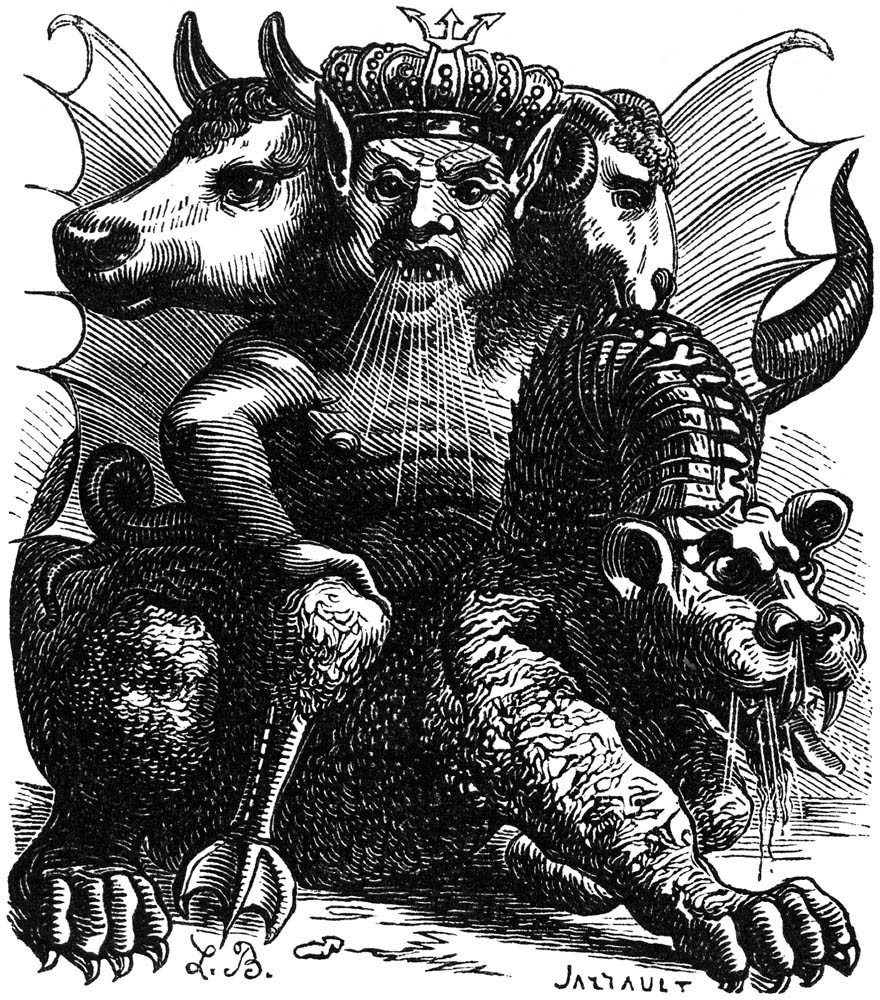
In the shadowed annals of demonology, few figures evoke as much intrigue and trepidation as Asmodeus. Often depicted as a seductive tempter or a wrathful destroyer of unions, Asmodeus reigns supreme over the “sphere of lust”—a metaphorical domain where carnal desires twist into obsession, jealousy, and ruin. Far from a mere symbol of forbidden pleasures, he embodies the perilous allure of unchecked passion, drawing from ancient religious texts, occult grimoires, and even modern folklore. This article delves into the multifaceted lore of Asmodeus, exploring his origins, depictions across cultures, and enduring legacy as the infernal architect of erotic torment.
Origins and Etymology: From Wrath to Wantonness
Asmodeus’s name traces back to the mists of ancient Persia, likely deriving from the Avestan aēšma-daēva, where aēšma signifies “wrath” and daēva denotes a demon. This etymological root ties him to Zoroastrianism’s Aēšma, the demon of fury and violence, suggesting an evolution from a spirit of raw anger to one of more intimate, eros-driven chaos. As Jewish demonology absorbed Persian influences during the Babylonian exile, Asmodeus emerged as a king of demons or shedim, blending wrath with the destructive power of desire.
In Talmudic legends, he is Ashmedai, a cunning entity tricked by King Solomon into aiding the construction of the Temple. Here, Asmodeus reveals a mischievous streak, desiring Solomon’s wives and even usurping the throne by hurling the king 400 leagues away—acts laced with jealous longing rather than pure malice. This foundational portrayal sets the stage for his later associations, where wrath and lust intertwine like serpents in a forbidden embrace.
Biblical and Apocryphal Shadows: The Slayer of Lovers
Asmodeus bursts into prominence in the Book of Tobit, a deuterocanonical text in the Catholic and Orthodox Bibles, as the “worst of demons.” Enamored—or enraged—by the maiden Sarah, he slays her seven successive husbands on their wedding nights, thwarting consummation out of possessive fury. The young Tobias, guided by the archangel Raphael, banishes him with the ritual smoke from a fish’s heart and liver, sending the demon fleeing to Egypt in terror. This tale paints Asmodeus not as a brute, but as a jealous suitor whose lust manifests as deadly obstruction, punishing the very act of marital union.
The pseudepigraphal Testament of Solomon expands this, portraying Asmodeus as a hybrid offspring of an angel and human, summoned by the wise king to labor on the Temple. He confesses his aversion to water and boasts of his prophetic powers, foretelling Israel’s kingdom schism. Defeated again by Raphael and a sheatfish, he embodies the peril of invoking infernal aid—his submission laced with resentment born of unquenched desires
.
Echoes in Jewish and Islamic Lore: Thrones, Usurpations, and Imprisonments
In Jewish mysticism, particularly the Kabbalistic Treatise on the Left Emanation, Asmodeus is born from the illicit union of the demoness Agrat bat Mahlat and King David himself, wedding a younger Lilith and dwelling in the third heaven’s ether. Subordinate to the archfiend Samael, he wields power to inflict pain only on Mondays, a rhythmic torment mirroring the ebb and flow of passion.
Islamic traditions reimagine him as Sakhr al-Jinn, the “Stony One,” in the Quran’s Surah Sad (38:30-40). This ifrit-king steals Solomon’s magical ring, usurping the throne for 40 days and plunging the realm into idolatry and vice. Regaining the ring from a fish’s belly, Solomon imprisons Sakhr in an iron-chained stone box, hurling it into the sea—a motif echoed in One Thousand and One Nights, where Asmodeus-like genies emerge from desert pillars or bottles, their fiery eyes and leonine forms symbols of bottled rage and longing.
These narratives humanize Asmodeus, transforming him from a monolithic evil into a trickster whose downfalls stem from hubris intertwined with erotic overreach, such as Solomon’s own lapse into lustful idolatry.
Demonological Dominion: The Prince of Lechery and Fornication
By the medieval period, Asmodeus solidified his throne in the “sphere of lust” within Christian demonology. Peter Binsfeld’s 1589 classification of the Seven Deadly Sins crowns him the demon of lust, a role affirmed in the Malleus Maleficarum (1486), where he is dubbed the “chief of fornication” and adversary to St. John. Commanding 72 legions under Lucifer, he incites gambling dens in Hell and preys on human weaknesses, his influence extending to wrathful vengeance.
The Dictionnaire Infernal (1818) offers a grotesque visage: three heads (a fire-spitting man, a sheep, a bull), a rooster’s leg, a serpent tail, and a ride upon a winged dragon—emblems of lascivious fury. In the Lesser Key of Solomon’s Ars Goetia, Asmoday appears with bull, man, and ram heads, flames licking from his maw as he perches on an infernal dragon, banner in hand. Beyond sex, his lust encompasses vampiric cravings and addictive indulgences, twisting desires into self-destruction.
Yet, some views temper his villainy; he responds to provocation rather than embodying innate evil, a nuanced fiend whose realm amplifies human frailties.
The Eternal Temptation: Lust’s Infernal Sovereign
Asmodeus endures not as a cartoonish devil, but as a mirror to humanity’s dual-edged desires. From Tobit’s vengeful spirit to Binsfeld’s lustful prince, he warns of passion’s power to build empires or shatter souls. In our era of unchecked appetites, his sphere of lust feels eerily prescient—a reminder that what seduces can also subjugate. Whether bound in a fish-smoked exile or limping through satirical streets, Asmodeus whispers: indulgence is a throne, but one built on thorns.