
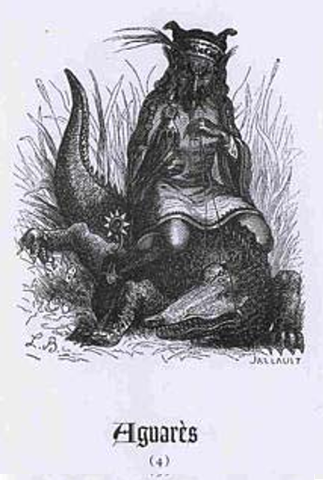
Who Is Agares in Demonology?
Agares is one of the 72 demons described in the Ars Goetia, the first section of the Lesser Key of Solomon, a 17th-century grimoire on demonology and ritual magic. Known as a Great Duke of Hell, Agares commands 31 legions of demons and is considered one of the most powerful infernal spirits under Lucifer’s rule.
In the Goetic hierarchy, Agares ranks as a noble and loyal servant who appears before magicians willing to summon him through complex rituals. His role and attributes have fascinated occultists and demonologists for centuries, blending elements of fallen angel mythology, language, and chaos.
Description and Appearance of Agares
According to classical grimoires, Agares appears as a benevolent-looking old man who rides a crocodile and carries a hawk on his fist. Despite this seemingly calm and wise image, his powers are far from harmless.
When summoned, Agares is said to speak softly but commands immense influence over languages, movement, and rebellion. The crocodile symbolizes danger beneath still waters, while the hawk represents swiftness and control — together, they reveal his dual nature as both a teacher and destroyer.
Powers and Abilities of Agares
In demonology, Agares is primarily known for his linguistic and destructive powers. His main abilities include:
- Teaching all languages instantly: Agares can grant fluency and understanding of any tongue, making him the demon of communication and interpretation.
- Causing earthquakes: He can shake the ground and disrupt balance, symbolizing his control over both literal and metaphorical instability.
- Making the runaways return: Agares can compel people to return to where they fled from — whether physically or spiritually.
- Inspiring immorality and rebellion: He encourages disobedience and chaos, particularly among those who resist authority.
These powers make Agares a figure of both knowledge and turmoil — a spirit representing the boundary between enlightenment and corruption.
Symbolism and Meaning of Agares
The name Agares has uncertain origins but may derive from ancient Semitic or Greek roots meaning “to gather” or “to move.” This connects directly to his powers over movement and communication.
In esoteric symbolism, Agares embodies the corruption of wisdom — knowledge used for pride or power rather than understanding. His association with language hints at the danger of speech and persuasion, showing how communication can both build and destroy.
Summoning and Ritual Associations
Traditional Goetic rituals describe summoning Agares within a protected circle inscribed with divine names. The magician invokes him through Solomonic seals and conjurations, requesting his aid in teaching languages or influencing others.
However, grimoires like The Goetia of Dr. Rudd warn that Agares must be treated with respect and caution. Improper invocation can result in spiritual or psychological harm. As with most Goetic demons, he serves as a mirror of human desire, offering gifts that often come with hidden costs.
Agares in Modern Occultism and Culture
Modern occultists often interpret Agares symbolically rather than literally. He is viewed as a psychological archetype — a manifestation of the human urge for knowledge, mastery of speech, and defiance of authority.
In popular culture, references to Agares occasionally appear in fantasy games, novels, and music, often depicting him as a scholar-like demon with destructive tendencies. While less well-known than entities like Bael or Asmodeus, Agares remains a compelling figure in Goetic lore due to his unique combination of intellect and chaos.
Conclusion
Agares, the Fallen Duke of Hell, stands at the crossroads between language and destruction, wisdom and rebellion. In demonology, he represents the seductive danger of knowledge — the idea that enlightenment, when corrupted by pride or defiance, can lead to downfall.
Whether seen as a literal infernal being or a metaphorical force, Agares continues to captivate scholars, occultists, and readers exploring the rich tradition of Goetic magic and demonology.