
Introduction
In demonological tradition, Alloces stands among the seventy-two principal spirits of the Ars Goetia, the first book of the Lesser Key of Solomon.
Compiled in the seventeenth century from earlier sources, this grimoire attributes to King Solomon the binding of infernal intelligences.
Alloces, listed as the fifty-second spirit, embodies both destruction and enlightenment—dual forces recurring throughout Goetic lore.
Historical Context and Etymology
The name Alloces appears in a lineage of grimoires stretching from the Middle Ages through the Renaissance.
In Johann Weyer’s Pseudomonarchia Daemonum (1577), he is recorded as Allocer or Alocer, the sixty-third spirit, mirroring later descriptions.
Weyer’s catalogue, influenced by earlier manuscripts such as the Livre des Esperitz, portrays him as a ducal commander in a structured infernal court.
Etymologically, the term may derive from Latin roots linked to allocation, suggesting appointment or distribution—perhaps referencing his role in granting familiars.
Variant spellings, including Allogor and Algor, appear in the Liber Officiorum Spirituum, describing him as a spear-bearing knight.
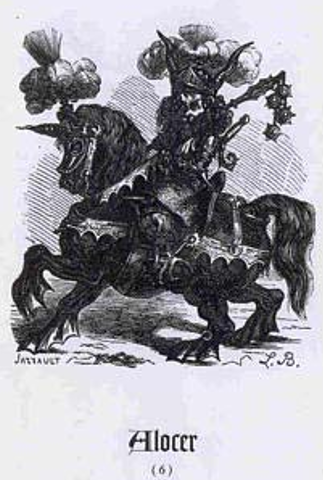
By the nineteenth century, Jacques Collin de Plancy’s Dictionnaire Infernal fixed Alloces’s image as a Grand Duke of Hell, crystallizing centuries of evolving lore.
Description and Appearance
Alloces manifests as a lion-headed soldier wreathed in flame, his eyes blazing like molten metal.
His complexion glows red, as if forged in infernal fire, and his breath issues heat like a furnace.
He rides a vast horse whose limbs coil into scaled, serpentine forms, merging equine grace with draconic strength.
His voice, deep and thunderous, commands attention even within protective circles.
The Ars Goetia prescribes a complex seal of intertwined lines, drawn upon consecrated material, to ensure his obedience during evocation.
Powers and Abilities
As a Great Duke, Alloces commands thirty-six legions of spirits.
His offices concern the imparting of secret knowledge, especially the science of astronomy—the mapping of celestial influences upon earthly affairs.
In the Renaissance, when astrology and astronomy intertwined, this mastery symbolized divine order reflected through the stars.
Alloces also teaches the liberal arts—grammar, rhetoric, logic, arithmetic, geometry, and music.
These disciplines, seen as the foundation of reason, become channels of magical eloquence and precision under his instruction.
His fiery intellect inspires ambition, yet the grimoires warn against pride born from such illumination.
Another power attributed to Alloces is the granting of faithful familiars.
These spirits, drawn from his legions, serve tasks of protection, divination, or knowledge.
Weyer notes that their loyalty mirrors the conjurer’s discipline—neglect or arrogance invites rebellion.
Role in the Infernal Hierarchy
Within the infernal order, Alloces ranks as a duke beneath the kings and princes of Hell.
He once served among the celestial hosts before joining Lucifer’s revolt, now commanding disciplined armies of spectral soldiers.
Unlike chaotic spirits, Alloces represents controlled might—the strategist rather than the berserker.
His equestrian imagery signifies knowledge as a charge forward, intellect harnessed as weaponry.
Conclusion
Alloces, the 52nd spirit of the Ars Goetia, unites martial discipline with scholarly illumination.
He embodies the Renaissance pursuit of wisdom tempered by danger—a figure where intellect and fire converge.
Through centuries of manuscripts, from Weyer’s Latin text to Plancy’s illustrated demonology, Alloces endures as a symbol of learning, command, and infernal majesty.