
Introduction
In the intricate hierarchy of the Ars Goetia, Amdusias—sometimes spelled Amdukias—stands as a Great Duke of Hell commanding twenty-nine legions of spirits.
He is one of the seventy-two demons reputedly bound by King Solomon and detailed in the Lesser Key of Solomon, a cornerstone of seventeenth-century occult literature.
Amdusias embodies the duality often found in Goetic figures: martial power fused with artistic mastery, destructive force paired with creative resonance.
Origins and Descriptions
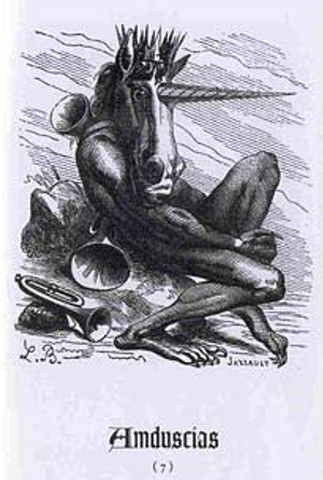
The Ars Goetia describes Amdusias as a commanding, fearsome figure whose presence is marked by unseen trumpets that announce his arrival.
Invisible instruments resound in the air when he appears, creating a haunting prelude to his manifestation.
He is sometimes depicted in human form, though certain accounts portray him with a unicorn-like head or hybrid features.
These traits emphasize his otherworldly nature and connection to both the wild and the sublime.
As a Great Duke, Amdusias’s rank and his twenty-nine legions signify significant authority within the infernal order—an emblem of power balanced by knowledge.
Attributes and Powers
Amdusias’s powers center on sound, music, and illusion.
He is famed for causing musical instruments to play unseen, producing an ethereal soundscape that blurs the boundary between reality and spirit.
This control over vibration and resonance aligns him with the mystical symbolism of music as a bridge between worlds.
He also possesses dominion over the natural world, able to bend trees at the summoner’s command.
This act of reshaping nature reflects authority over elemental forces, symbolizing transformation and mastery of the physical plane.
Additionally, Amdusias can grant familiars—spiritual assistants who serve conjurers in tasks of knowledge, protection, or communication.
He is said to answer questions truthfully when addressed with respect, though grimoires warn that careless summoning invites peril.
Role in Ritual Literature
Within the ritual framework of the Lesser Key of Solomon, Amdusias’s sigil serves as the focal point for invocation.
Practitioners were instructed to employ this geometric seal during ceremonies framed by protective circles and divine names.
The texts stress discipline, reverence, and precision, for his volatile energy demanded careful control.
When approached correctly, Amdusias was believed to respond with obedience, teaching arts related to music, eloquence, and elemental harmony.
These rites reflect the Renaissance blending of science, spirituality, and art—where music and mathematics mirrored divine order.
Cultural and Historical Context
Amdusias’s mythology embodies the Renaissance fascination with sound as a cosmic principle.
In biblical and classical traditions, trumpets often heralded divine messages or apocalyptic revelation.
By granting this motif to a demon, the Goetia reimagined celestial symbolism through an infernal lens.
His ability to bend trees and command natural forces resonates with pre-Christian mythic archetypes of forest spirits and horned deities, later recast by Christian demonology.
The synthesis of pagan, Jewish, and Christian influences in his portrayal highlights the Ars Goetia’s eclectic inheritance of older mystical systems.
Legacy in Demonology
While lesser known than figures like Baal or Asmodeus, Amdusias remains distinctive for his union of music and power.
He reflects humanity’s ancient belief that sound can shape reality—an echo of divine creation inverted through infernal art.
In later occult writings and modern interpretations, Amdusias is viewed as a symbol of artistic inspiration and control over chaotic forces.
His legacy endures as a reminder of the thin line between creative genius and the peril of hubris that ancient magicians sought to balance.
Conclusion
Amdusias, the 67th spirit of the Ars Goetia, bridges sound and sorcery, art and authority.
As a Great Duke commanding twenty-nine legions, he unites the musical and the martial, the natural and the supernatural.
Through his trumpet-born manifestations and elemental powers, Amdusias personifies the Renaissance vision of hidden harmony—where knowledge of the unseen could both elevate and endanger the seeker.