
Origins and Descriptions in Historical Texts
Berith, also known as Beherit, Baal-Berith, or Bofry, appears in several medieval and Renaissance grimoires. His name likely derives from Baal-Berith, a Canaanite deity of covenants and oaths, mentioned in the Hebrew Bible (Judges 8:33; 9:4). Over centuries, Christian theology transformed this ancient god into a demonic figure, reinterpreting divine traits as signs of corruption.
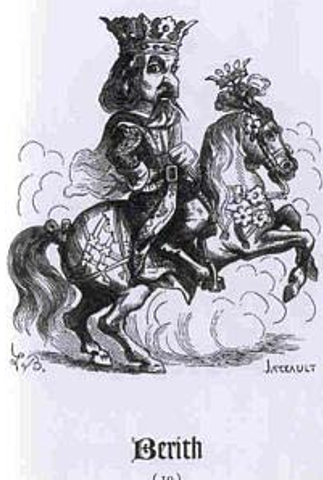
In Johann Weyer’s Pseudomonarchia Daemonum (1577) and the Ars Goetia of the Lesser Key of Solomon (17th century), Berith is listed as a Great Duke of Hell, commanding twenty-six legions of spirits. He appears as a red-clad soldier on a red horse, crowned in gold, his speech eloquent yet treacherous. These traits embody the duality of temptation—charismatic wisdom masking deceit.
Jacques Collin de Plancy’s Dictionnaire Infernal (1818) expands his profile, linking Berith to alchemy and the transmutation of metals into gold. Plancy notes that Berith can reveal the past, present, and future, though his accuracy depends on divine compulsion. Without it, he is an accomplished liar—an archetype of infernal cunning.
Role and Attributes in Demonological Tradition
Berith’s attributes center on knowledge, transformation, and deception. He is said to bestow honors, titles, and wealth upon those who invoke him, appealing to magicians seeking advancement or material success. His role as an alchemist emphasizes mastery over change—both physical and metaphysical.
Yet his deceitful nature serves as a moral warning. The grimoires caution that even truthful answers from Berith may hide spiritual traps. His name, once meaning “covenant,” becomes ironic, representing broken pacts and false promises.
In ritual traditions, Berith’s summoning requires strict safeguards. The Ars Goetia prescribes the use of a silver ring to protect against deception, and demands that the conjurer invoke divine authority to compel truth. These prescriptions reinforce a core Goetic belief: demons are powerful but ultimately subordinate to divine will.
Cultural and Theological Context
The evolution of Berith reflects the Christian demonization of pagan deities. As monotheism spread, regional gods were recast as fallen spirits. Baal-Berith’s transformation into the demon Berith exemplifies this process—turning a god of oaths into a liar of infernal courts.
His inclusion in the Ars Goetia and Pseudomonarchia Daemonum aligns with the Renaissance fascination for cataloguing spiritual hierarchies. Scholars of the period sought to reconcile forbidden knowledge with faith, framing magic as a controlled engagement with divine and infernal powers.
Berith’s ties to alchemy further connect him to the intellectual tensions of the era. Alchemy symbolized transformation and enlightenment, but also risked heresy. Thus, Berith’s gold-making ability becomes both promise and warning—a metaphor for spiritual corruption through greed.
Legacy and Interpretation
In later occult literature, Berith endures as a symbol of eloquence, ambition, and false wisdom. Artists and writers depict him as the eternal tempter who trades truth for power, echoing humanity’s struggle between knowledge and integrity.
Modern interpretations emphasize his paradoxical nature: a patron of intellect and artifice, yet bound to deceit. His red horse and crown remain enduring symbols of vanity, wealth, and the cost of forbidden mastery.
Conclusion
Berith, the 28th spirit of the Ars Goetia, stands as a figure of alchemy and deception, bridging the divine past of Baal-Berith and the infernal imagination of medieval demonology.
Commanding twenty-six legions and cloaked in red, he embodies the alluring danger of hidden knowledge.
Through Berith’s story, we glimpse the medieval effort to define truth against temptation—a mirror to the human desire for power, and the peril that follows its pursuit.