
Introduction
In the shadowed annals of demonology, few figures embody intellect and warfare as completely as Cimeies.
Also known as Cimejes, Kimaris, or Cimeries, this demon merges the elegance of a scholar with the discipline of a knight.
He stands as the 66th spirit in the Ars Goetia, the first section of the Lesser Key of Solomon.
Summoned, according to legend, by King Solomon, Cimeies serves as a Marquis of Hell commanding powerful legions.
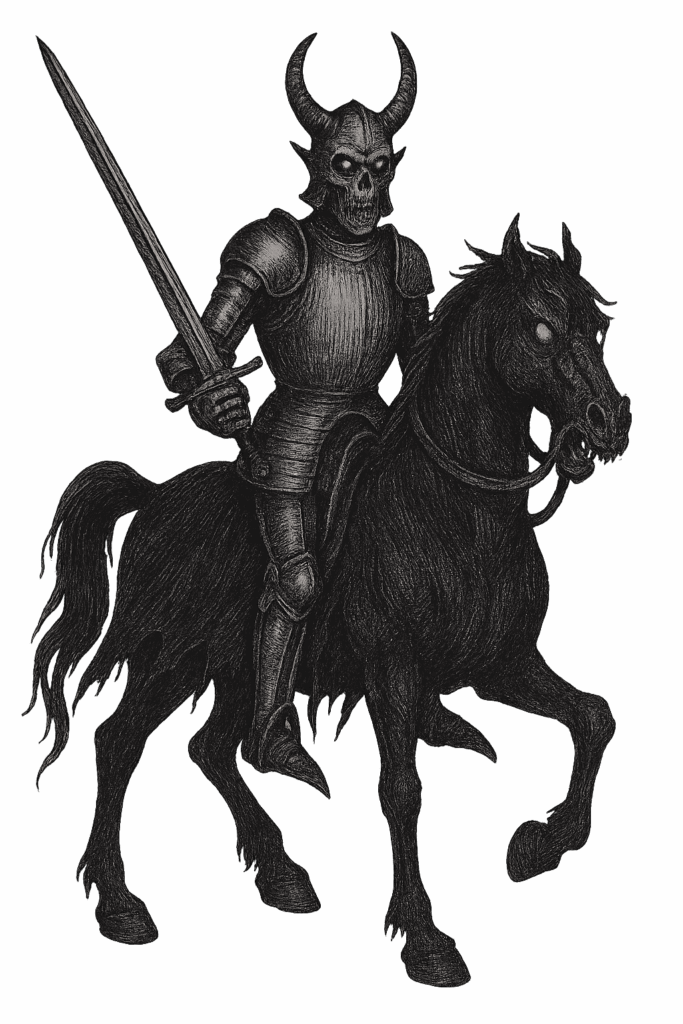
Unlike monstrous demons of fire and chaos, he appears as a noble warrior—“a goodly soldier” astride a black horse.
His image reflects the duality of knowledge and battle, where discipline forges wisdom as much as the sword.
This article explores Cimeies’ origins, powers, and symbolism, revealing his enduring influence in occult, philosophical, and modern esoteric traditions.
Origins in the Grimoires
Cimeies first appears in the Ars Goetia, compiled in the 17th century yet rooted in older magical sources.
He is one of the 72 demons bound by Solomon, a figure bridging theology, philosophy, and ceremonial magic.
Earlier references appear in Johann Weyer’s Pseudomonarchia Daemonum (1577), where a similar spirit takes form.
Weyer’s description established the foundation for Cimeies’ later persona as a noble but formidable warrior.
Even older texts, like the Munich Handbook of Necromancy (15th century), mention Tuvries, a spirit commanding legions and traversing water—an early reflection of Cimeies’ essence.
Etymologically, his name may derive from the Cimmerians, ancient warriors described by Homer as dwellers in eternal darkness.
This origin fits Cimeies’ association with twilight and hidden wisdom.
Other theories link his name to the Greek Chimaira, the fire-breathing hybrid, suggesting a mythic fusion of power and intellect.
Cimeies also appears in Thomas Rudd’s Rosie Crucian Secrets (17th century), where his rank shifts but his nature endures.
In John Dee’s Enochian writings, a related being named Cimeriel surfaces, blending angelic and infernal traits.
This duality highlights Cimeies’ liminal nature—poised between celestial reason and demonic strength.
Description and Demeanor
The Ars Goetia describes Cimeies as a noble warrior riding a black horse, radiating strength and dignity.
He is not grotesque, but regal—an image of dark chivalry, bound by purpose rather than malice.
His demeanor is calm yet commanding, embodying a general’s intellect and a scholar’s composure.
In artistic depictions, Cimeies often wields a bow, symbolizing precision and foresight.
His black steed represents relentless motion, carrying him through both earthly and spiritual realms.
Unlike chaotic demons, Cimeies values structure, reflecting discipline as a spiritual weapon.
Modern interpretations describe his aura as strategic energy—cold, focused, and unyielding.
He appears to those who seek mastery of both combat and reason, rewarding courage and clarity in equal measure.
Powers and Domains
Cimeies commands 20 legions of spirits, operating under his authority as a Marquis of Hell.
He rules, according to the Ars Goetia, over the spirits dwelling “in the parts of Africa.”
His power extends across intellectual, martial, and elemental domains, granting him influence over both knowledge and force.
His key abilities include:
- Locating Hidden Treasures: He reveals lost wealth, buried secrets, or forgotten wisdom, guiding seekers to discovery.
- Mastery of Logic and Rhetoric: Cimeies teaches the trivium—grammar, logic, and rhetoric—foundations of reason and persuasion.
- Forging Warriors: He transforms the summoner into a skilled fighter, instilling courage, tactics, and martial insight.
- Guiding Over Water and Air: He grants safe passage and swift travel, echoing his Cimmerian and Aquarian symbolism.
Astrologically, Cimeies aligns with Aquarius under Saturn’s dominion, reflecting intellect, endurance, and structure.
His sacred metal is copper, and his element is air, both representing refinement and mental agility.
Offerings of incense, iron weapons, or philosophical texts are said to honor his dual nature.
During summoning, magicians describe hearing distant hoofbeats before his arrival, signaling his disciplined yet immense presence.
Symbolism and Interpretation
Cimeies’ form as a mounted warrior mirrors humanity’s pursuit of mastery through discipline.
His black horse represents willpower and perseverance, while his bow symbolizes directed thought and strategic action.
He embodies the balance between intellect and instinct—a vital harmony in magical and philosophical traditions.
In occult philosophy, Cimeies parallels the archetype of the philosopher-warrior.
Like Hermes Trismegistus or Pythagoras, he merges logic with mystical understanding.
His domain over Africa in the grimoires may also symbolize the unknown frontier, where hidden wisdom lies buried.
Psychologically, Cimeies represents self-command and intellectual endurance.
He challenges practitioners to confront their limitations and refine both mind and will.
Invisibility, treasure-finding, and transformation—his gifts—mirror the alchemical process of turning ignorance into insight.
Cimeies thus becomes a mentor for those seeking strength through self-discipline and enlightenment through struggle.
Cimeies in Modern Occultism and Culture
Cimeies endures in modern esotericism, appearing in both Satanic and ceremonial traditions.
Anton LaVey’s Satanic Bible (1969) lists him among the Infernal Names, acknowledging his ancient prestige.
In chaos magic and Left-Hand Path systems, he is invoked as a patron of rational will and disciplined focus.
Cimeies also influences popular media.
In anime and fiction, his persona often inspires characters who blend intelligence with strength.
His archetype as a “noble demon” recurs in portrayals of tacticians, knights, and sorcerers bound by honor.
Occult practitioners today interpret Cimeies as a symbol of mental clarity and decisive leadership.
He is not a spirit of destruction, but of refinement—turning thought into precision and ambition into mastery.
Through meditation, invocation, or study, his presence is said to sharpen the mind and strengthen resolve.
Thus, Cimeies becomes a modern emblem of self-discipline, courage, and intellectual sovereignty.
Legacy of the Shadowed Marquis
Cimeies, the Shadowed Marquis, stands as a bridge between wisdom and warfare.
He exemplifies the paradox at the heart of demonology: the pursuit of light through the study of darkness.
To summon Cimeies is to confront the dual path of reason and power, intellect and instinct.
He rides eternally through the infernal hierarchy, a black horse against the endless horizon.
His bow is drawn not in wrath, but in focus—a symbol of mastery aimed at truth.
For those who seek him, Cimeies offers no easy answers, only the discipline to endure the quest for knowledge.
In the vast theater of Goetic demonology, Cimeies remains a timeless guide—proof that intellect, when tempered by strength, becomes an unbreakable weapon.