
Introduction
In the vast corpus of demonology, few entities embody intellect and deceit as elegantly as Malphas.
Described in grimoires such as the Ars Goetia—the first book of The Lesser Key of Solomon—Malphas appears as a president of Hell, commanding legions of infernal spirits.
Associated with architecture, strategy, and trickery, he stands as a figure of paradox—both builder and betrayer.
This article explores Malphas’s origins, attributes, and symbolism, tracing his evolution from medieval texts to modern occultism and cultural interpretations.
Origins in Demonology
Malphas is primarily known from the Ars Goetia, a 17th-century grimoire cataloging 72 spirits under King Solomon’s command.
He appears as the 39th demon, titled Great President of Hell, and rules over 40 legions of infernal entities.
The Ars Goetia draws upon medieval Jewish mysticism, Christian theology, and pre-Christian folklore, combining them into a cohesive hierarchy of spirits.
Like many Goetic figures, Malphas likely originated from older pagan deities or personified forces of nature later demonized under Christianity.
His name’s etymology is uncertain. Some scholars suggest Semitic or Indo-European roots, possibly tied to terms for “speech,” “malformation,” or “omen.”
While these connections remain speculative, they reinforce Malphas’s symbolic ties to both communication and forewarning.
Characteristics and Powers
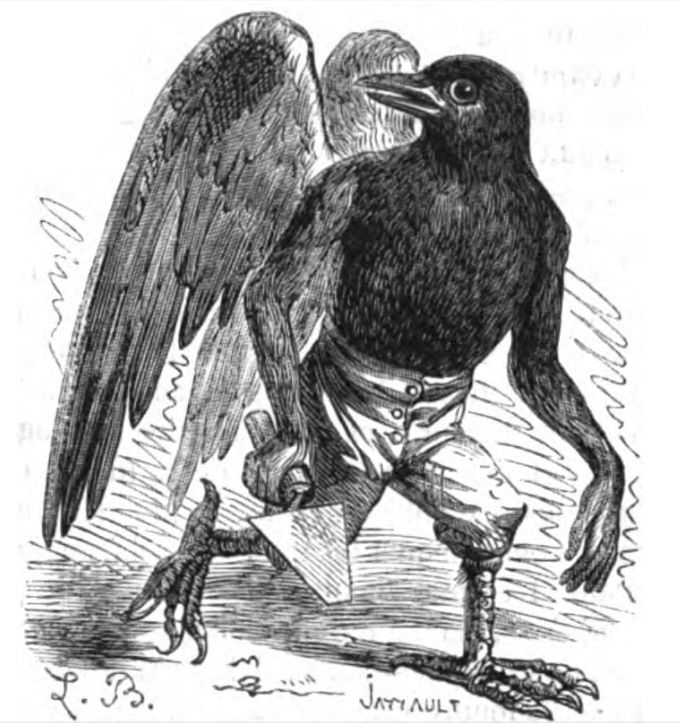
The Ars Goetia describes Malphas as a crow or raven, a form steeped in mystery and symbolism.
When summoned, he may assume a hoarse-voiced human shape, retaining the aura of his avian guise.
As a demon, his abilities are both practical and perilous. The text credits him with several powers:
- Master Builder: He constructs “houses, towers, and strongholds” with superhuman speed and precision.
- Architectural Genius: Malphas can raise fortifications or destroy them, symbolizing his dominion over creation and ruin alike.
- Revealer of Secrets: He unveils the hidden desires, motives, and thoughts of others.
- Provider of Familiars: He grants spirits or servitors to assist magicians in magical work.
- Deceiver of the Unwise: Though cooperative, he is known to mislead or betray those who invoke him carelessly.
This blend of creation and deception defines Malphas’s dual nature.
He offers great skill and insight but often exacts a hidden cost—a reflection of the Goetic theme that power without caution leads to peril.
Symbolism and Interpretation
Malphas’s crow form is deeply symbolic. In many cultures, crows and ravens serve as messengers between worlds, bridging the living and the dead.
They represent intelligence, adaptability, and foresight, yet also omens and trickery.
As such, Malphas embodies transformation and cunning—a being who builds both walls and illusions.
His role as a builder contrasts with the destructive chaos often attributed to infernal spirits, suggesting he governs order within disorder.
Esoterically, Malphas symbolizes ambition tempered by risk.
His deceitful aspect warns that wisdom gained through manipulation or hubris may ultimately collapse the very structures it creates.
He mirrors humanity’s own capacity to construct civilizations or destroy them through pride and deceit.
In alchemical and psychological terms, Malphas may represent the shadow architect—the mind’s ability to manifest and dismantle its own illusions.
Malphas in Ritual and Occult Practice
Within Goetic magic, summoning Malphas requires precision and restraint.
Practitioners employ his sigil, recite the appropriate conjurations, and establish authority through divine invocations before calling him forth.
He may appear first as a crow, then take a humanoid form if commanded.
The Ars Goetia warns that Malphas accepts sacrifices deceitfully, using them to ensnare the magician.
Therefore, invokers are cautioned to maintain dominance and purity of intent.
In modern occultism, interpretations of Malphas vary.
Some view him as a spirit of creative construction, sought by artists, engineers, and strategists.
Others approach him as an archetype of discipline and discernment, representing the ability to build and deconstruct ideas with clarity.
While historical texts portray him as treacherous, contemporary practitioners often emphasize his symbolic role as a guide through complexity and illusion.
Cultural and Historical Context
The rise of Malphas in grimoires coincided with Europe’s late-medieval and Renaissance fascination with forbidden knowledge.
During this era, architecture, astronomy, and natural philosophy were considered gateways to divine understanding—and therefore, potential heresy.
Malphas’s ability to reveal secrets and construct grand works likely mirrored human ambition to rival divine creation.
In this sense, he personified the dangers of intellectual overreach—the sin of pride translated into spiritual rebellion.
At the same time, texts like The Lesser Key of Solomon reveal humanity’s enduring curiosity about the mechanics of creation and willpower.
Malphas, as a demon of both intellect and deceit, encapsulates this paradox—bridging divine inspiration and infernal temptation.
Modern Interpretations
Today, Malphas occupies a nuanced role in occult philosophy and pop culture.
In contemporary demonology, he is invoked for strategic clarity, architectural insight, or psychological reconstruction—metaphorically aiding those who “build” their inner or outer worlds.
In literature and media, his crow symbolism endures, often representing manipulation, intelligence, and the blurred line between creation and corruption.
As a result, Malphas serves as both a cautionary emblem and a muse for those exploring the relationship between intellect, morality, and power.
Conclusion
Malphas, the crow-headed builder and deceiver of the Ars Goetia, embodies the timeless struggle between enlightenment and corruption.
As a president of Hell, he constructs both fortresses and illusions—reminding that knowledge without integrity becomes a snare.
Whether seen as a literal demon, a psychological archetype, or a metaphor for human ambition, Malphas endures as a figure of paradox and fascination.
He stands at the crossroads of wisdom and deceit, offering a lesson as enduring as his legend: that what we build in pride may one day rise against us.