
Introduction
In the shadowy annals of demonology, few figures fuse intellectual brilliance and visceral terror like Glasya-Labolas. Listed among the 72 spirits of the Ars Goetia—the opening book of the 17th-century grimoire The Lesser Key of Solomon—he stands as a paradox: a scholar of forbidden arts and a general of infernal carnage. Commanding thirty-six legions of spirits, Glasya-Labolas embodies the twin temptations of enlightenment and destruction that have fascinated occultists for centuries.
Origins in Grimoires and Demonological Tradition
Glasya-Labolas first appears in Johann Weyer’s Pseudomonarchia Daemonum (1577), a Renaissance forerunner to the Ars Goetia. There he ranks as the 25th spirit, later described in the Goetia as a mighty President or Earl of Hell. He commands thirty-six legions, a testament to his standing in Hell’s hierarchy.
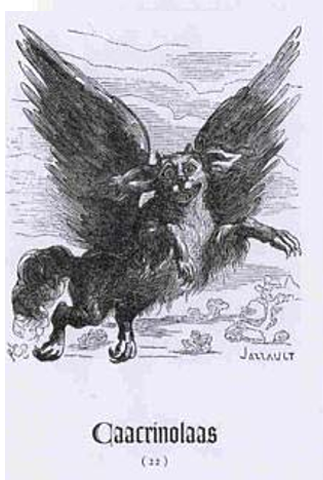
His name—possibly drawn from Hebrew roots meaning “to stumble” or “the fumbler”—suggests the danger of spiritual misstep masked as wisdom. Alternate spellings such as Caacrinolaas, Caassimolar, or Classyalabolas reflect centuries of linguistic drift in demonological manuscripts.
In later texts like the French Grand Grimoire, Glasya-Labolas’s rank fluctuates, showing how demonology evolved from theological catalogues into practical manuals of evocation, merging Christian, Hebrew, and classical motifs.
Appearance: The Griffin-Hound Hybrid
The Goetia describes Glasya-Labolas as a fierce dog with the wings of a griffin—a fusion of loyalty and savagery. His form suggests both guardian and predator, embodying the scholar’s dual nature: one who protects knowledge yet kills for it.
In Collin de Plancy’s Dictionnaire Infernal (1863), he appears with gleaming fur, avian plumage, and predatory eyes, poised between elegance and horror. Modern esoteric depictions accentuate this duality, surrounding him with beetles, skulls, and the smoke of copal incense, emblems of decay and rebirth.
Powers and Abilities: Wisdom’s Double-Edged Gift
Glasya-Labolas’s influence extends beyond brute force. He is the immediate transmitter of all arts and sciences, granting mastery of rhetoric, astronomy, and occult knowledge in an instant. As a seer, he unveils the past, present, and future, offering visions that can elevate or destroy.
Yet his teachings are perilous. Known as the “author of bloodshed and manslaughter,” he incites murder and betrayal, manipulating minds to breed love or hatred at will. He can render the summoner invisible, a boon for espionage or escape, but one shadowed by paranoia.
| Domain | Power | Potential Peril |
|---|---|---|
| Knowledge | Grants instant mastery of arts, sciences, and prophecy | Overwhelming insight or madness |
| Manipulation | Inspires love or hatred among allies/enemies | Emotional corruption, betrayal |
| Destruction | Incites manslaughter and war | Physical and moral ruin |
| Utility | Bestows invisibility and cunning | Obsession, addiction to secrecy |
Through him, wisdom becomes weaponized—a divine spark twisted into a blade.
Hierarchy, Sigil, and Summoning
In Hell’s administration, Glasya-Labolas rules thirty-six legions. His sigil, an angular glyph resembling a coiled serpent or labyrinth, must be drawn with precision; it anchors his obedience during evocation.
Rituals from the Ars Goetia prescribe:
- A consecrated circle and protective triangle,
- Incantations in angelic or Hebrew names,
- Offerings of incense or symbolic blood, representing intellect and sacrifice.
The magician must balance respect and restraint—failure or arrogance invites the chaos Glasya-Labolas commands. The Pseudomonarchia cautions that such spirits “must have offerings and sacrifices” lest they rebel.
Glasya-Labolas in Modern Culture
Although peripheral in mainstream lore, Glasya-Labolas thrives in modern fantasy, gaming, and occult media.
- In Magi: The Labyrinth of Magic, he appears as a wind-bound Djinn fused with griffin imagery.
- In Bayonetta 2 and Castlevania, his name becomes shorthand for aerial ferocity and infernal command.
- The Shin Megami Tensei series revives his mythic essence through demon fusion rituals drawn directly from grimoires.
These reinterpretations preserve his essence: a being of forbidden intellect whose lessons are steeped in blood.
A Demon for the Ambitious Age
Glasya-Labolas remains a mirror of human ambition—the drive to seek knowledge without restraint and to wield power without conscience. In an era obsessed with data, dominance, and revelation, his myth feels unnervingly modern.
To summon him is to grasp the griffin’s claw: sudden illumination followed by the threat of annihilation. The same mind that reaches for his wisdom risks being consumed by it.
In the end, Glasya-Labolas reminds every seeker that Hell’s greatest scholars are also its most efficient butchers—and that the cost of enlightenment may always be written in blood.