
Introduction
In the complex realm of demonology, few spirits command attention like Bael.
He stands as one of the most powerful and mysterious figures in occult lore.
Referenced in grimoires such as the Ars Goetia, Bael represents both wisdom and fear.
His origins reach deep into ancient mythology, blending divine reverence with later demonization.
This article explores Bael’s history, powers, and enduring cultural significance within esoteric traditions.
Origins and Etymology
Bael’s name traces to the Semitic title “Baal”, meaning “lord” or “master.”
In early Canaanite and Phoenician religions, Baal referred to various local deities.
These gods governed storms, fertility, and the cycles of agriculture.
With the rise of monotheism, especially in ancient Israel, Baal’s worship became heresy.
Prophets condemned him, turning a once-revered god into a symbol of corruption.
Over centuries, the name Baal evolved into Bael, acquiring darker attributes.
By the medieval period, Christian writers fully transformed him into a demonic entity.
He embodied rebellion, pride, and hidden knowledge—traits that echoed his divine origins.
This transition from god to demon reflects religion’s shift from polytheistic tolerance to exclusivity.
Bael in the Ars Goetia
The Ars Goetia, first published in the 17th century, opens its list with Bael.
He is the first of the 72 spirits, a testament to his rank and authority.
The grimoire describes him as a King ruling in the East, commanding 66 legions of demons.
His position at the beginning of the text marks him as a gatekeeper of infernal power.
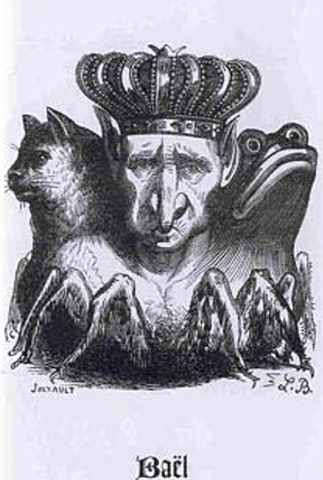
Bael’s appearance is uniquely unsettling.
He manifests as a man, a cat, or a toad—or as a hybrid of all three.
Some depictions give him three heads, representing different aspects of perception.
He speaks with a deep, hoarse voice that signifies command and dominion.
This triple form may symbolize omniscience: the ability to see all realms at once.
In later esoteric art, Bael is often crowned and enthroned.
He carries the sigil of his office—an emblem used for invocation and protection.
His animal forms connect him to primal instinct and earthly wisdom.
Powers and Abilities
Bael’s powers revolve around invisibility, intellect, and mastery over perception.
According to the Goetia, he grants invisibility to those who summon him correctly.
This ability represents not only physical concealment but also strategic advantage.
It allows the adept to act unseen, both materially and spiritually.
Bael also bestows wisdom, logic, and cunning upon his devotees.
He sharpens intellect and enhances persuasive ability in difficult circumstances.
His power over invisibility symbolizes insight hidden beneath illusion.
As a spirit of strategy, he aids those who seek control through subtlety.
Traces of his ancient divinity remain visible in his demonic profile.
As Baal, he governed the forces of weather, fertility, and agricultural renewal.
These creative elements now appear inverted in his infernal nature.
He represents both fertility of thought and the storm of destruction.
Thus, Bael stands as a paradox—creator and destroyer, teacher and deceiver.
Symbolism and Esoteric Meaning
Bael’s triple form embodies a symbolic unity of mind, instinct, and transformation.
The cat signifies stealth, intellect, and mystery.
The toad represents transformation, resilience, and the threshold between life and death.
The human form connects divine wisdom to mortal consciousness.
Together, they symbolize balance between the seen and unseen worlds.
In occult philosophy, Bael’s invisibility power has deeper meaning.
It suggests mastery of the inner self, where ego dissolves into awareness.
For practitioners of ceremonial magic, Bael governs the art of concealment—both literal and spiritual.
His sigil often appears in rituals of protection and enlightenment, not only deception.
Bael’s association with the East links him to dawn, beginnings, and illumination.
As the first spirit of the Goetia, he represents initiation—the opening of forbidden knowledge.
To invoke Bael is to confront the boundaries between the visible and the hidden.
Bael in Historical and Cultural Context
Bael’s identity evolved across cultures, blending myth, religion, and philosophy.
In ancient Syria and Phoenicia, Baal was invoked for rain and prosperity.
By contrast, early Christian demonologists cast him as a corrupter of nations.
He became an emblem of prideful wisdom, punished for defying divine order.
In medieval Europe, magicians saw Bael as both dangerous and enlightening.
Texts like Pseudomonarchia Daemonum describe him as obedient yet powerful when properly conjured.
His role inspired Renaissance scholars seeking hidden truths beyond church doctrine.
The transformation of Bael’s image mirrored society’s struggle between faith and forbidden knowledge.
Modern occultists interpret him as an archetype of insight through shadow.
In psychological terms, Bael symbolizes the hidden intellect beneath human limitation.
Artists and writers have portrayed him as the first gatekeeper of Hell, echoing his Goetic placement.
His presence in modern literature and games reflects his lasting mythic allure.
The Legacy of Bael
Bael’s story bridges ancient worship and medieval fear.
He embodies humanity’s shifting relationship with power and the unknown.
From Canaanite temples to Solomonic grimoires, his influence persists through time.
In demonology, he remains a ruler of the East and a master of concealment.
To scholars, Bael illustrates the evolution of myth under religious reform.
To occultists, he is a teacher of balance, guiding seekers through invisible realms.
Bael’s legacy reminds us that knowledge, once divine, can become dangerous in new faiths.
His name endures as both a warning and a symbol of illumination within darkness.