
Introduction
In the vast world of demonology, few entities embody intellect and severity as vividly as Furcas.
Known from the Ars Goetia, a section of The Lesser Key of Solomon, Furcas appears as a grim yet wise knight of Hell.
Commanding both fear and reverence, he represents the pursuit of wisdom through discipline and struggle.
Furcas’s dual nature—teacher and warrior—reveals a complex symbol of reason tempered by force.
He bridges martial strength and esoteric knowledge, reflecting the eternal tension between intellect and power.
This article explores Furcas’s origins, powers, and significance in demonology and occult philosophy.
Through his image, humanity’s quest for knowledge, balance, and moral clarity becomes vividly illuminated.
Origins and Historical Context
Furcas, sometimes spelled Forcas or Foras, emerges from Western medieval demonology.
This tradition sought to classify infernal spirits within a Christian moral framework.
He appears among the 72 spirits bound by King Solomon, as recorded in the Ars Goetia (17th century) and earlier in Johann Weyer’s Pseudomonarchia Daemonum (1577).
These grimoires combined elements of Christian theology, Jewish mysticism, and ancient folklore.
Such texts transformed ancient spirits of wisdom into infernal beings serving distinct symbolic roles.
The name “Furcas” may derive from the Latin furca, meaning “fork,” “pitchfork,” or “gallows.”
This linguistic root evokes judgment, duality, and punishment, reflecting his stern and moral nature.
While no link exists to a specific pagan deity, his traits align with the evolving Christian idea of reason corrupted by pride.
By the Renaissance, scholars saw demons like Furcas not only as tempters but also as keepers of hidden knowledge.
He came to represent the intellectual rigor that defined the era’s blend of mysticism and metaphysics.
Description and Attributes
The Ars Goetia describes Furcas as a Great President of Hell commanding 20 legions of spirits.
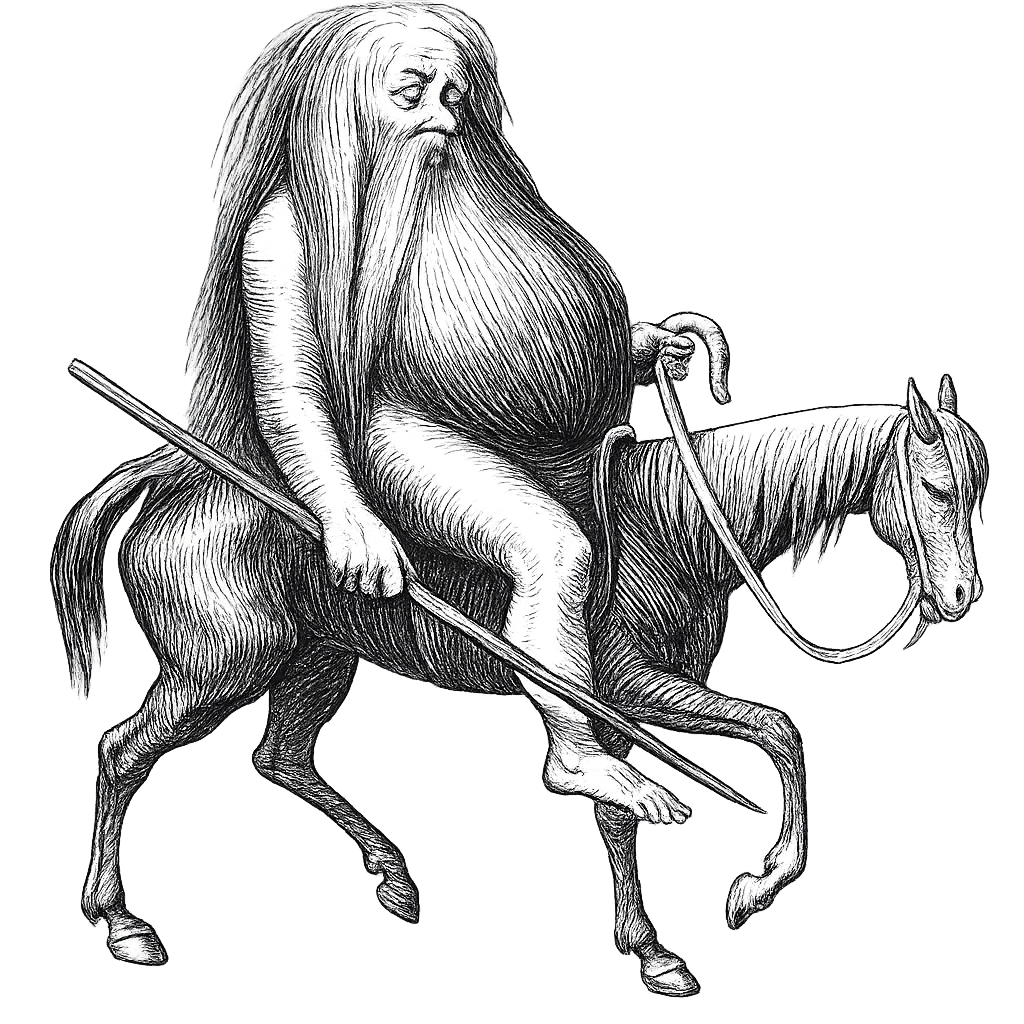
He appears as an aged knight with long gray hair and a stern, commanding presence.
Mounted on a horse and armed with a spear or pitchfork, he embodies the chivalric ideal turned infernal.
This portrayal merges the discipline of a warrior with the intellect of a philosopher.
Furcas stands as a demon of wisdom through hardship, an archetype of the scholar-warrior.
His principal powers include:
- Teaching Logic and Philosophy: He grants mastery of reasoning, ethics, and moral understanding.
- Revealing Knowledge: Furcas instructs in astronomy, rhetoric, and the properties of herbs and stones.
- Granting Invisibility: He can conceal individuals or intentions, symbolizing mastery over perception and discretion.
- Discovering Hidden Treasures: He reveals lost or buried knowledge and material riches.
Through these powers, Furcas bridges the rational and the mystical, embodying both intellect and hidden power.
Role in Occult Practices
In Goetic magic, summoning Furcas demands precision, patience, and respect.
Practitioners inscribe his sigil within a consecrated circle and invoke divine names for protection.
Maintaining composure is vital, for Furcas’s presence tests both discipline and intellect.
Grimoires warn that Furcas is not easily compelled.
His “cruel” nature reflects the harshness of truth itself—offering insight only to those who prove worthy.
Reckless invocation risks confusion or pride, dangers long associated with demonic teachers.
Modern occultists often interpret Furcas symbolically.
He represents the rational mind mastering chaos, the balance between intellect and humility.
His connection to ethics and restraint sets him apart from impulsive or destructive demonic forces.
Interpretations and Symbolism
Furcas’s image as a gray-bearded knight with a weapon captures wisdom earned through conflict.
His beard and armor signify endurance and authority, while the weapon reflects discernment and clarity.
It symbolizes the thinker’s sword—the ability to separate truth from illusion.
His teachings in logic and ethics elevate him beyond ordinary infernal figures.
He parallels philosophers like Hermes Trismegistus and Pythagoras, blending intellect and mysticism.
Invisibility and treasure-seeking enrich his symbolism.
Invisibility represents self-control and detachment—the observer who perceives truth without distortion.
Hidden treasure mirrors the alchemical search for enlightenment, the discovery of inner wisdom beneath the material world.
Psychologically, Furcas represents the stern mentor archetype—the inner guide who forces self-examination and discipline.
He challenges seekers to confront ignorance and transform intellect into understanding.
Cultural and Historical Significance
During the Renaissance, figures like Furcas fascinated scholars at the intersection of science, magic, and theology.
His inclusion in the Ars Goetia reflects this fusion of rational inquiry and esoteric symbolism.
Demons such as Furcas mirrored human intellect corrupted by pride yet striving toward enlightenment.
In literature and art, Furcas embodies the perilous pursuit of forbidden knowledge.
He appears as a warning in Faustian tales and alchemical allegories.
His lessons echo the tension between reason’s brilliance and its potential for destruction.
Modern occultists still study Furcas as a symbol of self-discipline and structured thought.
He is invoked for clarity, restraint, and ethical insight rather than chaos or temptation.
His appeal lies in his sobriety and logic, guiding practitioners toward reasoned spiritual growth.
While lesser-known than Paimon or Asmodeus, Furcas endures as a powerful reminder that wisdom demands humility.
He embodies intellect as both a weapon and a responsibility, a force that can illuminate or corrupt.
Conclusion
Furcas, the Knight of Hell and Great President of Knowledge, remains a striking figure in the Ars Goetia.
His aged, disciplined form embodies the eternal struggle between intellect and arrogance, truth and illusion.
To study Furcas is to confront the price of knowledge and the necessity of humility.
He teaches that true wisdom arises not from pride, but from perseverance and understanding.
Whether seen as a literal entity or a symbolic archetype, Furcas stands as a guide for those who seek clarity through discipline.
In his image, darkness yields to enlightenment, and intellect becomes both a sword and a light.