
Introduction
In the realm of demonology, few spirits embody the pursuit of knowledge as gracefully as Stolas, the Great Prince of Hell.
Appearing in the Ars Goetia, part of the 17th-century Lesser Key of Solomon, Stolas is famed for his mastery of astronomy, herbs, and precious stones.
Unlike many infernal entities, he is a teacher rather than a destroyer, guiding seekers toward hidden wisdom.
This article explores Stolas’s origins, powers, and cultural symbolism, tracing his path from medieval grimoires to modern occult and psychological interpretations.
He stands as a symbol of enlightenment through darkness—a reminder that even forbidden knowledge can illuminate the soul.
Origins in Demonology
Stolas first appears in the Ars Goetia, the opening section of The Lesser Key of Solomon, a cornerstone of Western occultism.
He is listed as the 36th spirit, holding the noble rank of Prince, and commanding twenty-six legions of demons.
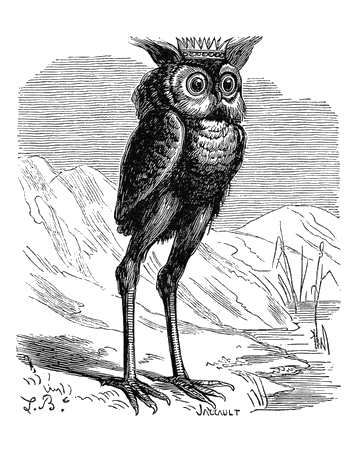
The Goetia describes him as a crowned owl who teaches the “virtues of herbs and precious stones” and the “courses of the stars.”
Earlier references trace to Johann Weyer’s Pseudomonarchia Daemonum (1577), a foundational text that shaped later Goetic demonology.
Weyer also describes Stolas as an owl-like being who imparts celestial knowledge to magicians.
These sources reflect Renaissance fascination with astronomy and alchemy, disciplines that sought to merge science and spirituality.
The name “Stolas” may derive from the Greek stolos, meaning “expedition” or “journey.”
This etymology aligns with his cosmic domain, suggesting movement through the heavens and intellectual exploration.
By the 17th century, Stolas had become an established figure in demonological hierarchies—a patron of scholars, astrologers, and seekers of the arcane.
Appearance and Attributes
Stolas is most famously depicted as a crowned owl perched upon a black branch, symbolizing nocturnal wisdom and silent authority.
In some accounts, he appears as a tall man with the head of a night bird, his eyes glowing with celestial fire.
Both forms emphasize his connection to the night sky and the hidden patterns of creation.
Each element of his image carries symbolic meaning:
- Owl Form: Represents intelligence, foresight, and mystery. The owl is sacred to Athena, goddess of wisdom, linking Stolas to divine intellect.
- Crown: Denotes his princely status among Hell’s hierarchy, marking him as a ruler of disciplined intellect rather than brute power.
- Human Shape: Suggests accessibility to mortals, enabling communication and instruction to those who summon him with respect.
His owl form also connects him to liminality—the threshold between light and dark, knowledge and ignorance.
In this way, Stolas becomes a guide through the shadowed spaces of the mind, where understanding often hides behind fear.
Powers and Abilities
Stolas governs knowledge of the cosmos, nature, and alchemy, blending scientific curiosity with occult revelation.
His most significant abilities include:
- Astronomical Mastery: Stolas teaches the courses of stars, planets, and celestial mechanics, a prized skill in the Renaissance.
- Alchemy and Herbalism: He reveals the hidden virtues of herbs, minerals, and gems, granting insight into their healing and mystical uses.
- Occult Scholarship: Stolas is said to instruct magicians in natural philosophy, combining logic with esoteric understanding.
- Clarity and Foresight: Those who approach him with respect may gain mental clarity, intuition, and insight into cosmic order.
Unlike many Goetic demons, Stolas’s lessons are non-destructive.
He encourages intellectual and spiritual development, guiding practitioners toward harmony between body, mind, and the natural world.
However, grimoires warn that all infernal dealings carry risks. Knowledge without humility can corrupt, just as light can blind.
Symbolism and Interpretation
Stolas’s enduring symbolism rests in his dual nature as both demon and teacher.
He embodies the pursuit of knowledge through forbidden means, a theme central to Western esotericism.
The owl, his chosen form, encapsulates paradox—wisdom through darkness, and enlightenment through mystery.
In alchemy, Stolas represents the Mercurial spirit, bridging heaven and earth.
His teachings mirror the alchemical process of transformation, where base understanding refines into golden awareness.
His crown suggests mastery over the intellect, and his wings signify transcendence through learning.
Psychologically, Stolas can be viewed as the archetype of the inner scholar.
He symbolizes curiosity, discipline, and the willingness to explore the unknown parts of oneself.
Through this lens, invoking Stolas becomes an act of self-reflection rather than literal evocation.
He invites seekers to embrace knowledge responsibly, tempering intellect with empathy.
Stolas in Ritual Practice
In Goetic tradition, summoning Stolas involves precision, focus, and purity of intent.
Practitioners use his sigil, a complex geometric emblem, as a key to his spiritual current.
The ritual requires a consecrated circle, incense of myrrh or sage, and chants from the Lesser Key of Solomon.
When invoked, Stolas is said to arrive with calm authority, often surrounded by a faint glow or the presence of an owl.
He speaks with eloquence and composure, offering instruction rather than temptation.
Because his domain is knowledge, his lessons manifest as insight, intuition, or creative inspiration, rather than physical phenomena.
Modern occultists often interpret Stolas’s invocation as a form of meditation or pathworking.
Through visualization, the practitioner seeks communion with their higher intellect—the part of the mind aligned with cosmic order.
In this way, Stolas becomes less a demon of Hell and more a symbol of inner illumination.
Cultural and Modern Influence
Stolas’s influence extends beyond grimoires into art, literature, and popular media.
He appears in artworks depicting Goetic hierarchies, often rendered as a serene, regal owl.
His image contrasts sharply with more violent demons, emphasizing his role as a guide of hidden truths.
In modern occultism, Stolas is revered as a patron of study, astrology, and self-knowledge.
His presence is sometimes invoked by writers, scientists, and magicians seeking clarity or creative insight.
He also appears in contemporary pop culture, such as Helluva Boss and other reinterpretations, where he is portrayed as a complex, intellectual being.
While these depictions vary, they all highlight his enduring connection to wisdom and cosmic understanding.
Across centuries, Stolas continues to embody the interplay of intellect, curiosity, and spiritual transformation.
Conclusion
Stolas, the Owl Prince of Hell, remains one of the most captivating figures in the Ars Goetia.
His dominion over the stars and the natural world reflects humanity’s eternal quest for understanding.
Through him, the boundaries between science and magic, reason and mystery, become beautifully intertwined.
Whether viewed as a literal demon, a mythic teacher, or a symbol of higher knowledge, Stolas endures as a guardian of enlightenment.
He reminds seekers that wisdom demands humility, and that even in darkness, the stars still shine.