
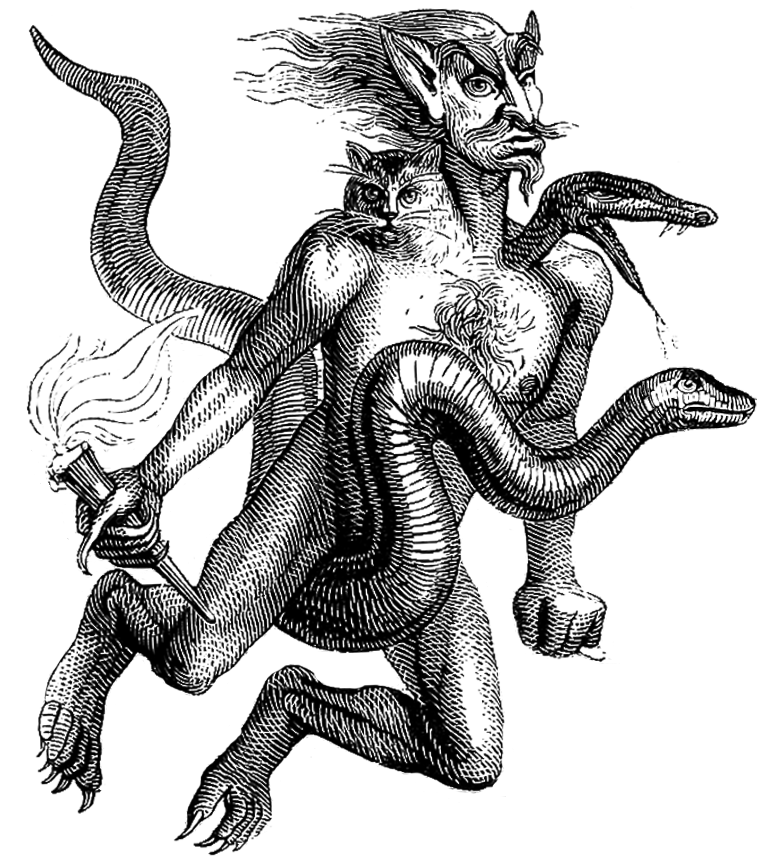
Aim: The 23rd Spirit of the Ars Goetia
Aim, also called Aym or Haborym, appears in the Ars Goetia as the twenty-third spirit bound by King Solomon. He rules as a duke of Hell commanding twenty-six legions of infernal spirits. His powers unite destruction and intellect, linking fire, wit, and revelation. Scholars of demonology view him as a complex figure balancing chaos and knowledge.
Origins and Hierarchy
Aim’s story emerges from Western demonology, where biblical fallen angels merged with pagan gods and medieval imagination.
In the Ars Goetia, he ranks as a duke—positioned below infernal princes yet above common spirits. This middle rank marks him as a commander of influence and insight.
Some historians connect Aim to ancient deities such as the Canaanite Amon or Egyptian Amun, both gods of fertility and war. Over centuries, these divine aspects evolved into a Christianized demon who rules fire and intellect.
Johann Weyer’s Pseudomonarchia Daemonum also records Aim. Weyer, a sixteenth-century physician, influenced later grimoires that shaped the Ars Goetia. His descriptions helped formalize the demon’s image as a fiery duke ruling the middle orders of Hell.
Appearance and Symbolism
The Ars Goetia portrays Aim as a striking yet terrifying entity. He appears as a handsome man carrying a blazing torch, yet he bears three heads—a man, a serpent, and a calf marked by twin stars.
Mounted upon a viper, he represents cunning, danger, and illumination.
Each head symbolizes a domain of mastery: intellect through the human face, secrecy through the serpent, and primal power through the calf. Together they reveal the fusion of divine wisdom and destructive energy.
Artists later reimagined Aim’s torch as the fire of transformation, turning his destructive flame into a metaphor for creative rebirth.
Abilities and Domains
Aim governs both fire and knowledge, combining elements of war and enlightenment. His principal power is to ignite cities, towers, and fortresses—an image of unstoppable change. Yet his torch can also kindle mental brilliance.
He reportedly grants:
- Cleverness and eloquence, sharpening wit and speech.
- Revelation of hidden truths, offering insight into mysteries of time and mind.
- Destructive fire, used symbolically to remove barriers or enemies.
Aim’s dual nature shows how ancient demonology blurred wisdom and danger. His flames destroy corruption but may also consume the unprepared. Medieval accounts warn that those who invoke him must keep strict discipline, lest the fire of genius turn to madness.
Interpretations in Occult and Culture
In modern esoteric studies, Aim often symbolizes transformative fire rather than evil. Occult theorists view him as an archetype of rebirth through destruction, similar to alchemical purification. His imagery appears in literature, art, and popular culture exploring forbidden knowledge and inner awakening.
Psychological readings describe him as the embodiment of creative risk—the force that drives innovation yet threatens stability. Contemporary writers connect him to the mythic trickster, a figure who challenges stagnation by burning away illusion.
However, traditional demonologists still depict Aim as volatile. His fire reveals truth but punishes arrogance. This tension between insight and peril mirrors the human pursuit of wisdom that defies boundaries.
Historical Influence
Aim’s legend reflects Renaissance fascination with hidden sciences. Magicians of that era saw him as a patron of geometry, rhetoric, and alchemy—arts that joined intellect with transformation. His reputation as a fiery teacher paralleled the age’s belief that knowledge could both elevate and destroy.
Through translations and reinterpretations, Aim’s name survived in countless grimoires and occult commentaries. His enduring appeal lies in his symbolic duality: he is both torchbearer and arsonist, teacher and tempter.
Conclusion
Aim endures as one of the most intriguing figures of the Ars Goetia. His triple-headed form and burning torch express humanity’s struggle between enlightenment and ruin. To study him is to confront the ancient belief that wisdom and danger share the same flame.
Across centuries, Aim’s story continues to glow in the study of demonology and myth. He remains a vivid reminder that illumination, once kindled, can never be fully contained.