
Introduction
In the intricate world of demonology, few spirits capture the imagination like Amon, the Marquis of Hell.
Revered across occult traditions, Amon’s name appears in medieval grimoires, Renaissance texts, and modern esoteric writings.
He is known as a demon of wrath and reconciliation, commanding the emotional extremes of love, anger, and conflict.
Appearing in the Ars Goetia of The Lesser Key of Solomon, Amon rules over forty legions of infernal spirits.
His dual nature—both destructive and healing—symbolizes the fine line between chaos and balance.
This article explores his origins, attributes, powers, and cultural legacy, revealing how Amon bridges the realms of fury and understanding.
Origins and Historical Context
Amon’s earliest detailed appearance comes from the Ars Goetia, a 17th-century grimoire cataloging 72 demons under King Solomon’s command.
He is listed as the seventh spirit, a Great and Mighty Marquis who governs matters of emotion and loyalty.
Earlier records appear in Johann Weyer’s Pseudomonarchia Daemonum (1577), which heavily influenced later demonological texts.
Weyer describes Amon as a formidable entity who can reconcile friends and foes yet also incite fury and destruction.
The origins of Amon’s name are complex. Some scholars trace it to Amun, the Egyptian god of creation and hidden wisdom.
Amun, later merged with Ra, symbolized divine power concealed within mystery, a theme mirrored in Amon’s hidden influence.
Others propose that Amon’s name derives from Semitic roots meaning “faithful” or “trusted,” emphasizing loyalty’s dark reflection in demonic lore.
During the Renaissance, when scholars merged theology and magic, Amon became a figure of duality.
He embodied both reconciliation and rebellion, showing that the forces binding humanity could also divide it.
His inclusion in the Goetia reflected the era’s fascination with controlling emotions and balancing moral extremes through ritual practice.
Description and Appearance
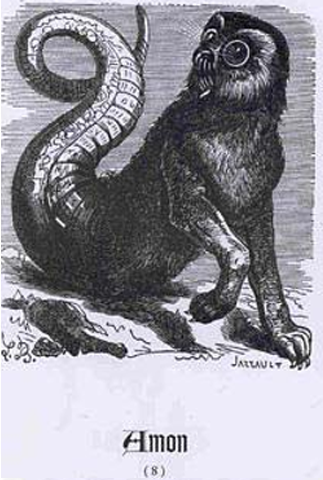
The Ars Goetia describes Amon as a powerful entity with a fearsome, hybrid form.
He appears initially as a wolf with a serpent’s tail, spitting fire and radiating feral aggression.
At the magician’s command, he can assume human shape, bearing the head of a raven with sharp, intelligent eyes.
This dual imagery carries deep symbolism:
- Wolf Body: Represents rage, instinct, and untamed power. It reflects Amon’s role in channeling destructive emotion.
- Serpent Tail: Symbolizes hidden wisdom, transformation, and the dangerous lure of knowledge.
- Raven Head: Suggests foresight, intellect, and communication between realms—both divine and infernal.
Unlike purely monstrous demons, Amon’s form combines ferocity with intellect.
He embodies the union of mind and instinct, teaching control through confrontation with inner chaos.
In occult illustrations, he often carries fire in his mouth—a reminder that speech can both wound and heal.
Powers and Abilities
Amon’s powers revolve around emotion, foresight, and transformation.
As a Marquis, he wields authority over forty legions of spirits and governs matters of love, anger, and reconciliation.
His main abilities include:
- Reconciliation: Amon can restore friendships and mend relationships damaged by anger or betrayal.
- Conflict and Wrath: He can also provoke enmity or inflame passion, demonstrating his mastery over emotional extremes.
- Prophecy: The Ars Goetia notes that Amon reveals past and future events, offering insight into hidden truths.
- Mental Clarity: He provides understanding of complex emotions, helping practitioners gain self-control through awareness.
Amon’s dual nature makes him both dangerous and valuable.
He teaches that anger, when mastered, becomes strength—but when uncontrolled, it consumes.
In ritual magic, he is invoked for healing relationships, resolving inner turmoil, and transforming rage into purpose.
Symbolism and Interpretation
Amon represents the reconciliation of opposites—a theme central to Western occult philosophy.
His wolf aspect reflects primal instinct; his raven head signifies intellect and strategy.
Together, they reveal the union of emotion and reason, violence and forgiveness.
In esoteric symbolism, Amon’s fire-breathing form embodies the purifying force of transformation.
He burns away illusion, exposing the truth within chaos.
To summon Amon, therefore, is to confront one’s own anger, jealousy, or suppressed emotion.
Psychologically, Amon can be viewed as an archetype of emotional mastery.
He represents the shadow self, the part of the psyche that holds rage, fear, and desire.
By facing this shadow, one gains wisdom and balance—echoing the Jungian path of individuation.
Spiritually, Amon’s lessons align with alchemical transformation: the refinement of base emotions into enlightenment.
His presence teaches that destruction can precede renewal, and that reconciliation often requires understanding darkness first.
Amon in Ritual Practice
Traditional Goetic magic requires precision and discipline when working with Amon.
Practitioners employ protective circles, his sigil, and divine invocations to establish authority and safety.
His sigil, an intricate geometric seal, serves as a symbolic key to his infernal current.
Amon’s appearance during summoning is said to bring heat, flickering shadows, and sudden emotional intensity.
Respect is essential; careless summoners risk emotional volatility or conflict.
When invoked with purpose and balance, however, Amon can clarify relationships, restore peace, and enhance communication.
Modern demonologists often view such invocations as psychological or meditative acts rather than literal conjurations.
Through ritual focus, practitioners explore their inner emotions, using Amon as a mirror for anger, reconciliation, and personal evolution.
Cultural and Historical Influence
Amon’s enduring appeal lies in his paradoxical nature.
He is both wolf and raven, destroyer and mediator, embodying the duality at the heart of human experience.
In Renaissance art and magic, Amon symbolized controlled passion—the transformation of fury into creativity.
Alchemists linked him to the philosophical fire, a force that consumes but also refines.
Later occult orders, such as The Golden Dawn, interpreted Amon as an aspect of Mercurial intelligence, bridging instinct and intellect.
In modern culture, his imagery appears subtly in literature, games, and art, representing characters who balance rage with wisdom.
He stands as a reminder that even infernal forces can teach harmony when approached with respect and understanding.
Modern Interpretations
Today, Amon is often seen not as a literal demon but as a symbol of emotional alchemy.
Contemporary occultists interpret him as a guide through the cycles of anger, loss, and healing.
Through meditation on his sigil, one may confront suppressed conflict and achieve inner balance.
In Luciferian and Thelemic traditions, Amon’s dual power symbolizes self-sovereignty and transformation through adversity.
He represents the mastery of one’s passions, turning destruction into creation.
This makes Amon a timeless figure—both infernal teacher and inner guardian of balance.
Conclusion
Amon, the Marquis of Hell, remains one of demonology’s most complex and fascinating spirits.
His hybrid form and dual nature reflect humanity’s struggle between rage and understanding.
Through fire and reconciliation, he teaches that true power lies in mastery of emotion.
From ancient Egypt’s hidden god Amun to the Goetic grimoires of Europe, his legacy endures as a bridge between darkness and light.
Whether viewed as a literal spirit, an archetype, or a force of transformation, Amon endures as the eternal mediator—
the wolf who burns with fury, and the raven who speaks of peace.