
Introduction
In the shadowy study of demonology, few entities intrigue scholars as deeply as the demon Barbatos.
Listed among the 72 spirits of the Ars Goetia, the first section of the Lesser Key of Solomon, Barbatos stands as both Earl and Duke of Hell.
This unique dual rank reflects his balance between wisdom and command—attributes that make him one of the most fascinating Goetic spirits.
Blending ancient knowledge with a connection to nature, Barbatos represents harmony between the mystical and the material.
To study him is to explore how medieval occultists united theology, astrology, and natural philosophy into one coherent worldview.
Understanding the demon Barbatos reveals not just a supernatural figure but a timeless symbol of hidden knowledge and equilibrium.
This guide explores his origins, appearance, powers, and lasting legacy in occult and cultural traditions.
Origins in Demonology
The origins of Barbatos trace back to early modern demonology, particularly the Ars Goetia of the Lesser Key of Solomon.
Compiled in the 17th century, this grimoire catalogs 72 infernal spirits allegedly bound by King Solomon.
Barbatos holds the eighth position in this hierarchy, ranking him among the most prominent demonic nobles.
The name Barbatos likely derives from the Latin barbatus, meaning “bearded” or “aged.”
This etymology paints him not as a monster but as a sage-like figure, a teacher cloaked in mystery.
Before his fall, he belonged to the angelic Order of Virtues, celestial beings known for their miraculous power.
His descent from grace reflects a familiar pattern in demonology: divine wisdom corrupted into infernal insight.
Johann Weyer’s Pseudomonarchia Daemonum (1577) also records Barbatos, describing him as both powerful and benevolent.
Unlike purely destructive demons, Barbatos bridges the divine and the infernal, guiding magicians toward understanding rather than chaos.
Within Hell’s hierarchy, he serves under commanders such as Satanachia, emphasizing the bureaucratic order that defines Goetic cosmology.
Through him, scholars glimpse a structured underworld, not a chaotic abyss.
Appearance and Manifestation
According to the Ars Goetia, Barbatos manifests when the sun enters Sagittarius—typically from late November to mid-December.
This celestial alignment connects him to the element of fire and the wisdom of archery, intuition, and truth-seeking.
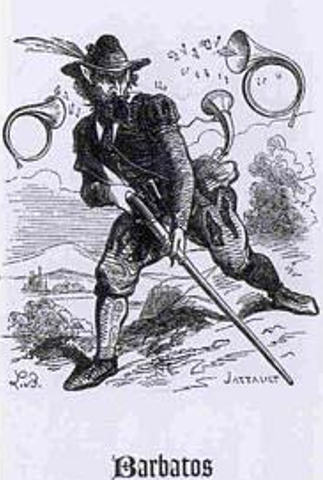
Barbatos often appears as a rugged hunter or archer, clad in green garments that blend with the forest.
His beard symbolizes wisdom, while horns mark his infernal nature.
He is accompanied by four noble kings and their legions, arriving like a spectral hunting procession.
The horns of his retinue echo through the trees, announcing the arrival of a Duke of Hell who commands both men and beasts.
This imagery merges Christian demonology with pagan woodland archetypes, suggesting a synthesis of cultures and myths.
Summoning and Sigil
Barbatos’s sigil—a copper-drawn seal featuring geometric symmetry—is essential for safe invocation.
Rituals traditionally occur under Sagittarius, when his influence peaks.
Magicians recite incantations such as Eveta Fubin Barbatos to establish contact.
Practitioners describe his energy as patient, wise, and grounded, making him one of the more approachable spirits of the Goetia.
He often communicates through dreams, visions, or subtle natural signs, preferring insight to spectacle.
Powers and Abilities
Barbatos is revered for his mastery of natural and spiritual knowledge.
His influence extends across divination, nature communion, and social reconciliation.
Ruling over 30 legions of spirits, he embodies both authority and empathy.
1. Mastery Over Nature and Animals
Barbatos is famed for his ability to understand animal speech.
He interprets the songs of birds, the cries of beasts, and the whispers of wind and water.
Through his guidance, practitioners learn harmony with natural forces, a skill prized by herbalists and shamans.
In magical terms, he reveals secrets hidden in nature—unknown herbs, sacred groves, or concealed pathways.
This communion bridges humanity and wilderness, uniting intellect and instinct.
2. Divination and Hidden Knowledge
Barbatos is a seer of time, revealing truths about past, present, and future events.
He can lift enchantments, exposing treasures or artifacts hidden by magic.
Many seekers of forbidden knowledge invoke him to clarify dreams or locate lost objects.
Beyond material gain, Barbatos teaches astrology and esoteric wisdom, guiding magicians through celestial correspondences.
His lessons foster intellectual discipline and spiritual awareness, blending scholarship with mysticism.
3. Social Harmony and Influence
A diplomat among demons, Barbatos reconciles enemies, mends friendships, and restores trust.
His conciliatory nature reflects his angelic origins, where Virtues governed peace and order.
He grants charisma and eloquence to leaders, aiding negotiation and persuasion.
This influence extends to politics, artistry, and interpersonal relationships, where harmony is both goal and reward.
Many occultists also credit him with musical inspiration, linking him to rhythmic cycles of nature and creation.
Symbolism and Interpretation
Symbolically, Barbatos represents balance between chaos and order.
He stands at the threshold where intellect meets instinct, teaching that wisdom grows through harmony with the natural world.
His bow and hunting attire recall pagan gods of the forest, while his Virtue origins tie him to divine illumination.
Thus, Barbatos embodies the fusion of earthly intuition and heavenly reason—a guide for those who seek knowledge without corruption.
In modern spiritual psychology, he symbolizes reconciliation with the self: the integration of wild impulses with moral insight.
Legacy and Cultural Influence
Across centuries, Barbatos has remained a fixture in occult literature, art, and popular culture.
In Renaissance grimoires, he represented the ideal of a rational, enlightened demon, distinct from destructive fiends.
Later occult movements, such as the Hermetic Order of the Golden Dawn, reinterpreted him as an elemental spirit of earth and air.
Today, Barbatos appears in fantasy novels, role-playing games, and digital media, often portrayed as a wise forest spirit or mystical guide.
These depictions preserve his original duality: fierce yet benevolent, powerful yet introspective.
Such endurance reflects humanity’s fascination with knowledge that blurs moral boundaries—wisdom drawn from darkness to serve the light.
Conclusion
Barbatos, the bearded Duke of Hell, remains one of the most intriguing figures in demonology.
His lore blends angelic grace, natural harmony, and infernal authority into a single, enduring myth.
Through him, the Ars Goetia reveals not merely a demon of power, but a symbol of wisdom, reconciliation, and truth-seeking.
To study Barbatos is to explore the eternal dialogue between reason and instinct, light and shadow, and knowledge and mystery.
In the vast hierarchy of Hell, he reminds us that even in darkness, understanding can lead toward balance—and perhaps, redemption.