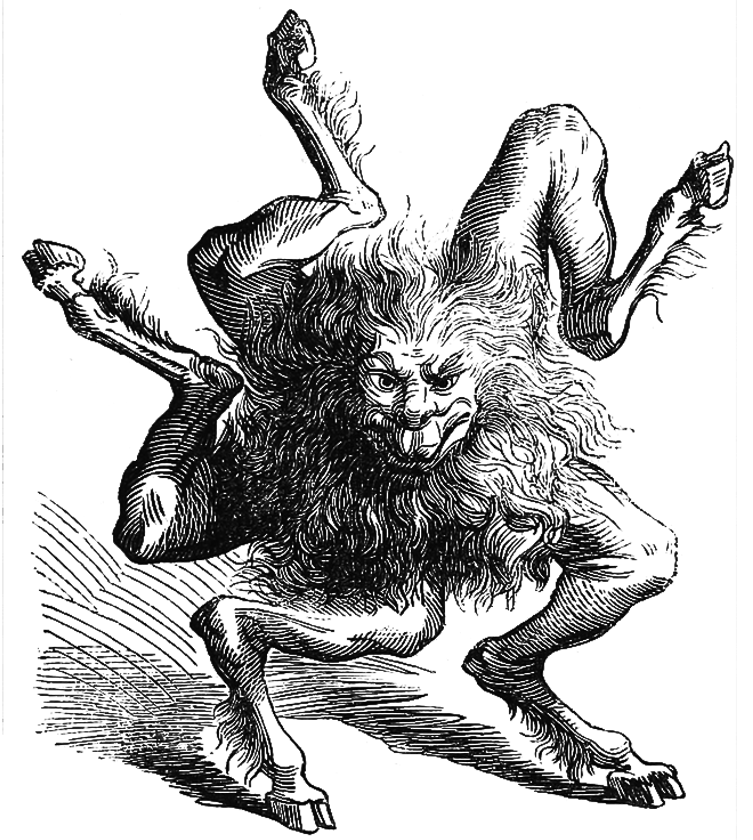
In the vast and intricate lore of demonology, few entities are as enigmatic as Buer, a demon described in various grimoires and occult texts. Often depicted as a president of Hell commanding fifty legions of demons, Buer occupies a unique position in the infernal hierarchy. This article explores Buer’s origins, attributes, and significance in demonological traditions, drawing from historical texts such as the Pseudomonarchia Daemonum and the Lesser Key of Solomon.
Origins and Historical Context
Buer’s earliest detailed mention appears in Johann Weyer’s Pseudomonarchia Daemonum (1577), a catalog of demons that influenced later works like the Ars Goetia, part of the Lesser Key of Solomon. These texts, compiled during the Renaissance, reflect a fascination with the supernatural and the classification of spiritual beings. Buer is listed as a president, a rank indicating authority over a significant number of demonic legions, and is described as a teacher of philosophy, logic, and herbal medicine.
The name “Buer” may derive from linguistic or mythological roots, though its etymology remains speculative. Some scholars suggest a connection to the Latin bubalus (buffalo), possibly alluding to Buer’s lion-like appearance, while others propose links to alchemical or astrological symbolism. Regardless, Buer’s inclusion in grimoires underscores the era’s blend of Christian demonology, classical philosophy, and esoteric knowledge.
Appearance and Attributes
Buer’s depiction is striking and symbolic. According to the Ars Goetia, he appears as a centaur-like creature with the head of a lion and multiple legs radiating like spokes from his body, resembling a wheel. This imagery may symbolize agility, omniscience, or cosmic harmony, as wheels often represent cycles or divine order in mystical traditions. The lion’s head signifies strength and nobility, aligning with Buer’s role as a teacher of wisdom.
Buer is attributed with several powers:
Philosophical and Logical Insight: He imparts knowledge of moral and natural philosophy, as well as logic, making him a patron of intellectual pursuits within demonic lore.
Healing and Herbal Knowledge: Buer is said to teach the properties of herbs and plants, offering remedies for ailments. This aligns him with the archetype of the healer, a rare trait among demons.
Divination and Truth: He provides true answers to questions posed by conjurers, emphasizing his role as a source of hidden knowledge.
These abilities suggest a complex figure, blending intellectual enlightenment with practical skills, contrasting with the malevolent stereotypes of demons.
Role in Ritual and Summoning
In the tradition of Western occultism, summoning Buer requires adherence to specific rituals outlined in grimoires. Practitioners would draw protective circles, recite incantations, and use sigils—unique symbols associated with the demon—to invoke his presence. Buer’s sigil, a intricate design of lines and curves, is believed to act as a focal point for his energy. Conjurers sought Buer’s aid for intellectual clarity, healing, or divination, though such practices were fraught with spiritual and moral risks, as warned by both occultists and religious authorities.
The Lesser Key of Solomon advises caution when dealing with Buer, emphasizing the need for respect and precision in rituals. His willingness to assist, however, sets him apart from more malevolent demons, suggesting a cooperative nature when properly approached.
Cultural Significance
Buer’s role in demonology reflects broader cultural anxieties and aspirations of the Renaissance. The pursuit of knowledge—whether philosophical, scientific, or esoteric—was both revered and feared, as it challenged religious orthodoxy. Buer, as a demon of learning and healing, embodies this tension: a figure who offers forbidden wisdom at the cost of engaging with the infernal.
In modern times, Buer has found a place in popular culture, appearing in literature, games, and media inspired by occult themes. His unique appearance and intellectual attributes make him a compelling figure for reinterpretation, often portrayed as a misunderstood or neutral entity rather than purely evil.
Conclusion
Buer stands as a fascinating paradox in demonology—a demon who teaches wisdom, heals ailments, and answers truthfully. His lion-headed, wheel-like form and multifaceted powers distinguish him from the more destructive entities of Hell’s hierarchy. While rooted in the grimoires of the Renaissance, Buer’s legacy endures in modern occultism and popular imagination, symbolizing the eternal human quest for knowledge, even at the edge of the abyss.