
Introduction: The Enigmatic Spirit of Storms and Secrets
Among the many figures cataloged in the Ars Goetia, few capture the imagination like Furfur, the storm-wielding Earl of Hell. Described in multiple grimoires and occult texts, Furfur embodies both chaotic power and hidden wisdom, commanding thunder, lightning, and passion with equal force.
Rooted in Western esoteric tradition, Furfur appears primarily in The Lesser Key of Solomon, a 17th-century grimoire that remains one of the most influential works in ceremonial magic. This article examines Furfur’s origins, characteristics, powers, and enduring significance in demonology and modern occultism.
Origins and Historical Context
Furfur is listed as the 34th spirit in the Ars Goetia, one of 72 demons allegedly summoned and bound by King Solomon. The Ars Goetia reflects a synthesis of Jewish mysticism, Christian angelology, and pre-Christian occult traditions, blending theology with symbolic psychology.
Etymologically, the name Furfur may derive from the Latin word “furfur,” meaning “bran” or “chaff,” though some occult scholars connect it to the sound of wind or storms, aligning with his elemental dominion.
In the infernal hierarchy, Furfur is ranked as a Great Earl of Hell, commanding 26 legions of spirits. His position represents not merely authority but also control over nature’s most volatile forces — storms and desire — reflecting medieval attempts to categorize both divine and chaotic phenomena within a structured cosmic order.
Appearance and Symbolism
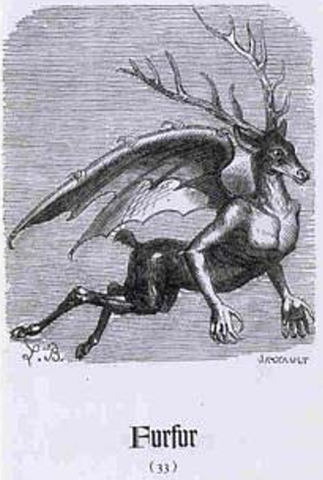
The Ars Goetia describes Furfur’s appearance as that of a hart or stag with a fiery tail, a striking image combining elegance and danger. When compelled by a skilled magician, he may transform into an angelic or human figure, symbolizing truth revealed through control and mastery.
The stag, a creature associated with speed, nobility, and nature’s mystery, signifies Furfur’s link to the untamed forces of the natural world. The flame emanating from his tail embodies his destructive and illuminating potential — fire as both creator and destroyer.
Furfur’s sigil, a precise geometric design, serves as his symbolic and magical signature. Within ritual practice, it acts as a spiritual key, allowing contact or invocation when drawn correctly. In occult philosophy, this sigil represents the intersection of chaos and control — the dual essence of his domain.
Powers and Abilities
Furfur’s powers center on weather, passion, deception, and revelation. His role in the Ars Goetia makes him one of the most dynamic spirits, governing both natural and emotional forces.
Primary Abilities Attributed to Furfur:
- Control of Weather: Commands storms, thunder, lightning, and other atmospheric phenomena.
- Revelation of Knowledge: Discloses divine and hidden truths when compelled by a proper seal.
- Deception: Naturally deceitful, Furfur lies unless bound by the conjurer’s authority — a recurring theme in Goetic lore.
- Love and Desire: Influences romantic and sexual attraction, inspiring passion or reconciliation.
- Communication: Speaks in a hoarse, storm-like voice, often symbolizing raw, unfiltered truth.
Furfur’s dual powers of creation and chaos make him an unpredictable yet potent force within occult practice. His influence bridges physical storms and emotional turbulence, illustrating how nature and human passion mirror one another.
Personality and Behavior
Like many Goetic demons, Furfur is described as willful and deceptive, reluctant to serve unless constrained by divine authority. Summoners are advised to use a magic circle and triangle when working with him, ensuring both safety and compliance.
This adversarial dynamic — the magician asserting control over a rebellious spirit — reflects the medieval belief in divine hierarchy: even demons could be subdued through sacred names and disciplined will.
Despite his infernal nature, Furfur’s angelic transformation when compelled to speak truthfully suggests a dual aspect — the potential for enlightenment hidden within darkness. In this sense, Furfur embodies the tension between truth and illusion, a core theme of the Goetia and Western esotericism.
Cultural and Symbolic Significance
Furfur’s role in demonology reveals much about medieval cosmology and magical thought. The Ars Goetia was not merely a guide to summoning spirits — it was a spiritual taxonomy, an attempt to understand and control the unknown through ritual and hierarchy.
As a storm demon, Furfur symbolizes humanity’s age-old struggle with the uncontrollable forces of nature — the tempest, the lightning bolt, the passions of the heart. His association with both Venus (love) and the element of Air (intellect) unites emotional and intellectual extremes, reflecting the dual nature of creation itself.
In modern occultism, Furfur remains a figure of fascination. Ceremonial magicians and Thelemites may invoke his archetype to explore emotional mastery, transformation, or inspiration. Contemporary interpretations also view him psychologically — as the embodiment of creative chaos and the storm of insight that precedes clarity.
The Sigil of Furfur
The sigil of Furfur, found in The Lesser Key of Solomon, is a distinctive symbol of looping, angular lines that invoke motion and volatility. It functions as a ritual seal and meditative focus, designed to align the magician’s intent with the spirit’s nature.
In meditation or ritual, focusing on Furfur’s sigil can serve as an exercise in channeling creative energy, mastering emotional storms, or invoking truth through disciplined focus.
Conclusion: The Fiery Earl of Revelation
Furfur, the 34th demon of the Ars Goetia, stands as one of the most complex and dynamic entities in demonological tradition. As a Great Earl of Hell, he governs the forces of storm, passion, and insight, blending elemental power with philosophical symbolism.
To medieval scholars, Furfur represented the fear and fascination of nature’s chaos; to modern occultists, he symbolizes the transformative energy of truth and passion. Whether viewed as a literal entity or an archetype of creative fire, Furfur remains a timeless figure — a spirit of revelation born from the storm.