
Introduction
In the intricate lore of demonology, few figures balance conflict and healing as elegantly as Leraje, the Green Archer of Hell.
Appearing in the Ars Goetia of The Lesser Key of Solomon, Leraje embodies paradox—both warrior and healer, destroyer and restorer.
This article explores his origins, appearance, powers, and symbolic meaning, tracing how a Renaissance demon became a timeless emblem of precision, balance, and transformation.
Origins in the Grimoires
Leraje, also called Leraie, Oray, or Loray, appears as the 14th spirit in the Ars Goetia.
He holds the rank of Marquis of Hell and commands thirty legions of infernal spirits.
The Ars Goetia, compiled in the mid-17th century, was based on earlier sources such as Johann Weyer’s Pseudomonarchia Daemonum (1577).
Weyer described Leraje as a demon who provokes battles and later heals the wounds he creates.
These texts drew on medieval and Renaissance efforts to catalog the unseen world.
They merged Christian demonology, Jewish mysticism, and classical symbolism, creating an infernal hierarchy that reflected humanity’s fascination with moral and cosmic order.
Within this hierarchy, Leraje represents not wanton destruction, but disciplined conflict—a spirit who governs both strife and resolution.
Appearance and Attributes
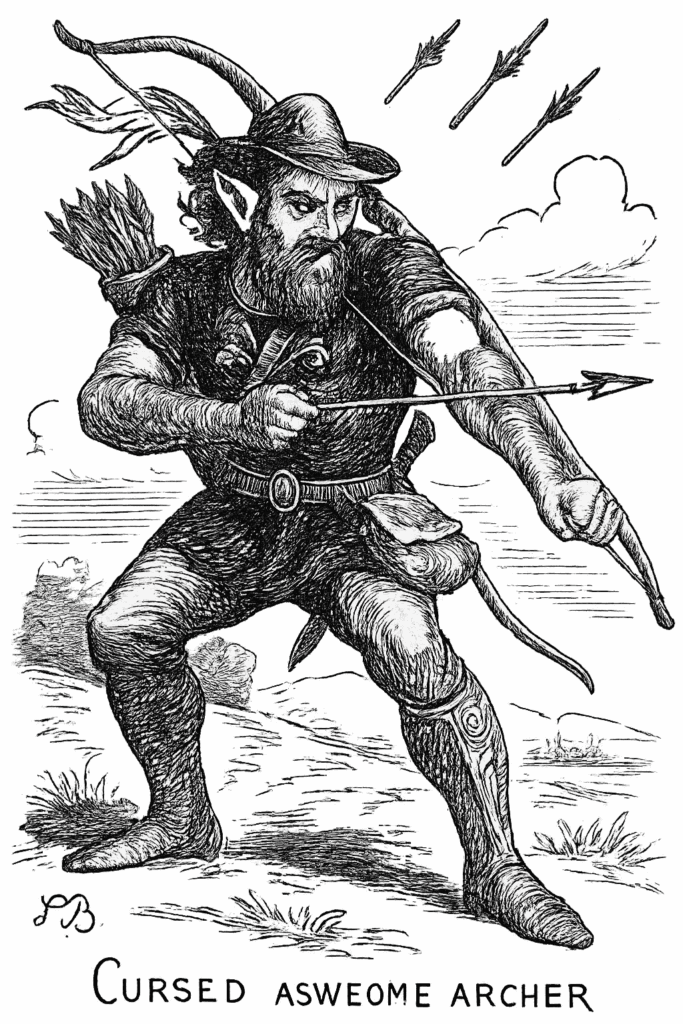
According to the Ars Goetia, Leraje appears as a handsome archer dressed in green, carrying a bow and quiver of arrows.
This image evokes a blend of warrior elegance and natural vitality, echoing forest deities and mythic hunters from pre-Christian lore.
His green attire symbolizes renewal, vitality, and growth. Yet, as the color of poison and envy, it also hints at the corruption within nature’s beauty.
His chief powers include:
- Kindling Battles: Leraje incites conflict, inspiring warriors and fanning disputes into open combat.
- Healing Wounds: He paradoxically heals injuries—especially those caused by arrows—demonstrating his dual mastery over harm and recovery.
- Commanding Legions: As a Marquis, he leads thirty legions, enforcing precision and discipline in their ranks.
This combination of warfare and restoration marks Leraje as a figure of profound equilibrium. His arrows wound only to teach; his healing reveals the purpose of pain.
Symbolism and Interpretation
Leraje’s symbolism reaches beyond literal combat.
His arrows represent intention and focus, tools of both destruction and enlightenment.
They strike precisely, teaching that the greatest battles are often fought within.
His dual nature mirrors the cycle of conflict and renewal, suggesting that every wound can become a source of wisdom.
In alchemical symbolism, this mirrors the solve et coagula principle—breaking apart to rebuild stronger.
Psychologically, Leraje represents the inner warrior-healer archetype.
He embodies courage tempered by compassion, anger transformed into awareness.
His green garb reflects balance with nature, and his bow symbolizes the discipline required to direct one’s energy.
Modern occultists often view Leraje as a mediator of inner conflict.
Through his influence, strife becomes a catalyst for healing and evolution, not destruction.
Leraje in Ritual Practice
Traditional grimoires instruct that Leraje’s sigil be drawn within a consecrated circle and invoked with precision.
His presence, though martial, is calm—focused, not furious.
Practitioners invoke him for:
- Resolving disputes and rivalries
- Overcoming personal or creative blockages
- Developing focus, discipline, and emotional control
- Healing lingering resentments or “spiritual wounds”
Offerings of green candles, laurel, or arrow symbols are thought to honor his dual domain of war and restoration.
Because he governs both harm and healing, respect and clarity of purpose are essential.
In modern occult circles, Leraje is sometimes invoked for athletic success, conflict resolution, or ritual cleansing after emotional trauma.
Cultural and Modern Influence
While lesser-known than figures like Baal or Asmodeus, Leraje’s archetype appears throughout culture.
His archer’s precision and green attire echo mythic figures like Apollo, Sagittarius, and even Robin Hood—symbols of skill, justice, and rebellion.
In fiction and modern media, Leraje’s name surfaces in role-playing games, literature, and digital occultism.
His image often merges the elegance of an elven archer with the stoicism of a divine soldier.
Within modern occultism, he endures as a guide for transformation through conflict.
To call upon Leraje is to confront struggle—not to avoid it, but to emerge purified and focused.
Conclusion
Leraje, the Green Marquis of Hell, stands as one of the Ars Goetia’s most balanced and evocative spirits.
He teaches that conflict and healing are not opposites but stages of the same process.
His bow and arrows symbolize precision, intention, and the discipline to transform adversity into insight.
In every age, from Solomon’s circle to modern ritual, Leraje embodies the paradox of strength:
to wound is to awaken, and to heal is to understand.
Whether seen as a mythic teacher, an archetype of balance, or a literal spirit, Leraje remains a patron of focus, renewal, and resilience.