
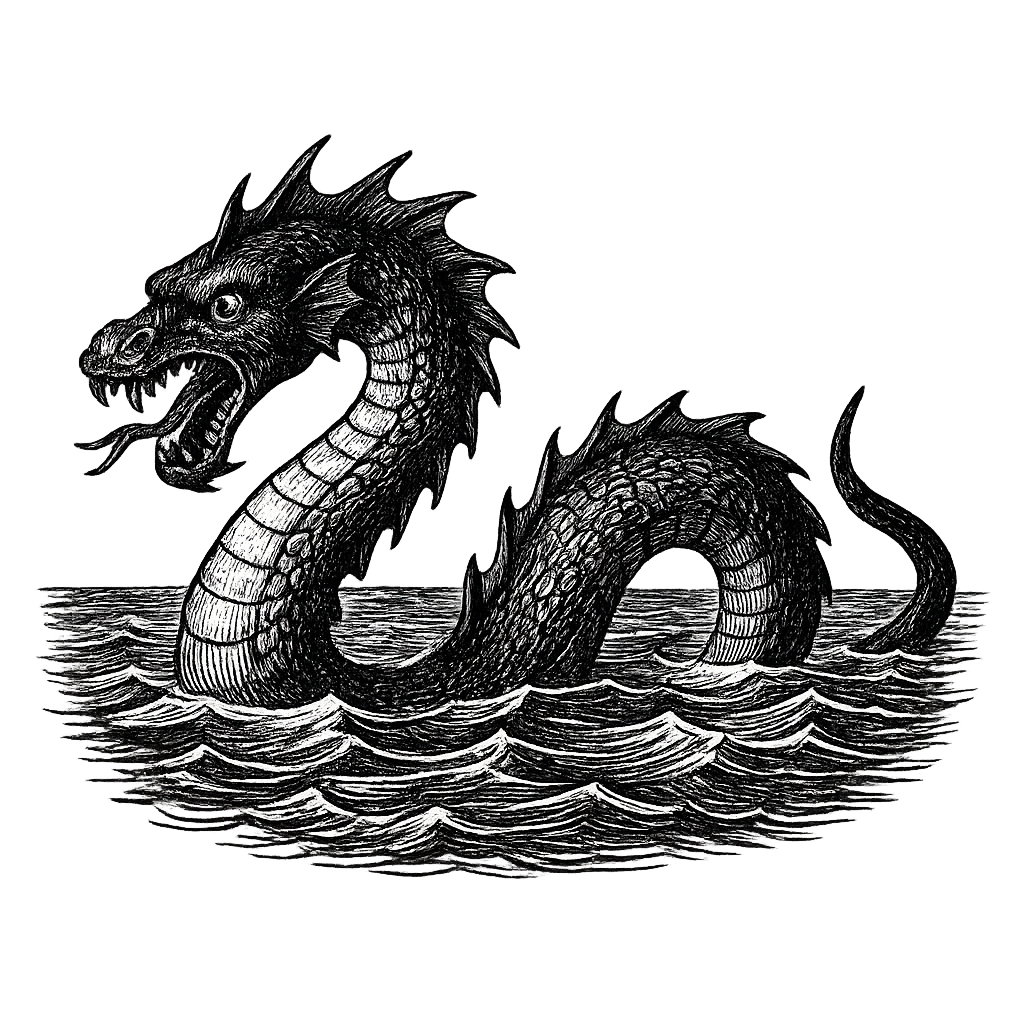
Leviathan: The Demon Prince of Envy and Lord of the Abyss
In the dark annals of demonology, few names inspire more dread than Leviathan, the colossal sea serpent demon whose very name stirs visions of chaos, the abyss, and divine wrath. Once a biblical symbol of power and disorder, Leviathan evolved into one of the Princes of Hell, ruling over the corrosive sin of envy.
This article explores Leviathan’s origins, mythological background, and demonological transformation, revealing how an ancient chaos monster became the infernal embodiment of human jealousy and emotional turmoil.
Origins: Leviathan in Ancient Myth and the Bible
Leviathan’s roots trace back to ancient Near Eastern mythology, descending from Lotan, the Ugaritic sea serpent defeated by the storm god Hadad. This battle echoes across cultures in the Chaoskampf mythos — from Marduk’s slaying of Tiamat to Ninurta’s conquest of the seven-headed dragon.
The Hebrew term Leviathan derives from lwh (“to coil” or “twist”), painting a vivid picture of a massive, coiling sea serpent. In the Hebrew Bible, Leviathan appears as a creature of chaos in Job 41, Psalms 74, and Isaiah 27:1, where it represents God’s mastery over creation.
Later interpretations — especially in Talmudic and apocryphal texts — transformed Leviathan into a mythic beast of the apocalypse, its flesh reserved for a messianic feast and its death marking divine triumph.
From Sea Monster to Prince of Hell: Leviathan in Demonology
As Judaism and Christianity evolved, Leviathan took on demonic attributes, becoming a ruler of Hell’s hierarchy. The Book of Enoch describes Leviathan as a female sea beast paired with Behemoth, while the Septuagint’s translation linked it to the dragon of Revelation, identifying it with Satan.
In medieval demonology, theologian Peter Binsfeld (1589) named Leviathan as the demon prince of envy, one of the Seven Princes of Hell — alongside Lucifer (pride), Mammon (greed), and Beelzebub (gluttony).
Sébastien Michaelis later depicted Leviathan as a fallen seraph tempting humanity toward heresy. In LaVeyan Satanism, Anton LaVey’s Satanic Bible (1969) elevated Leviathan to one of the Four Crown Princes of Hell, symbolizing the element of water, the west, and emotional depth.
The Sphere of Envy: Leviathan’s Dark Dominion
In Christian theology, envy is one of the seven deadly sins, defined by resentment toward others’ blessings. As the Prince of Envy, Leviathan embodies this vice — envious of God’s authority, demanding his own dominion beneath the waves.
In occult lore, Leviathan whispers envy into human hearts, twisting perception and sowing discord. This “Leviathan spirit”, described in modern spiritual warfare, coils around the soul, constricting truth and peace like a serpent crushing its prey.
Thus, Leviathan is not only a mythic creature of chaos but also a psychological archetype of jealousy — the poison that devours from within.
Description and Powers of Leviathan
Leviathan’s imagery blends biblical grandeur with occult terror. Descriptions portray a massive serpent or dragon, its scales impenetrable, eyes blazing like the sun, and breath igniting the seas.
According to the Book of Job, “out of its mouth go burning lamps.” Medieval texts claim its body spans 300 miles, its mere odor toxic to life, and its hunger capable of boiling oceans.
Powers attributed to Leviathan:
-
Control over the sea and storms
-
Dominion over envy and emotional corruption
-
Revelation of forbidden knowledge
-
Manipulation of perception and illusion
-
Summoning abyssal entities and marine spirits
Occult grimoires warn that invoking Leviathan leads to spiritual drowning unless one confronts their own envy and emotional chaos.
Leviathan in Prophecy and Eschatology
In Isaiah 27:1, Leviathan’s death marks the dawn of divine order: “The Lord will punish Leviathan the twisting serpent.” This eschatological slaying became a cornerstone of apocalyptic imagery.
In Christian tradition, Leviathan guards the mouth of Hell, devouring sinners. Medieval manuscripts and Gothic cathedrals often depict this as the Hellmouth, a vast serpent swallowing the damned.
For Gnostics and Kabbalists, the defeat of Leviathan symbolizes liberation from the material world — the soul’s release from envy, desire, and illusion.
Modern Echoes: Leviathan in Pop Culture and Occultism
Leviathan’s legend persists in modern culture — from Lovecraftian horrors and TV series like Hazbin Hotel to dark fantasy and video games. In modern occultism, Leviathan represents depth, emotion, and transformation, governing the subconscious and the hidden tides of human emotion.
For Satanists, Leviathan remains a symbol of self-mastery through awareness of one’s inner abyss — embracing the darkness to find truth.
Conclusion: Leviathan as Myth and Mirror
Leviathan endures not just as a demonic sea serpent, but as a reflection of the human soul. Its story warns of envy’s destructive pull and the chaos born of resentment.
To face Leviathan is to face one’s own depths — the envious currents that threaten to consume, yet can also lead to transformation when mastered.