
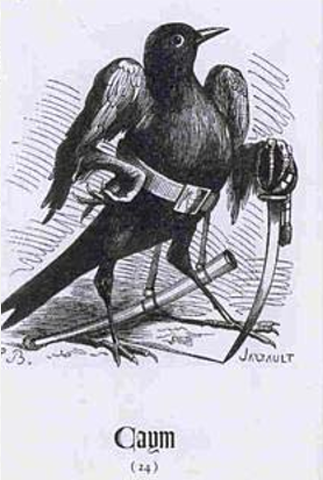
Raum: The Crow-Formed Earl of Hell in the Ars Goetia
Meta Description:
Discover Raum, the 40th demon of the Ars Goetia — a crow-formed Earl of Hell who reveals secrets, destroys cities, and commands 30 legions.
Introduction: Raum, the Raven of Revelation
In the complex world of demonology, few figures are as intriguing as Raum. He blends knowledge, destruction, and transformation into one mysterious force. Raum’s presence spans ancient grimoires and modern occult thought, marking him as a bridge between ages.
Prominent in The Lesser Key of Solomon, Raum is both a Great Earl of Hell and a keeper of hidden wisdom. His legend reflects humanity’s fascination with power and secrecy — and the eternal struggle between creation and chaos.
Origins in Demonology
Raum appears as the 40th spirit in the Ars Goetia, the first book of The Lesser Key of Solomon. This 17th-century grimoire lists 72 spirits bound by King Solomon’s command. Raum’s title as a Great Earl of Hell gives him authority over 30 legions of demons, confirming his high rank in the infernal order.
The meaning of his name remains uncertain. It may stem from ancient words for “space,” “void,” or “emptiness,” linking him to mysteries beyond the visible world. Raum’s power flows through these unseen realms, where treasure and truth alike can be stolen or revealed.
His earliest mention appears in Johann Weyer’s Pseudomonarchia Daemonum (1577). Renaissance occultists saw spirits like Raum not as mindless evil but as forces of knowledge and consequence. When invoked through exact ritual, such entities could grant wisdom or advantage — though always at a price.
Appearance and Symbolism
In the Ars Goetia, Raum takes the form of a crow. This image is ancient and symbolic. Crows stand for death, mystery, and prophecy in many mythologies. They are creatures of shadow and intellect — fitting emblems for a demon who moves between worlds.
When compelled by a summoner, Raum may appear in human form, though no detailed description survives. His dual nature — crow and man — reflects his function as a messenger between realms, a spirit of knowledge that can both build and destroy.
The crow’s dark feathers symbolize hidden wisdom and unseen power. In some interpretations, Raum’s crow form connects him to necromantic arts and revelations from the dead. He is the embodiment of insight that rises from ruin.
Powers and Abilities
Raum’s powers blend revelation and rebellion. In the Ars Goetia, he is described as a spirit who both reveals truth and tears down order. His gifts are vast, dangerous, and transformative.
Powers Attributed to Raum:
- Reveals secrets of the past, present, and future.
- Destroys dignities and kingdoms, bringing down the proud.
- Steals treasures from rulers and redistributes them.
- Sows conflict between enemies or brings reconciliation among friends.
- Influences authority, often undermining structures of control.
Raum’s energy is both intellectual and destructive. He represents knowledge without restraint — truth that can liberate or ruin. His dominion reaches into human ambition, emotion, and revelation, making him one of the most complex spirits of the Goetia.
Role and Behavior in Occult Tradition
In Solomonic magic, Raum is summoned with great care. His nature, aligned with the Air element, makes him swift, cunning, and unpredictable. His rank as a Great Earl adds pride to his temperament.
Ritual instructions warn that Raum must be confined within a circle or triangle. His crow-like speed makes him elusive and mischievous. When properly contained, he speaks clearly and obeys the conjurer’s command.
Practitioners call upon Raum for many reasons:
- To uncover hidden information.
- To gain strategic or material advantage.
- To understand motives or uncover deception.
- To transform loss into wisdom.
Raum teaches that order arises from chaos. Those who seek him must master control — for his revelations can unsettle as easily as they enlighten.
Cultural and Symbolic Significance
Raum’s endurance in occult tradition reveals humanity’s ongoing fascination with forbidden knowledge. In medieval Europe, such spirits represented the tension between faith and power, between divine order and human will.
The crow imagery links Raum to ancient archetypes. In Norse myth, Odin’s ravens, Huginn and Muninn, bring back knowledge from distant realms. In Celtic lore, the goddess Morrígan takes the form of a crow to preside over battle and fate. These connections emphasize Raum’s role as a harbinger of prophecy and transformation.
In modern occultism, Raum is often viewed as a psychological symbol rather than a literal being. He represents the shadow aspect of wisdom — the painful truths that lead to self-awareness. To summon Raum is to face the storm within and emerge transformed.
The Sigil of Raum
The sigil of Raum, recorded in The Lesser Key of Solomon, serves as his mark of power. It is composed of sharp, curved lines that evoke motion and wings — a symbol of flight, freedom, and knowledge in motion.
In ritual, this sigil acts as a spiritual key that binds Raum to the magician’s will. Modern practitioners also use it for meditation, focusing on personal change, clarity after chaos, or the courage to accept transformation.
When drawn precisely and used with focus, Raum’s sigil becomes a mirror for self-knowledge — a reminder that illumination often comes through confrontation with darkness.
Conclusion: Raum, the Crow of Revelation
Raum, the Great Earl of Hell, is both destroyer and teacher. His legend speaks of the power that hides in ruin and the wisdom born from chaos. Through him, the seeker learns that loss and knowledge share the same shadow.
In the Ars Goetia, Raum is not just a demon but a symbol of transformation. He tears down what is false to reveal what is real. He embodies the eternal dance between power and consequence — the price of seeing beyond the veil.
To invoke Raum is to invite revelation through destruction. Whether viewed as myth, archetype, or spirit, he remains a timeless figure of hidden truth and rebirth through darkness.