
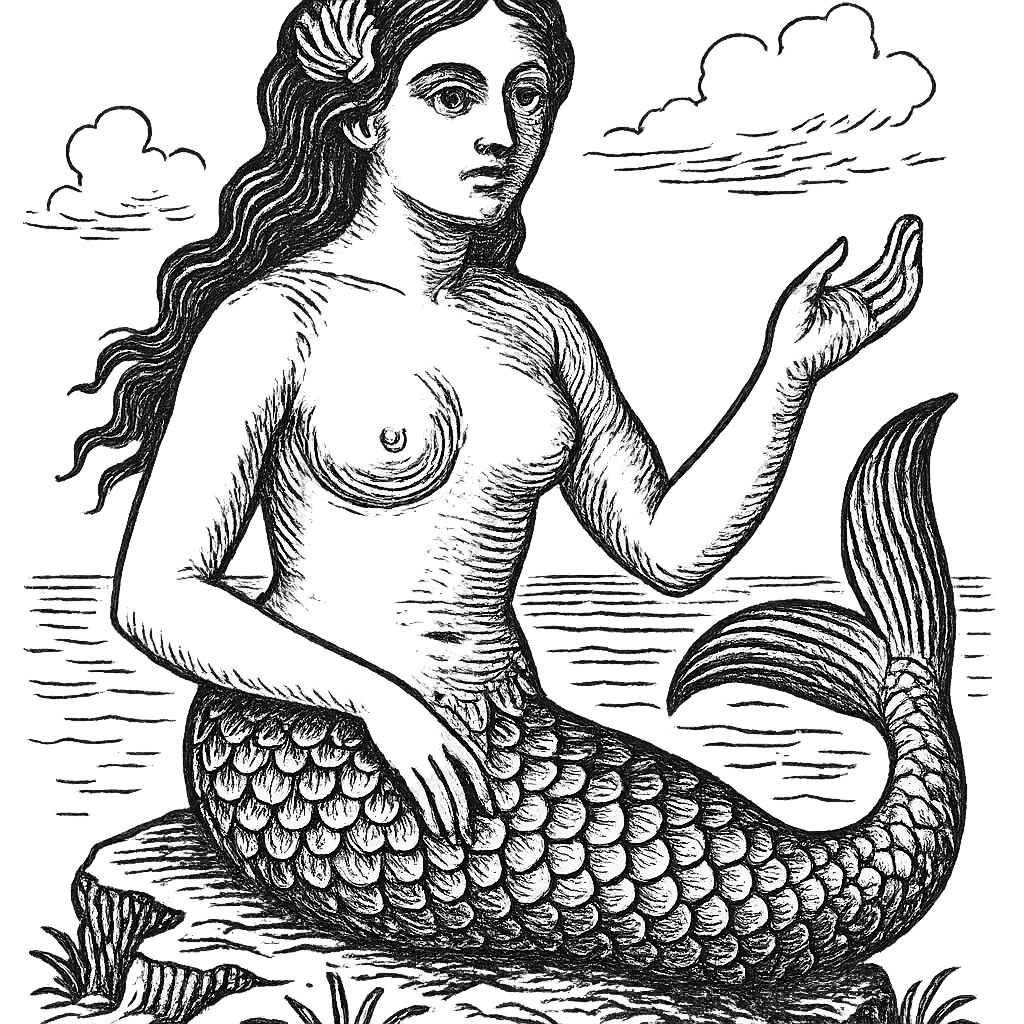
Vepar: The Forty-Second Spirit of the Ars Goetia
Vepar, also known as Vephar or Separ, appears in the Ars Goetia as the forty-second of seventy-two infernal spirits.
He holds the title of Great Duke of Hell, commanding twenty-nine legions of demons. His dominion over the sea makes him one of the few Goetic spirits tied directly to water and navigation.
Students of demonology view Vepar as a maritime figure reflecting both danger and discovery.
Origins in Demonological Texts
Vepar’s earliest references appear in Renaissance and early modern grimoires. The Ars Goetia, compiled in the seventeenth century, draws on earlier sources such as Johann Weyer’s Pseudomonarchia Daemonum (1577).
These works blend Christian theology, Jewish mysticism, and classical myth, forming the structured hierarchy later known as the Goetia.
Within this system, Vepar embodies the union of spiritual power and natural peril, symbolizing humankind’s struggle to master the elements.
Appearance and Powers
The Ars Goetia describes Vepar as a mermaid or merman, an image that underscores his rule over the oceans. He governs naval matters, guiding ships laden with weapons and supplies across treacherous waters.
His powers include stirring tempests, creating turbulent seas, and endangering fleets.
He also controls decay and disease, causing men to die within three days through pestilence and corruption.
Such imagery mirrors early modern fears of storms and infection, both of which threatened seafarers and explorers.
Beyond destruction, Vepar also represents knowledge of tides and currents. In symbolic interpretations, he governs the mysteries of transformation—birth, death, and renewal within the watery element.
Position in the Infernal Hierarchy
As a Great Duke, Vepar ranks high within Hell’s military order. His twenty-nine legions mark him as a commander of formidable strength.
The Ars Goetia portrays Hell as a mirrored monarchy with kings, dukes, princes, and knights. Vepar’s title and naval command suggest a structured bureaucracy reflecting earthly empires.
This organization allowed magicians to assign distinct domains to each demon, aligning ritual magic with Renaissance concepts of cosmic order.
Historical and Cultural Context
Vepar’s attributes reveal the concerns of the sixteenth and seventeenth centuries. During this era, maritime expansion defined power, commerce, and imagination.
The sea represented both opportunity and terror. Sailors faced storms, piracy, and disease, while nations sought control over vast oceans.
Vepar personified this duality—his blessings ensured safe passage, yet his wrath brought shipwreck and plague.
The motif of worm-infested death recalls medieval explanations of illness before germ theory. Worms symbolized internal corruption, linking physical decay to moral or spiritual sin.
Through such imagery, Vepar became a personification of divine retribution delivered through nature’s most uncontrollable force—the sea.
Comparison with Related Spirits
Among Goetic spirits, Vepar’s aquatic nature is unusual. While Dagon shares maritime roots through ancient Philistine myth, Vepar is distinctly destructive.
He contrasts with healing spirits like Buer or intellectual ones like Paimon.
Instead, his storms and plagues align him with Agares, who commands winds and earthquakes.
This specialization reinforces the Goetia’s taxonomy of demons, where each spirit controls a natural or metaphysical principle.
Symbolism and Modern Interpretation
Modern scholars interpret Vepar less as a literal being and more as a symbol of transformation. Water, in alchemical language, dissolves and purifies; it can both destroy and renew.
Thus, Vepar’s storms represent necessary upheaval—the destruction preceding rebirth.
Artists and occult theorists use him to explore themes of mortality, ambition, and the peril of exploration.
His legend endures because it mirrors human confrontation with the unknown depths of nature and the self.
Conclusion
Vepar, the maritime duke of the Ars Goetia, embodies the power and peril of the sea. His command over storms, decay, and navigation captures early modern Europe’s fascination with exploration and fear of nature’s wrath.
Through grimoires like the Pseudomonarchia Daemonum and Ars Goetia, he remains a vivid emblem of humanity’s attempt to master forces beyond control.
In every retelling, Vepar stands as both navigator and nemesis—a reminder that knowledge and destruction often sail the same tide.