The Fury That Breaks the Herd and the House
Aeshma is wrath once it has become an intelligence. He moves through drunken violence, blood-feud, cruelty and the sudden delight of breaking what cannot defend itself.
This record follows the presence through the traditions that preserved its name. Ancient sources, later commentaries and occult interpretations do not always reveal an identical form, yet the same current remains visible beneath their differences: a power recognized by what changes when it draws near.
Name and Identity
The name Aeshma has crossed languages, regions and ritual settings without losing the central force by which it is recognized. Spellings and titles vary, but the surviving forms—Aēšma, Eshm, Aeshma Daeva, Demon of the Wounding Spear—belong to a connected record rather than unrelated inventions.
The name also survives as Eshm, Aeshma Daeva, Demon of the Wounding Spear. These forms belong to the same entry unless a separate historical identity can be demonstrated.
The Oldest Record
Avestan texts name Aeshma among the most dangerous daevas and oppose him through Sraosha, the power of obedient hearing and disciplined order. His name later echoes through traditions connected with Asmodeus.
The oldest testimony does more than place a frightening being in the past. It establishes a territory, a hierarchy and a pattern of danger that later generations continued to recognize under changing names.
Nature and Dominion
He governs rage, assault, disorder, intoxicated violence and the destruction of communal peace.
Wrath — a traditional domain through which the entity’s influence is described and recognized.
Violence — a traditional domain through which the entity’s influence is described and recognized.
Drunken Disorder — a traditional domain through which the entity’s influence is described and recognized.
Blood-Feud — a traditional domain through which the entity’s influence is described and recognized.
The accumulated tradition should not be mistaken for one frozen doctrine. Each period exposes another aspect of the entity while preserving the central force by which it is known.
Manifestation
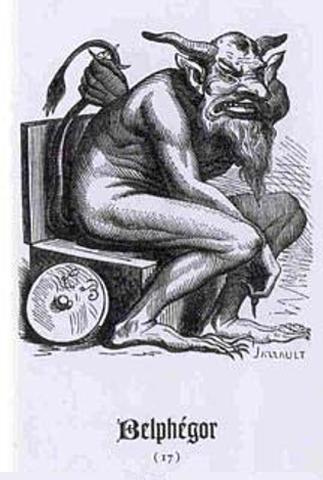
He appears as a red-eyed warrior carrying a bloodied mace, a shape surrounded by the sound of fighting, or a heat that enters the head before reason collapses.
A manifestation is not limited to a visible body. Atmosphere, recurrent dreams, disturbances in animals, changes of voice and altered behaviour may precede the form later witnesses attempt to describe.
Signs of Presence
Anger arriving without proportion — a recurring sign preserved in lore, testimony or later occult interpretation.
Weapons handled compulsively — a recurring sign preserved in lore, testimony or later occult interpretation.
Animals panicking at raised voices — a recurring sign preserved in lore, testimony or later occult interpretation.
Dreams of a mace striking a door repeatedly — a recurring sign preserved in lore, testimony or later occult interpretation.
Within the tradition, the pattern matters more than an isolated disturbance: repetition, convergence and the impression that separate signs have begun to move with one intention.
Rites and Occult Traditions
Zoroastrian tradition opposes Aeshma with Sraosha, sacred recitation, wakefulness and obedience to truth. The conflict is between fury that cannot hear and the spiritual faculty that listens.
Protective, exorcistic, devotional and adversarial approaches may exist side by side. Their differences reveal how each culture understood the entity’s authority, danger and place in the invisible order.
Dangers
Aeshma turns injury into identity. Under his pressure, the offended person no longer wants justice; only the continuation of wrath feels alive.
The oldest warnings treat contact as consequential. The danger does not end when the apparition withdraws; it may remain as altered desire, damaged judgment, recurring dreams or a relationship that has begun to serve the presence.
Transformation Through History
His name and function travel into later demonology, but the Avestan figure remains a precise embodiment of violent fury opposed by spiritual discipline.
Later literature and popular culture often magnify one feature while erasing another. The authoritative record must preserve those later transformations without allowing them to replace the earliest surviving identity.
Related Entities
Sraosha — a connected presence, adversary, host or occult current within the surrounding tradition.
Angra Mainyu — a connected presence, adversary, host or occult current within the surrounding tradition.
Asmoday — a connected presence, adversary, host or occult current within the surrounding tradition.
Druj — a connected presence, adversary, host or occult current within the surrounding tradition.
Daevas — a connected presence, adversary, host or occult current within the surrounding tradition.