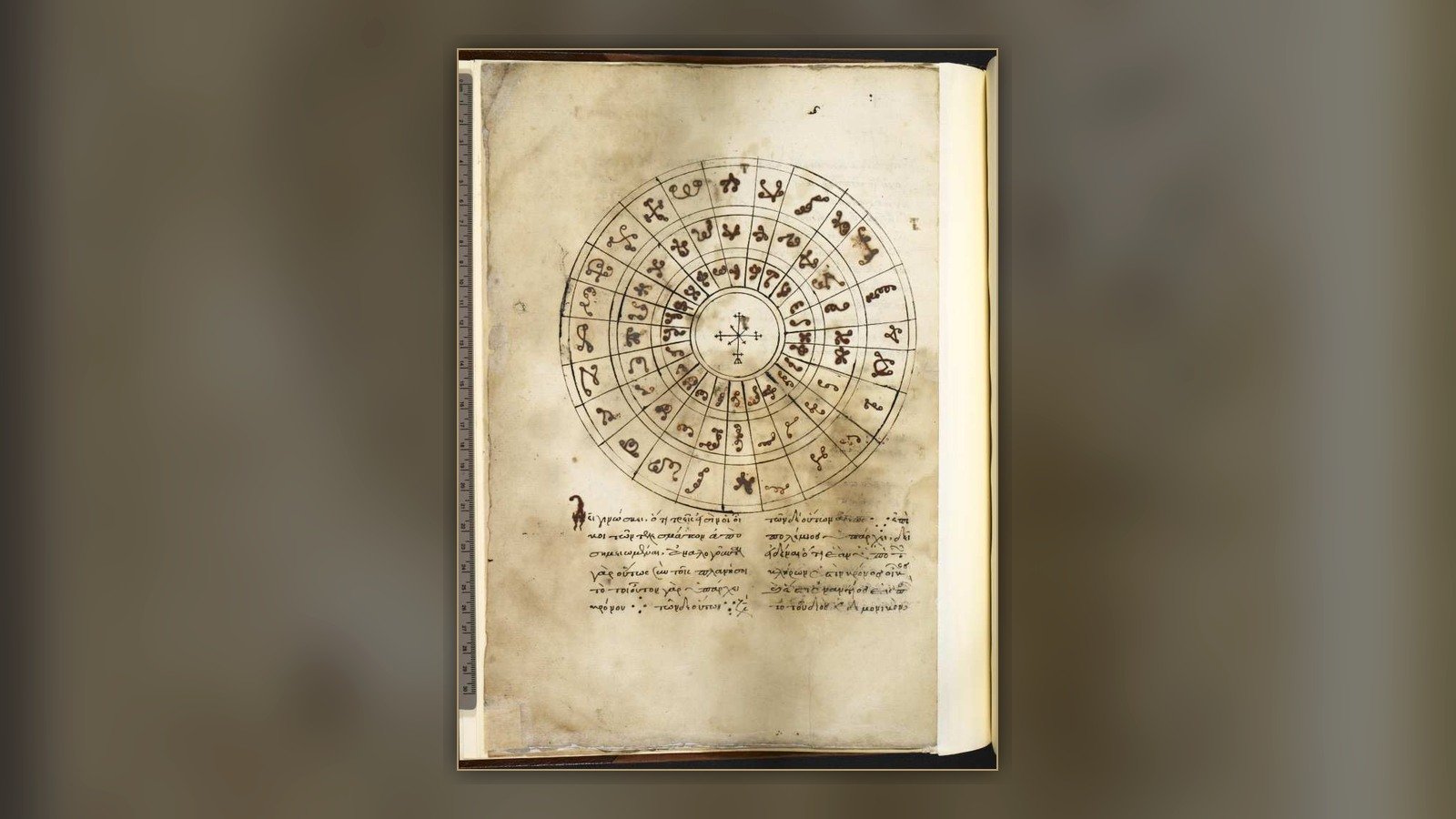
A fifteenth-century folio in the British Library opens onto a tradition far older than the manuscript that contains it. Written in Greek and attributed to Solomon, the work now called the Hygromanteia gathers planetary timing, ritual tools, circles, divination, prayers and spirit operations into a form that stands behind much of later European Solomonic magic. It is not one immutable book. It is a moving archive whose sections changed as they crossed centuries, regions and languages.
A Book Without a Single Final Form
The name Hygromanteia is a modern scholarly convenience for a family of Greek texts also described as the Magical Treatise of Solomon. No surviving manuscript can be treated as the single original. Copies differ in sequence, contents and completeness, and some transmit material that is absent from others.
The witnesses include British Library Harley MS 5596, Bologna University Library MS 3632, manuscripts in Athens, Paris and Munich, and other related compilations. Most surviving copies are late medieval or early modern, but their vocabulary and techniques preserve older layers.
This instability is essential rather than accidental. Solomonic magic developed through workshops of copying and adaptation, not through the publication of a canonical edition.
This section matters within the history of Hygromanteia because it joins a textual claim to a recoverable practice of copying, ownership or institutional control. The archive cannot verify every promised supernatural effect, but it can establish who preserved the words, how the material was arranged and which later traditions inherited its structure.
The surviving evidence must be read at the level of the individual witness. Titles migrate, manuscripts combine unrelated works, and later editors normalize spellings that a copyist left unstable. Shelf mark, folio and date are therefore not decorative citations; they are the controls that keep a famous occult name attached to a real object.
Solomon as the Master of Hidden Arts
The attribution to King Solomon gives the book a sacred genealogy. Medieval readers knew Solomon as the biblical king of wisdom, while Jewish, Christian, Byzantine and Islamic traditions expanded that wisdom into command over spirits, animals, winds and secret knowledge.
Pseudonymous attribution did not require readers to believe that the physical manuscript had been written by Solomon’s hand. It placed the operations under a legendary authority whose wisdom could reconcile forbidden technique with biblical history.
The royal name also imposed hierarchy. Spirits were not approached as equals; they were constrained within a cosmos supposedly ordered by divine names, angelic powers and the inherited wisdom of the king.
This section matters within the history of Hygromanteia because it joins a textual claim to a recoverable practice of copying, ownership or institutional control. The archive cannot verify every promised supernatural effect, but it can establish who preserved the words, how the material was arranged and which later traditions inherited its structure.
Later occult publishing often produces a clean, continuous text from several damaged or divergent witnesses. That work can make a tradition readable, but it may conceal the decisions of editors. Comparing the edition with a catalogue and image restores omissions, marginalia, layout and the physical sequence in which a historical reader encountered the material.
Harley MS 5596 and the Material Witness
Harley MS 5596 is a fifteenth-century Greek manuscript preserved by the British Library. Its folios contain divinations, astrological procedures and ritual material associated with the Magical Treatise of Solomon. The physical page shows compact script, practical arrangement and the marks of a working compilation rather than a luxury display volume.
The manuscript’s date does not date every operation it contains. A copy can be late while preserving earlier recipes, names and structures. Comparison with other Greek witnesses allows scholars to identify shared cores and later additions.
The object therefore gives the tradition a precise archival body. It prevents the Hygromanteia from dissolving into the vague phrase “ancient magic” and anchors it in a specific scribal culture.
This section matters within the history of Hygromanteia because it joins a textual claim to a recoverable practice of copying, ownership or institutional control. The archive cannot verify every promised supernatural effect, but it can establish who preserved the words, how the material was arranged and which later traditions inherited its structure.
Claims of great antiquity require special care. A manuscript may preserve old material while being physically much later, and a legendary attribution may express authority rather than authorship. Separating date of object, date of textual layer and mythical origin produces a stronger history than accepting or dismissing the tradition as a whole.
Planetary Hours and the Architecture of Time
Many operations depend on planetary days and hours. The practitioner is instructed to align a work with a celestial ruler, selecting a time whose qualities correspond to the desired result. Timing is not decoration; it is part of the mechanism.
The book assumes that the heavens distribute qualities through recurring cycles. Saturn, Jupiter, Mars, the Sun, Venus, Mercury and the Moon govern different dispositions, materials and classes of action. Astrological tables convert the sky into a ritual calendar.
This architecture later became familiar in Western grimoires. The Hygromanteia shows that the Key of Solomon’s concern with timing emerged from a deeper Byzantine and Mediterranean technical tradition.
This section matters within the history of Hygromanteia because it joins a textual claim to a recoverable practice of copying, ownership or institutional control. The archive cannot verify every promised supernatural effect, but it can establish who preserved the words, how the material was arranged and which later traditions inherited its structure.
Every act of copying is evidence of valuation. Paper, ink and time were spent because someone considered the material useful, dangerous, prestigious or worthy of preservation. Even where performance cannot be demonstrated, transmission itself is a documented historical action with social and intellectual consequences.
Tools, Inks and Consecrated Matter
The text pays close attention to knives, pens, inks, parchment, vessels, garments and other implements. Objects must be made or acquired under proper conditions, purified, named and sometimes inscribed. The ritual depends upon matter disciplined by procedure.
Such instructions reveal the practical economics of magic. A reader needed access to metals, animal substances, pigments, incense and craft knowledge. The grimoire presupposes a network of artisans and materials even when it imagines a solitary operator.
The later Key of Solomon preserves the same conviction: power is not only spoken. It is built into tools through sequence, timing, prayer and sign.
This section matters within the history of Hygromanteia because it joins a textual claim to a recoverable practice of copying, ownership or institutional control. The archive cannot verify every promised supernatural effect, but it can establish who preserved the words, how the material was arranged and which later traditions inherited its structure.
Images must also be identified precisely. A related seal, later title page or parallel manuscript can illuminate the subject, but it should not be called the exact folio when it is not. This article distinguishes contextual imagery from direct facsimile so that atmosphere never replaces provenance.
Circles, Directions and the Controlled Space
Protective circles and directional arrangements establish a temporary world inside the working place. Divine names, crosses, characters or prayers define boundaries. The operator occupies a centre from which the surrounding powers are ordered and addressed.
The circle is both protection and diagram. It separates the consecrated interior from the uncertain exterior while mapping a hierarchy of names around the body. Its geometry makes invisible relationships visible.
Later Solomonic manuscripts elaborated these designs, but the underlying logic is already present: ritual success requires a space constructed as carefully as the tool or invocation.
This section matters within the history of Hygromanteia because it joins a textual claim to a recoverable practice of copying, ownership or institutional control. The archive cannot verify every promised supernatural effect, but it can establish who preserved the words, how the material was arranged and which later traditions inherited its structure.
The surviving evidence must be read at the level of the individual witness. Titles migrate, manuscripts combine unrelated works, and later editors normalize spellings that a copyist left unstable. Shelf mark, folio and date are therefore not decorative citations; they are the controls that keep a famous occult name attached to a real object.
Divination Before Evocation
The Hygromanteia includes methods for obtaining knowledge through lots, bowls, mirrors, dreams, celestial signs and other forms of divination. These procedures are not secondary curiosities. They belong to the same search for access to hidden causes.
Some operations seek answers without demanding the visible appearance of a spirit. Others use an intermediary, image or reflective surface. The tradition therefore spans a spectrum from technical astrology to explicitly spirit-mediated revelation.
This breadth explains why the text travelled so effectively. A copyist could select useful divinatory material while omitting more dangerous conjurations, producing a new manuscript with a different threshold of risk.
This section matters within the history of Hygromanteia because it joins a textual claim to a recoverable practice of copying, ownership or institutional control. The archive cannot verify every promised supernatural effect, but it can establish who preserved the words, how the material was arranged and which later traditions inherited its structure.
Later occult publishing often produces a clean, continuous text from several damaged or divergent witnesses. That work can make a tradition readable, but it may conceal the decisions of editors. Comparing the edition with a catalogue and image restores omissions, marginalia, layout and the physical sequence in which a historical reader encountered the material.
From Greek Manuscripts to the Key of Solomon
Scholars have identified close structural and textual relationships between the Greek Magical Treatise of Solomon and later forms of the Clavicula Salomonis. The transmission was not a simple one-time translation. Motifs, chapters and procedures moved through multiple recensions and languages.
Greek, Italian and Latin environments all contributed to the transformation. As the text travelled west, prayers were adapted, diagrams redrawn and local ritual vocabulary introduced. What later appeared as a European grimoire retained a Byzantine skeleton.
The Hygromanteia is therefore one of the most important missing links in the history of ceremonial magic. It reveals that the Key of Solomon was inherited, assembled and repeatedly rewritten.
This section matters within the history of Hygromanteia because it joins a textual claim to a recoverable practice of copying, ownership or institutional control. The archive cannot verify every promised supernatural effect, but it can establish who preserved the words, how the material was arranged and which later traditions inherited its structure.
Claims of great antiquity require special care. A manuscript may preserve old material while being physically much later, and a legendary attribution may express authority rather than authorship. Separating date of object, date of textual layer and mythical origin produces a stronger history than accepting or dismissing the tradition as a whole.
The Manuscript That Refuses a Beginning
No surviving witness allows a historian to point to the exact day when the tradition began. The oldest layers reach toward late antique and Graeco-Egyptian practices, while the manuscripts themselves belong to medieval Byzantine culture. The absence of an autograph is normal for a living technical tradition.
What survives is a chain of evidence: shared recipes, repeated names, parallel tool consecrations, planetary structures and recognizable ritual sequences. The chain is strong even where individual links remain uncertain.
The darkness of the Hygromanteia lies partly in this depth. Behind every preserved page stands another lost copy, another workshop and another reader who altered the book before passing it onward.
This section matters within the history of Hygromanteia because it joins a textual claim to a recoverable practice of copying, ownership or institutional control. The archive cannot verify every promised supernatural effect, but it can establish who preserved the words, how the material was arranged and which later traditions inherited its structure.
Every act of copying is evidence of valuation. Paper, ink and time were spent because someone considered the material useful, dangerous, prestigious or worthy of preservation. Even where performance cannot be demonstrated, transmission itself is a documented historical action with social and intellectual consequences.
The Book as Historical Evidence
The enduring power of Hygromanteia comes from the meeting of claim and object. A legendary author, celestial teacher or infernal hierarchy may dominate the title, but the historical work begins with paper, parchment, handwriting, type, pigment, binding and custody. These features identify when a witness could have been made and how it passed from one set of hands to another.
Provenance also changes meaning. A ritual text in a private notebook, a confiscated bundle in a court file and the same leaves in a national library are not socially identical objects. Each setting imposes a new interpretation: tool, evidence, curiosity, pathology, heritage or research source. Forbidden history is the sequence of those transformations.
The featured image used here is an authentic historical reproduction connected directly to the subject or, where explicitly stated, to the precise manuscript tradition discussed. It has been framed for a modern 16:9 website format without replacing the central archival image. Credit and reuse status are recorded in the package ledger.
What the Archive Refused to Lose
The Hygromanteia and the Lost Roots of Solomonic Magic ultimately survives because prohibition never operated alone. Copyists, collectors, physicians, clergy, defendants, censors and librarians all participated in transmission, sometimes while condemning the material they preserved. Their motives were different, but the cumulative result is a record that can still be examined rather than merely repeated as legend.
The most responsible occult history does not drain mystery from the source. It replaces vague mystery with exact strangeness: a named shelf mark, an unexpected language, a corrected spirit name, an erased line, a later hand in the margin, a printed prohibition or a diagram copied by someone whose identity has disappeared. These details are darker than invention because they belong to the surviving object.
Reading the Surviving Witnesses
Researchers approaching Hygromanteia should separate the physical witness from the modern title used to group it. Catalogue descriptions establish dimensions, support, script, foliation and the works bound before and after the relevant text. Those details often reveal whether the item was planned as a coherent book or assembled from papers with independent histories.
Transcription creates another layer. Unfamiliar names can be altered by a single misread letter, especially when Greek, Hebrew, Latin, French, German or invented ritual syllables cross scripts. Variant spelling should therefore be recorded rather than silently corrected, because the history of error is part of the transmission of Hygromanteia.
Digital access has transformed this field by allowing a reader to compare image and edition across institutions. It has not abolished the need for caution. Colour balance, cropped edges, missing blanks and online metadata can affect interpretation, while some composite volumes remain only partially photographed.
The strongest account combines primary witness, institutional catalogue and specialist scholarship. Popular retellings are useful for tracing cultural memory, but they should not be allowed to replace the source that created the story. This hierarchy of evidence gives the narrative depth without turning it into a debunking exercise.
Researchers approaching Hygromanteia should separate the physical witness from the modern title used to group it. Catalogue descriptions establish dimensions, support, script, foliation and the works bound before and after the relevant text. Those details often reveal whether the item was planned as a coherent book or assembled from papers with independent histories.