Across only a few folios in a Cambridge manuscript, a procession of spirits enters the record: kings, dukes, marquises and presidents, each assigned an appearance, an office and a number of infernal legions. The Livre des Esperitz is compact, but its importance is immense. It preserves one of the earliest complete French catalogues of demons and stands near the ancestry of Johann Weyer’s Pseudomonarchia Daemonum and the later Ars Goetia.
Four Folios in Trinity College
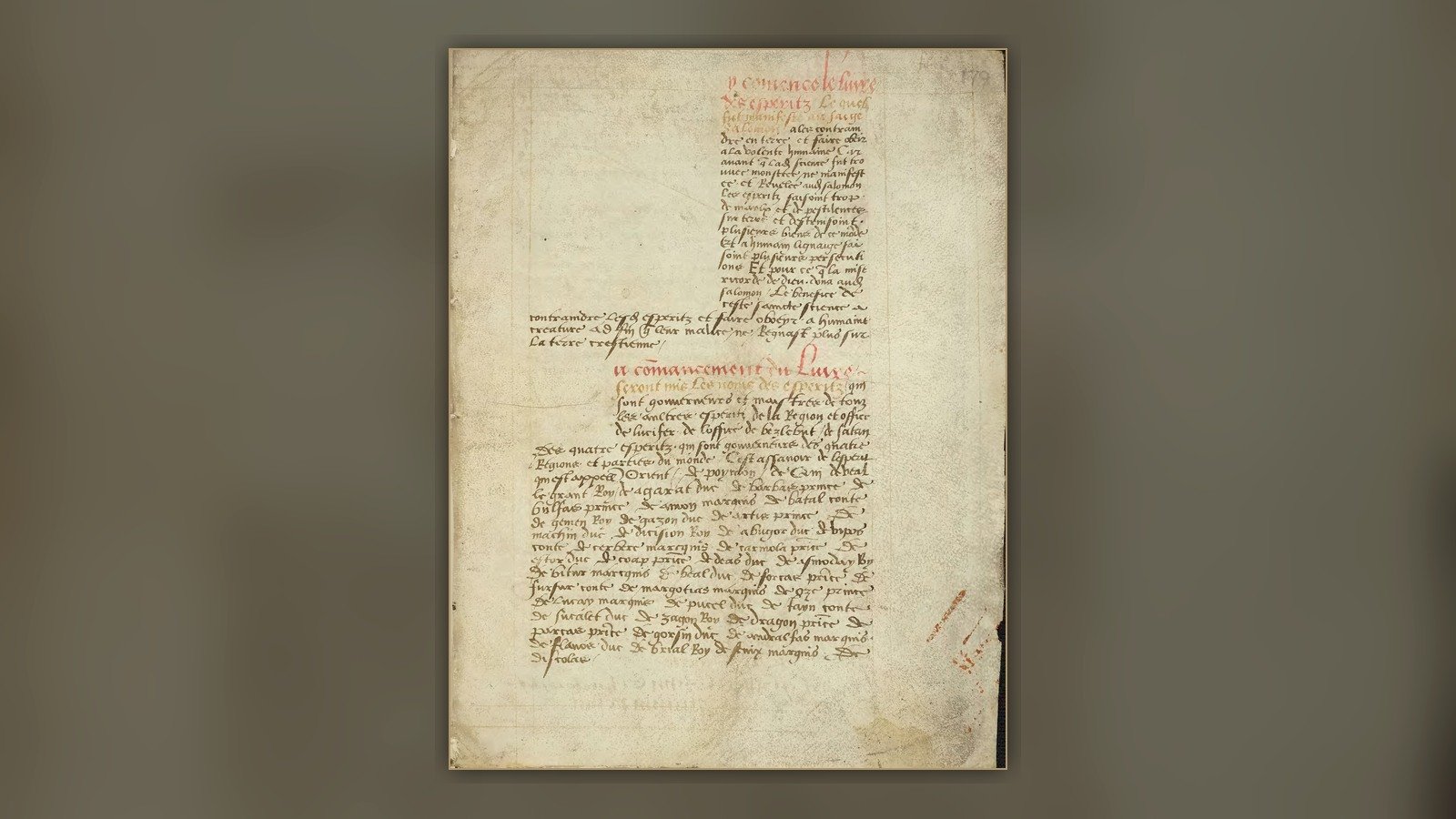
The surviving Livre des Esperitz occupies folios 179r to 182v of Trinity College Cambridge MS O.8.29. The copy is generally placed in the middle of the sixteenth century, although the text it transmits is understood to derive from an older tradition.
The catalogue sits inside a larger composite manuscript rather than as an independent bound grimoire. This setting matters: practical and demonological texts were often preserved by being inserted among other material, where ownership and purpose could be less obvious.
The physical brevity of the work should not be confused with marginal importance. A few leaves can preserve the genealogy of a tradition later expanded into entire printed demonologies.
This section matters within the history of Livre des Esperitz because it joins a textual claim to a recoverable practice of copying, ownership or institutional control. The archive cannot verify every promised supernatural effect, but it can establish who preserved the words, how the material was arranged and which later traditions inherited its structure.
The surviving evidence must be read at the level of the individual witness. Titles migrate, manuscripts combine unrelated works, and later editors normalize spellings that a copyist left unstable. Shelf mark, folio and date are therefore not decorative citations; they are the controls that keep a famous occult name attached to a real object.
French for a Working Reader
The text is written in French rather than learned Latin. Its direct language suggests a reader who needed usable descriptions and offices more than theological argument. The entries move with the economy of a handbook.
The vernacular lowers one barrier while increasing another danger. Knowledge that might once have required clerical education could circulate among literate artisans, court servants or practical experimenters.
The Livre des Esperitz belongs to the moment when ritual knowledge crossed from restricted scholarly languages into forms that could travel more widely.
This section matters within the history of Livre des Esperitz because it joins a textual claim to a recoverable practice of copying, ownership or institutional control. The archive cannot verify every promised supernatural effect, but it can establish who preserved the words, how the material was arranged and which later traditions inherited its structure.
Later occult publishing often produces a clean, continuous text from several damaged or divergent witnesses. That work can make a tradition readable, but it may conceal the decisions of editors. Comparing the edition with a catalogue and image restores omissions, marginalia, layout and the physical sequence in which a historical reader encountered the material.
A Hierarchy of Forty-Six Spirits
The manuscript describes forty-six named spirits. They appear under titles such as king, duke, marquis, count or president, and many command specified numbers of legions. Rank translates the invisible world into a courtly and military order.
The hierarchy is not purely decorative. Rank determines dignity, command and sometimes the conditions under which a spirit is approached. The infernal kingdom mirrors earthly structures familiar to the manuscript’s readers.
This administrative Hell later became one of ceremonial magic’s most recognizable features. The catalogue makes terror legible by arranging it.
This section matters within the history of Livre des Esperitz because it joins a textual claim to a recoverable practice of copying, ownership or institutional control. The archive cannot verify every promised supernatural effect, but it can establish who preserved the words, how the material was arranged and which later traditions inherited its structure.
Claims of great antiquity require special care. A manuscript may preserve old material while being physically much later, and a legendary attribution may express authority rather than authorship. Separating date of object, date of textual layer and mythical origin produces a stronger history than accepting or dismissing the tradition as a whole.
Bodies Made from Heraldry and Beasts
The spirits are described through composite forms: animals, monstrous bodies, armed riders, human faces and transformations. Appearance often signals office, but the relationship is not always straightforward.
Such descriptions draw on medieval bestiaries, heraldry, biblical demonology and oral imagination. A spirit can appear as a beast and then assume human form, implying that visible shape is a chosen mask rather than a stable body.
The entries are frightening because they are specific. A named figure with a rank, voice and function is more tangible than an abstract doctrine of evil.
This section matters within the history of Livre des Esperitz because it joins a textual claim to a recoverable practice of copying, ownership or institutional control. The archive cannot verify every promised supernatural effect, but it can establish who preserved the words, how the material was arranged and which later traditions inherited its structure.
Every act of copying is evidence of valuation. Paper, ink and time were spent because someone considered the material useful, dangerous, prestigious or worthy of preservation. Even where performance cannot be demonstrated, transmission itself is a documented historical action with social and intellectual consequences.
Offices of Knowledge and Destruction
The catalogue attributes powers over hidden treasure, languages, sciences, reconciliation, deception, travel, warfare and death. Some offices promise intellectual or practical benefits, while others are openly violent.
This mixture explains the enduring appeal of spirit lists. They present forbidden assistance as a specialized economy: one spirit for knowledge, another for favour, another for ruin.
The book does not offer a philosophical defence of these desires. It records them with the cold efficiency of an index.
This section matters within the history of Livre des Esperitz because it joins a textual claim to a recoverable practice of copying, ownership or institutional control. The archive cannot verify every promised supernatural effect, but it can establish who preserved the words, how the material was arranged and which later traditions inherited its structure.
Images must also be identified precisely. A related seal, later title page or parallel manuscript can illuminate the subject, but it should not be called the exact folio when it is not. This article distinguishes contextual imagery from direct facsimile so that atmosphere never replaces provenance.
The Conjuring Context Around the Catalogue
The broader manuscript environment and related texts contain conjurations, figures and procedures that place the list within ritual practice. A catalogue alone identifies powers; conjuration provides the grammar for addressing them.
Divine names and coercive formulas express a Christian magical paradox. The operator claims authority through sacred language while deliberately seeking beings understood as fallen or dangerous.
This tension is central to the Solomonic tradition. The magician does not worship the spirits in the text’s own logic; he attempts to command them through a superior name.
This section matters within the history of Livre des Esperitz because it joins a textual claim to a recoverable practice of copying, ownership or institutional control. The archive cannot verify every promised supernatural effect, but it can establish who preserved the words, how the material was arranged and which later traditions inherited its structure.
The surviving evidence must be read at the level of the individual witness. Titles migrate, manuscripts combine unrelated works, and later editors normalize spellings that a copyist left unstable. Shelf mark, folio and date are therefore not decorative citations; they are the controls that keep a famous occult name attached to a real object.
From French Manuscript to Johann Weyer
Johann Weyer printed a longer demon catalogue, the Pseudomonarchia Daemonum, as an appendix to De praestigiis daemonum. Scholars have traced significant relationships between Weyer’s list and the Livre des Esperitz or their common textual family.
Names, ranks, appearances and offices recur, but the printed sequence contains changes and additions. Transmission created new spellings and identities as copyists and printers interpreted unfamiliar names.
The comparison shows that demonology was not invented anew in the sixteenth century. Print exposed and reorganized a manuscript archive already in motion.
This section matters within the history of Livre des Esperitz because it joins a textual claim to a recoverable practice of copying, ownership or institutional control. The archive cannot verify every promised supernatural effect, but it can establish who preserved the words, how the material was arranged and which later traditions inherited its structure.
Later occult publishing often produces a clean, continuous text from several damaged or divergent witnesses. That work can make a tradition readable, but it may conceal the decisions of editors. Comparing the edition with a catalogue and image restores omissions, marginalia, layout and the physical sequence in which a historical reader encountered the material.
Before the Seventy-Two of the Goetia
The later Ars Goetia presents seventy-two spirits and a highly recognizable system of seals. The Livre des Esperitz contains fewer spirits and does not match that later work in every detail. It must not be described as a simple early edition of the Goetia.
Its importance is genealogical. It preserves forms that passed through Weyer and other channels into the seventeenth-century Lemegeton tradition. Similarity records descent, not identity.
Respecting the differences makes the history more powerful. The Goetia emerges not as a book suddenly revealed, but as the end of centuries of cataloguing and mutation.
This section matters within the history of Livre des Esperitz because it joins a textual claim to a recoverable practice of copying, ownership or institutional control. The archive cannot verify every promised supernatural effect, but it can establish who preserved the words, how the material was arranged and which later traditions inherited its structure.
Claims of great antiquity require special care. A manuscript may preserve old material while being physically much later, and a legendary attribution may express authority rather than authorship. Separating date of object, date of textual layer and mythical origin produces a stronger history than accepting or dismissing the tradition as a whole.
The Catalogue That Survived by Compression
The manuscript gives no complete biography of its compiler and no secure account of every stage before the Cambridge copy. The textual record nevertheless permits close comparison with later witnesses.
Every changed spelling, shifted rank and altered number of legions is evidence. These variations reveal how names were heard, copied and normalized across French, Latin and printed traditions.
The Livre des Esperitz survives like a compressed chamber. Open its few folios and the later architecture of the infernal hierarchy becomes visible in unfinished form.
This section matters within the history of Livre des Esperitz because it joins a textual claim to a recoverable practice of copying, ownership or institutional control. The archive cannot verify every promised supernatural effect, but it can establish who preserved the words, how the material was arranged and which later traditions inherited its structure.
Every act of copying is evidence of valuation. Paper, ink and time were spent because someone considered the material useful, dangerous, prestigious or worthy of preservation. Even where performance cannot be demonstrated, transmission itself is a documented historical action with social and intellectual consequences.
The Book as Historical Evidence
The enduring power of Livre des Esperitz comes from the meeting of claim and object. A legendary author, celestial teacher or infernal hierarchy may dominate the title, but the historical work begins with paper, parchment, handwriting, type, pigment, binding and custody. These features identify when a witness could have been made and how it passed from one set of hands to another.
Provenance also changes meaning. A ritual text in a private notebook, a confiscated bundle in a court file and the same leaves in a national library are not socially identical objects. Each setting imposes a new interpretation: tool, evidence, curiosity, pathology, heritage or research source. Forbidden history is the sequence of those transformations.
The featured image used here is an authentic historical reproduction connected directly to the subject or, where explicitly stated, to the precise manuscript tradition discussed. It has been framed for a modern 16:9 website format without replacing the central archival image. Credit and reuse status are recorded in the package ledger.
What the Archive Refused to Lose
The Livre des Esperitz Before the Ars Goetia ultimately survives because prohibition never operated alone. Copyists, collectors, physicians, clergy, defendants, censors and librarians all participated in transmission, sometimes while condemning the material they preserved. Their motives were different, but the cumulative result is a record that can still be examined rather than merely repeated as legend.
The most responsible occult history does not drain mystery from the source. It replaces vague mystery with exact strangeness: a named shelf mark, an unexpected language, a corrected spirit name, an erased line, a later hand in the margin, a printed prohibition or a diagram copied by someone whose identity has disappeared. These details are darker than invention because they belong to the surviving object.
Reading the Surviving Witnesses
Researchers approaching Livre des Esperitz should separate the physical witness from the modern title used to group it. Catalogue descriptions establish dimensions, support, script, foliation and the works bound before and after the relevant text. Those details often reveal whether the item was planned as a coherent book or assembled from papers with independent histories.
Transcription creates another layer. Unfamiliar names can be altered by a single misread letter, especially when Greek, Hebrew, Latin, French, German or invented ritual syllables cross scripts. Variant spelling should therefore be recorded rather than silently corrected, because the history of error is part of the transmission of Livre des Esperitz.
Digital access has transformed this field by allowing a reader to compare image and edition across institutions. It has not abolished the need for caution. Colour balance, cropped edges, missing blanks and online metadata can affect interpretation, while some composite volumes remain only partially photographed.
The strongest account combines primary witness, institutional catalogue and specialist scholarship. Popular retellings are useful for tracing cultural memory, but they should not be allowed to replace the source that created the story. This hierarchy of evidence gives the narrative depth without turning it into a debunking exercise.
Researchers approaching Livre des Esperitz should separate the physical witness from the modern title used to group it. Catalogue descriptions establish dimensions, support, script, foliation and the works bound before and after the relevant text. Those details often reveal whether the item was planned as a coherent book or assembled from papers with independent histories.
Transcription creates another layer. Unfamiliar names can be altered by a single misread letter, especially when Greek, Hebrew, Latin, French, German or invented ritual syllables cross scripts. Variant spelling should therefore be recorded rather than silently corrected, because the history of error is part of the transmission of Livre des Esperitz.
Digital access has transformed this field by allowing a reader to compare image and edition across institutions. It has not abolished the need for caution. Colour balance, cropped edges, missing blanks and online metadata can affect interpretation, while some composite volumes remain only partially photographed.
The strongest account combines primary witness, institutional catalogue and specialist scholarship. Popular retellings are useful for tracing cultural memory, but they should not be allowed to replace the source that created the story. This hierarchy of evidence gives the narrative depth without turning it into a debunking exercise.