A forbidden book did not disappear merely because its title entered an index. It could be locked away, corrected, read under licence, copied in secret or preserved in the very institution that condemned it. The Index Librorum Prohibitorum became the most famous instrument of Roman Catholic book control, but its relationship with magic was more complex than a single list of grimoires. Rules, local tribunals, theological judgments and expurgation all helped police the boundary of permissible knowledge.
Before the Roman Index
Church and civil authorities condemned books long before the sixteenth century. Manuscripts could be burned, propositions censured and authors punished, but enforcement was local and uneven.
The printing press transformed the problem. Hundreds of copies could cross borders faster than traditional review, while Reformation controversy made the control of doctrine an urgent political task.
The Index emerged from a broader struggle to govern mass-produced reading.
This section matters within the history of Index of Forbidden Books because it joins a textual claim to a recoverable practice of copying, ownership or institutional control. The archive cannot verify every promised supernatural effect, but it can establish who preserved the words, how the material was arranged and which later traditions inherited its structure.
The surviving evidence must be read at the level of the individual witness. Titles migrate, manuscripts combine unrelated works, and later editors normalize spellings that a copyist left unstable. Shelf mark, folio and date are therefore not decorative citations; they are the controls that keep a famous occult name attached to a real object.
The Roman Index of 1559
Pope Paul IV’s 1559 Roman Index was severe, prohibiting authors and categories of works on a scale that alarmed even some Catholic scholars. It reflected the hard atmosphere of confessional conflict.
The list did not function as a neutral bibliography. It linked reading to obedience and placed printers, booksellers, teachers and owners within a regulatory system.
Possession could become evidence of disloyalty even when a book had been acquired for study.
This section matters within the history of Index of Forbidden Books because it joins a textual claim to a recoverable practice of copying, ownership or institutional control. The archive cannot verify every promised supernatural effect, but it can establish who preserved the words, how the material was arranged and which later traditions inherited its structure.
Later occult publishing often produces a clean, continuous text from several damaged or divergent witnesses. That work can make a tradition readable, but it may conceal the decisions of editors. Comparing the edition with a catalogue and image restores omissions, marginalia, layout and the physical sequence in which a historical reader encountered the material.
The Tridentine Index and Its Rules
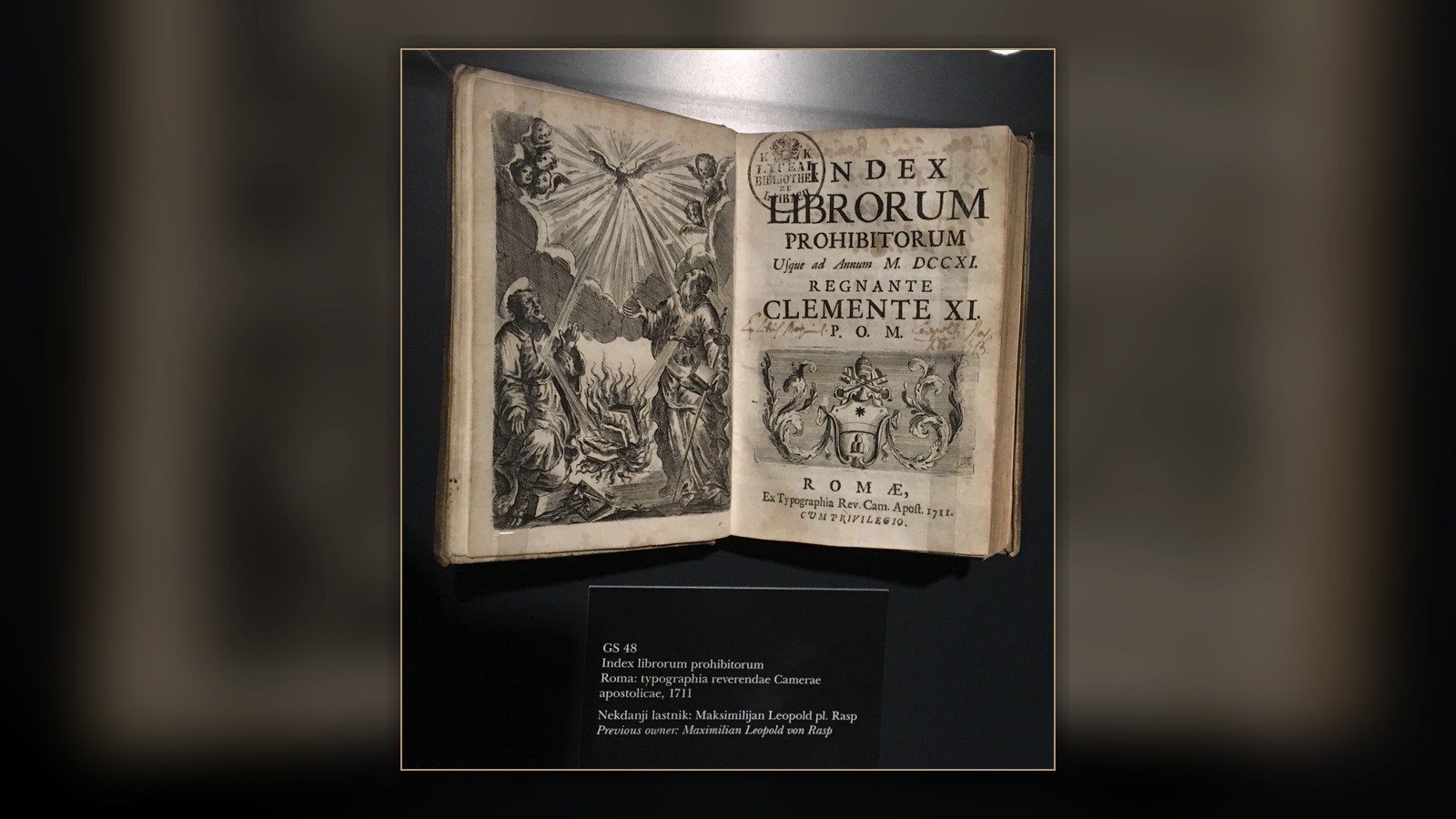
After the Council of Trent, a revised Index appeared in 1564 with ten general rules. These rules addressed categories of writing beyond individually named titles.
Rule IX prohibited books dealing with practices such as geomancy, hydromancy, aeromancy, pyromancy, onomancy, chiromancy, necromancy and related divinations, while allowing some forms of natural observation under controlled interpretation.
The category rule mattered deeply for magic. A work could be forbidden by content even if no censor had listed its exact title.
This section matters within the history of Index of Forbidden Books because it joins a textual claim to a recoverable practice of copying, ownership or institutional control. The archive cannot verify every promised supernatural effect, but it can establish who preserved the words, how the material was arranged and which later traditions inherited its structure.
Claims of great antiquity require special care. A manuscript may preserve old material while being physically much later, and a legendary attribution may express authority rather than authorship. Separating date of object, date of textual layer and mythical origin produces a stronger history than accepting or dismissing the tradition as a whole.
The Congregation of the Index
A permanent Congregation of the Index emerged in the 1570s, formally associated with examining suspect books, preparing editions and deciding whether works could be corrected or must be prohibited.
The institution worked beside the Roman Inquisition rather than replacing it. Jurisdictions overlapped, and local bishops or states could enforce censorship differently.
The history is administrative as well as theological: files, consultations and decrees transformed intellectual danger into procedure.
This section matters within the history of Index of Forbidden Books because it joins a textual claim to a recoverable practice of copying, ownership or institutional control. The archive cannot verify every promised supernatural effect, but it can establish who preserved the words, how the material was arranged and which later traditions inherited its structure.
Every act of copying is evidence of valuation. Paper, ink and time were spent because someone considered the material useful, dangerous, prestigious or worthy of preservation. Even where performance cannot be demonstrated, transmission itself is a documented historical action with social and intellectual consequences.
Magic, Divination and Unauthorized Revelation
Books promising spirit evocation, treasure finding, astrology beyond accepted limits, necromancy or supernatural revelation raised several concerns at once. They could invoke demons, misuse sacred names and claim knowledge outside ecclesiastical authority.
Not every occult text was indexed by title. Some circulated too obscurely, remained in manuscript or fell under general prohibitions. Absence from a printed Index does not prove approval.
The censor’s map was always incomplete, which made category rules and local judgment essential.
This section matters within the history of Index of Forbidden Books because it joins a textual claim to a recoverable practice of copying, ownership or institutional control. The archive cannot verify every promised supernatural effect, but it can establish who preserved the words, how the material was arranged and which later traditions inherited its structure.
Images must also be identified precisely. A related seal, later title page or parallel manuscript can illuminate the subject, but it should not be called the exact folio when it is not. This article distinguishes contextual imagery from direct facsimile so that atmosphere never replaces provenance.
Expurgation: Correcting Instead of Destroying
Some works could be permitted after passages were deleted or rewritten. Expurgatory indexes identified sentences, chapters or names to remove, allowing useful learning to survive in a purified form.
Owners sometimes crossed out prohibited sections by hand. The damaged page becomes direct evidence of censorship: ink, knife or pasted paper records the encounter between reader and decree.
Expurgation reveals that control was selective. Authorities often wanted to discipline knowledge rather than eliminate every book containing it.
This section matters within the history of Index of Forbidden Books because it joins a textual claim to a recoverable practice of copying, ownership or institutional control. The archive cannot verify every promised supernatural effect, but it can establish who preserved the words, how the material was arranged and which later traditions inherited its structure.
The surviving evidence must be read at the level of the individual witness. Titles migrate, manuscripts combine unrelated works, and later editors normalize spellings that a copyist left unstable. Shelf mark, folio and date are therefore not decorative citations; they are the controls that keep a famous occult name attached to a real object.
Licences and Restricted Readers
Permission to read prohibited books could be granted to qualified scholars, theologians or officials. Access depended on office, purpose and trust rather than on a universal rule applied equally to every reader.
This hierarchy created forbidden libraries inside institutions charged with guarding orthodoxy. A text could be dangerous for the public and necessary for the censor investigating it.
Control of knowledge therefore relied on controlling the reader as much as the page.
This section matters within the history of Index of Forbidden Books because it joins a textual claim to a recoverable practice of copying, ownership or institutional control. The archive cannot verify every promised supernatural effect, but it can establish who preserved the words, how the material was arranged and which later traditions inherited its structure.
Later occult publishing often produces a clean, continuous text from several damaged or divergent witnesses. That work can make a tradition readable, but it may conceal the decisions of editors. Comparing the edition with a catalogue and image restores omissions, marginalia, layout and the physical sequence in which a historical reader encountered the material.
The 1897 Constitution Officiorum ac Munerum
Pope Leo XIII reorganized book-censorship rules in the 1897 apostolic constitution Officiorum ac munerum. The document continued prohibitions on books teaching or recommending superstition, divination, magic and spirit invocation.
The late date demonstrates that occult literature was not only an early modern concern. Spiritualism, modern esotericism and new print markets renewed older anxieties.
The Index adapted its language while preserving the central claim that some knowledge harmed faith and morals by circulation alone.
This section matters within the history of Index of Forbidden Books because it joins a textual claim to a recoverable practice of copying, ownership or institutional control. The archive cannot verify every promised supernatural effect, but it can establish who preserved the words, how the material was arranged and which later traditions inherited its structure.
Claims of great antiquity require special care. A manuscript may preserve old material while being physically much later, and a legendary attribution may express authority rather than authorship. Separating date of object, date of textual layer and mythical origin produces a stronger history than accepting or dismissing the tradition as a whole.
1966 and the End of Juridical Force
In 1966 the Congregation for the Doctrine of the Faith announced that the Index no longer had juridical force with ecclesiastical penalties. The notification did not declare every listed book wise or harmless; it shifted responsibility toward conscience and general moral law.
The formal mechanism ended after more than four centuries, but library marks, censored editions and archival files remain. They allow historians to reconstruct what authorities feared and what readers continued to seek.
The Index’s final legacy is paradoxical. By naming dangerous books and preserving censorship records, it created one of history’s largest maps of forbidden reading.
This section matters within the history of Index of Forbidden Books because it joins a textual claim to a recoverable practice of copying, ownership or institutional control. The archive cannot verify every promised supernatural effect, but it can establish who preserved the words, how the material was arranged and which later traditions inherited its structure.
Every act of copying is evidence of valuation. Paper, ink and time were spent because someone considered the material useful, dangerous, prestigious or worthy of preservation. Even where performance cannot be demonstrated, transmission itself is a documented historical action with social and intellectual consequences.
The Book as Historical Evidence
The enduring power of Index of Forbidden Books comes from the meeting of claim and object. A legendary author, celestial teacher or infernal hierarchy may dominate the title, but the historical work begins with paper, parchment, handwriting, type, pigment, binding and custody. These features identify when a witness could have been made and how it passed from one set of hands to another.
Provenance also changes meaning. A ritual text in a private notebook, a confiscated bundle in a court file and the same leaves in a national library are not socially identical objects. Each setting imposes a new interpretation: tool, evidence, curiosity, pathology, heritage or research source. Forbidden history is the sequence of those transformations.
The featured image used here is an authentic historical reproduction connected directly to the subject or, where explicitly stated, to the precise manuscript tradition discussed. It has been framed for a modern 16:9 website format without replacing the central archival image. Credit and reuse status are recorded in the package ledger.
What the Archive Refused to Lose
The Index of Forbidden Books and the Policing of Magic ultimately survives because prohibition never operated alone. Copyists, collectors, physicians, clergy, defendants, censors and librarians all participated in transmission, sometimes while condemning the material they preserved. Their motives were different, but the cumulative result is a record that can still be examined rather than merely repeated as legend.
The most responsible occult history does not drain mystery from the source. It replaces vague mystery with exact strangeness: a named shelf mark, an unexpected language, a corrected spirit name, an erased line, a later hand in the margin, a printed prohibition or a diagram copied by someone whose identity has disappeared. These details are darker than invention because they belong to the surviving object.
Reading the Surviving Witnesses
Researchers approaching Index of Forbidden Books should separate the physical witness from the modern title used to group it. Catalogue descriptions establish dimensions, support, script, foliation and the works bound before and after the relevant text. Those details often reveal whether the item was planned as a coherent book or assembled from papers with independent histories.
Transcription creates another layer. Unfamiliar names can be altered by a single misread letter, especially when Greek, Hebrew, Latin, French, German or invented ritual syllables cross scripts. Variant spelling should therefore be recorded rather than silently corrected, because the history of error is part of the transmission of Index of Forbidden Books.
Digital access has transformed this field by allowing a reader to compare image and edition across institutions. It has not abolished the need for caution. Colour balance, cropped edges, missing blanks and online metadata can affect interpretation, while some composite volumes remain only partially photographed.
The strongest account combines primary witness, institutional catalogue and specialist scholarship. Popular retellings are useful for tracing cultural memory, but they should not be allowed to replace the source that created the story. This hierarchy of evidence gives the narrative depth without turning it into a debunking exercise.
Researchers approaching Index of Forbidden Books should separate the physical witness from the modern title used to group it. Catalogue descriptions establish dimensions, support, script, foliation and the works bound before and after the relevant text. Those details often reveal whether the item was planned as a coherent book or assembled from papers with independent histories.
Transcription creates another layer. Unfamiliar names can be altered by a single misread letter, especially when Greek, Hebrew, Latin, French, German or invented ritual syllables cross scripts. Variant spelling should therefore be recorded rather than silently corrected, because the history of error is part of the transmission of Index of Forbidden Books.
Digital access has transformed this field by allowing a reader to compare image and edition across institutions. It has not abolished the need for caution. Colour balance, cropped edges, missing blanks and online metadata can affect interpretation, while some composite volumes remain only partially photographed.
The strongest account combines primary witness, institutional catalogue and specialist scholarship. Popular retellings are useful for tracing cultural memory, but they should not be allowed to replace the source that created the story. This hierarchy of evidence gives the narrative depth without turning it into a debunking exercise.
Researchers approaching Index of Forbidden Books should separate the physical witness from the modern title used to group it. Catalogue descriptions establish dimensions, support, script, foliation and the works bound before and after the relevant text. Those details often reveal whether the item was planned as a coherent book or assembled from papers with independent histories.
Transcription creates another layer. Unfamiliar names can be altered by a single misread letter, especially when Greek, Hebrew, Latin, French, German or invented ritual syllables cross scripts. Variant spelling should therefore be recorded rather than silently corrected, because the history of error is part of the transmission of Index of Forbidden Books.