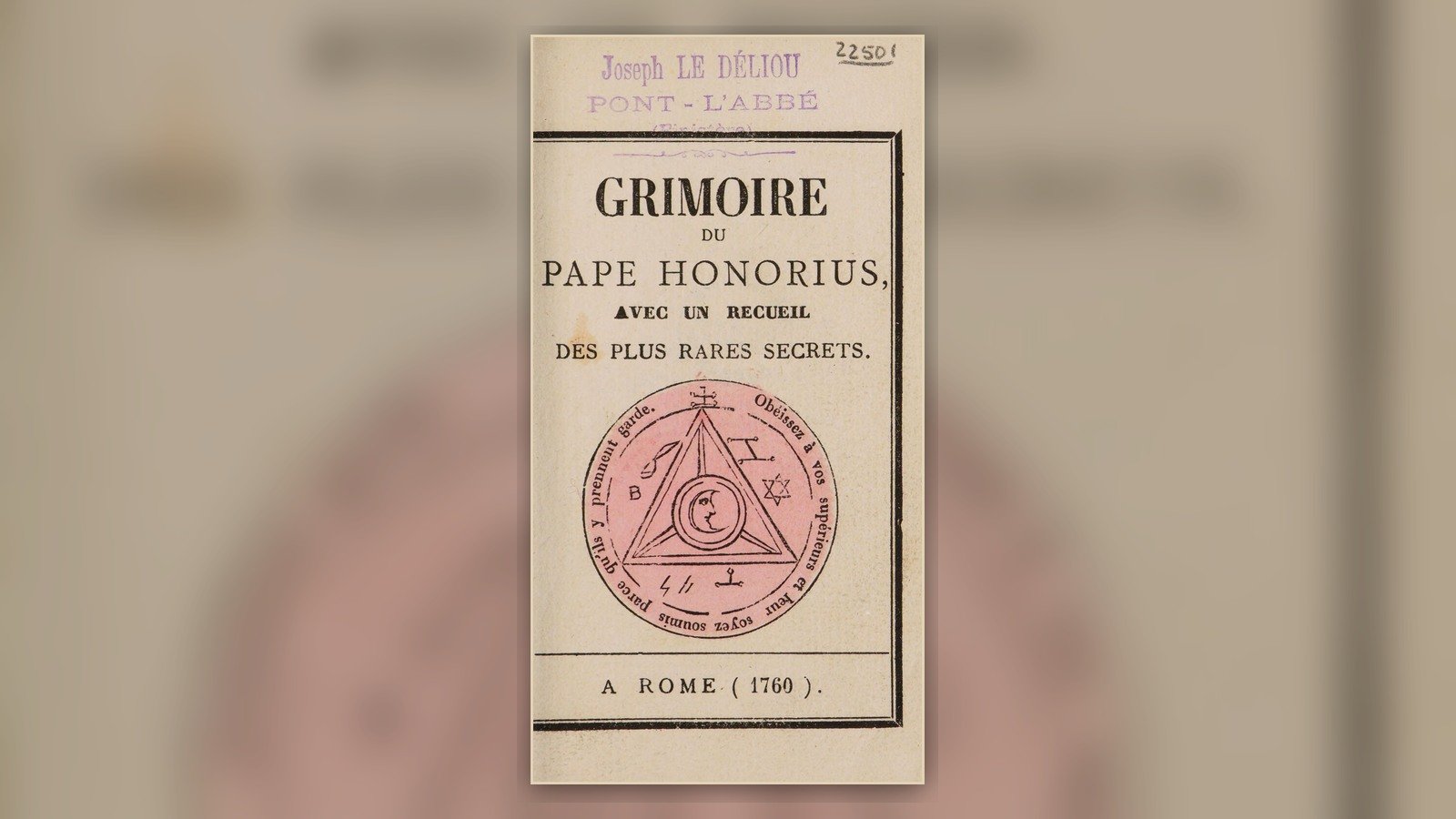
Few forbidden books violate authority as directly as the Grimoire of Pope Honorius. It does not reject the Church from outside. It seizes priesthood, liturgy, fasting, sacrifice and the language of command, then claims that a pope transmitted the secret. The title page performs the first conjuration: papal authority is made to authorize the very operations official religion condemned.
The Book in the Archive
The Grimoire of Pope Honorius and the Corruption of Sacred Authority belongs to the eighteenth- and nineteenth-century market for illicit religious books and clerical magic. The subject survives not as a single perfectly fixed revelation but through Wellcome copies, Bavarian holdings and French bibliographic records. Those witnesses allow titles, dates, physical construction, ownership and textual variation to be separated from the legends printed inside the work.
This article follows the record without flattening its darkness. Its central concern is the redirection of Mass, priestly status and sacred command toward spirit evocation. The aim is to show how the book was built, what it asked a reader to believe or perform, and why popular French grimoires, folklore about priest-magicians and the enduring confusion with other books of Honorius continued long after the earliest surviving copies were produced.
A Pope Who Did Not Write the Book
The grimoire is usually connected by legend to Pope Honorius III, but its language, print history and magical context belong to a much later period. Papal attribution is a device of authority, not reliable authorship. This detail matters because a French black-magic grimoire circulating in variant printed editions under a false papal attribution was never a neutral container of ideas. Its arrangement determined what a reader encountered first, which authorities appeared to agree, and which operations seemed to belong to a single inherited system.
Within the eighteenth- and nineteenth-century market for illicit religious books and clerical magic, the section would have carried practical and emotional weight. A copied name, a diagram, an instruction or a false attribution could transform the act of reading into preparation. The page offered a route from curiosity toward ritual commitment without requiring the reader to possess a complete institutional education.
The surviving evidence must be read at several levels. The wording records a claim; the physical witness records when and how that claim was transmitted; later editions record the changes made by printers and owners. Together they make the history more compelling than a simplified legend.
Not the Sworn Book of Honorius
The Grimoire du Pape Honorius must be distinguished from the medieval Sworn Book or Liber Juratus Honorii. They share a prestigious name but differ in structure, period and ritual world. It is one of the places where the text’s central signature—the redirection of Mass, priestly status and sacred command toward spirit evocation—becomes visible as a designed system rather than a loose collection of superstitions.
The operator imagined by the book is neither a passive believer nor a modern academic reader. He is expected to copy, prepare, pronounce, wait and interpret. The instructions create authority by demanding effort, and every demanded preparation makes the eventual promise appear more exclusive.
Comparison among witnesses is essential. A name can be corrupted, a seal reversed, a heading moved and an entire operation shortened. Such variation does not erase the tradition; it shows how the tradition lived in the hands of scribes, printers, dealers and practitioners.
False Rome and False Dates
Editions announce Rome, 1670, 1760 or other misleading imprints. Such details create distance from actual printers and place the text inside an imagined chain of prohibited ecclesiastical transmission. The passage also exposes the central tension of the work: institutional holiness becomes the source of private coercive power. That contradiction is not accidental decoration. It is the engine that gives the grimoire its forbidden character.
Sacred and illicit language remain entangled. Divine names may protect the circle while the operation pursues wealth, command or secret contact. The grimoire rarely sees this as inconsistency; it assumes a hierarchical universe in which higher names can compel lower beings.
For a historical reader, the danger lay partly in the possibility that the words were effective and partly in the possibility that using them without permission was itself a spiritual crime. The material object therefore stood at the intersection of hope, fear and transgression.
The Priest as Magician
Some instructions presume ordination or imitate clerical functions. The operator uses a status normally devoted to sacrament and pastoral authority as a technical advantage in commanding invisible beings. Later editors repeatedly selected this material because it could survive outside its original setting. It could be copied as a diagram, sold as a secret, detached as a charm or cited as evidence that an older magical authority had existed.
That portability explains much of popular French grimoires, folklore about priest-magicians and the enduring confusion with other books of Honorius. Printed occult culture did not preserve texts perfectly; it preserved what could be recognized, marketed and reused. The most memorable names and figures became anchors around which new editions were assembled.
Archival reconstruction returns the operation to Wellcome copies, Bavarian holdings and French bibliographic records. Shelf marks, paper, title pages and institutional descriptions do not diminish the occult atmosphere. They reveal the exact route by which a dangerous idea reached the present.
Mass Redirected
Prayers, offices and ritual actions resembling the Mass are reorganized for private magical ends. Sacred language is not discarded; it is treated as the strongest available force and applied outside institutional permission. This detail matters because a French black-magic grimoire circulating in variant printed editions under a false papal attribution was never a neutral container of ideas. Its arrangement determined what a reader encountered first, which authorities appeared to agree, and which operations seemed to belong to a single inherited system.
Within the eighteenth- and nineteenth-century market for illicit religious books and clerical magic, the section would have carried practical and emotional weight. A copied name, a diagram, an instruction or a false attribution could transform the act of reading into preparation. The page offered a route from curiosity toward ritual commitment without requiring the reader to possess a complete institutional education.
The surviving evidence must be read at several levels. The wording records a claim; the physical witness records when and how that claim was transmitted; later editions record the changes made by printers and owners. Together they make the history more compelling than a simplified legend.
Fasting, Blood and Sacrifice
The book’s darker reputation comes from operations involving fasting, animal sacrifice, blood and specially prepared materials. Editions differ, but transgression is central to the claim that ordinary devotional limits have been crossed. It is one of the places where the text’s central signature—the redirection of Mass, priestly status and sacred command toward spirit evocation—becomes visible as a designed system rather than a loose collection of superstitions.
The operator imagined by the book is neither a passive believer nor a modern academic reader. He is expected to copy, prepare, pronounce, wait and interpret. The instructions create authority by demanding effort, and every demanded preparation makes the eventual promise appear more exclusive.
Comparison among witnesses is essential. A name can be corrupted, a seal reversed, a heading moved and an entire operation shortened. Such variation does not erase the tradition; it shows how the tradition lived in the hands of scribes, printers, dealers and practitioners.
Conjurations and Spirit Offices
The grimoire names spirits and supplies commands, dismissals and protective forms. Its demons inhabit a Christian legal universe in which divine names can still be used to compel infernal obedience. The passage also exposes the central tension of the work: institutional holiness becomes the source of private coercive power. That contradiction is not accidental decoration. It is the engine that gives the grimoire its forbidden character.
Sacred and illicit language remain entangled. Divine names may protect the circle while the operation pursues wealth, command or secret contact. The grimoire rarely sees this as inconsistency; it assumes a hierarchical universe in which higher names can compel lower beings.
For a historical reader, the danger lay partly in the possibility that the words were effective and partly in the possibility that using them without permission was itself a spiritual crime. The material object therefore stood at the intersection of hope, fear and transgression.
Priest-Magicians in Popular Memory
European folklore repeatedly imagines priests who possess hidden books, command storms, uncover treasure or bind spirits. The grimoire gives printed form to that anxiety: the most dangerous magician may be someone trained in sacred ritual. Later editors repeatedly selected this material because it could survive outside its original setting. It could be copied as a diagram, sold as a secret, detached as a charm or cited as evidence that an older magical authority had existed.
That portability explains much of popular French grimoires, folklore about priest-magicians and the enduring confusion with other books of Honorius. Printed occult culture did not preserve texts perfectly; it preserved what could be recognized, marketed and reused. The most memorable names and figures became anchors around which new editions were assembled.
Archival reconstruction returns the operation to Wellcome copies, Bavarian holdings and French bibliographic records. Shelf marks, paper, title pages and institutional descriptions do not diminish the occult atmosphere. They reveal the exact route by which a dangerous idea reached the present.
Censorship and Survival
A notorious title could be condemned, hidden or sold precisely because it was forbidden. Small formats, false imprints and private collections helped the book survive outside official libraries. This detail matters because a French black-magic grimoire circulating in variant printed editions under a false papal attribution was never a neutral container of ideas. Its arrangement determined what a reader encountered first, which authorities appeared to agree, and which operations seemed to belong to a single inherited system.
Within the eighteenth- and nineteenth-century market for illicit religious books and clerical magic, the section would have carried practical and emotional weight. A copied name, a diagram, an instruction or a false attribution could transform the act of reading into preparation. The page offered a route from curiosity toward ritual commitment without requiring the reader to possess a complete institutional education.
The surviving evidence must be read at several levels. The wording records a claim; the physical witness records when and how that claim was transmitted; later editions record the changes made by printers and owners. Together they make the history more compelling than a simplified legend.
The Corruption of Authority
The book remains powerful as an idea because it stages corruption from within. It asks what happens when the symbols of absolute religious legitimacy are detached from obedience and placed in the hands of a solitary operator. It is one of the places where the text’s central signature—the redirection of Mass, priestly status and sacred command toward spirit evocation—becomes visible as a designed system rather than a loose collection of superstitions.
The operator imagined by the book is neither a passive believer nor a modern academic reader. He is expected to copy, prepare, pronounce, wait and interpret. The instructions create authority by demanding effort, and every demanded preparation makes the eventual promise appear more exclusive.
Comparison among witnesses is essential. A name can be corrupted, a seal reversed, a heading moved and an entire operation shortened. Such variation does not erase the tradition; it shows how the tradition lived in the hands of scribes, printers, dealers and practitioners.
What the Book Left Behind
The history of Grimoire of Pope Honorius is not exhausted by deciding whether its legendary attribution is true. Its importance lies in the people who copied it, printed it, hid it, condemned it and carried portions of it into new settings. The work made the redirection of Mass, priestly status and sacred command toward spirit evocation available as a reproducible form.
What remains is a layered object: part ritual technology, part publishing strategy, part cultural memory. Its deepest contradiction—institutional holiness becomes the source of private coercive power—allowed it to move between devotion and transgression. That movement is the reason the book belongs in an archive of forbidden history rather than in a list of curiosities.
The surviving witnesses identified through Wellcome copies, Bavarian holdings and French bibliographic records preserve the trace of real decisions: a scribe choosing a name, a printer selecting a false date, a reader marking a seal. Those traces are the historical evidence. They are also what makes the book continue to feel dangerously close.
How to Read the Surviving Evidence
The first task is to distinguish the title used by modern readers from the physical item described by a catalogue. A title may cover several manuscript families, and a single bound volume may contain works copied at different moments. For Grimoire of Pope Honorius, sequence, hand, paper and neighbouring texts can change the meaning of a passage.
Names and diagrams require particular caution. Copyists often transmitted forms they could not translate, while printers recut seals from imperfect exemplars. A variation is not automatically a new spirit or a hidden cipher. It may be the visible history of copying, and that history should be preserved rather than silently normalized.
Translation adds another layer. Latin, French, German, Italian, Hebrew-derived forms and invented ritual syllables move unevenly between editions. The same instruction may become more Christian, more infernal or more practical depending on the translator’s vocabulary and intended market.
Digital facsimiles make comparison possible, but the screen can conceal scale, binding, blank leaves and colour changes. The most reliable account combines the image with the institutional description and specialist scholarship. That method protects accuracy while keeping the reader close to the texture of the original object.
Popular editions remain evidence too, but evidence of reception. They reveal which portions of a French black-magic grimoire circulating in variant printed editions under a false papal attribution publishers believed would sell, frighten or persuade. Their changes explain how popular French grimoires, folklore about priest-magicians and the enduring confusion with other books of Honorius became more influential than the earliest textual form.
The first task is to distinguish the title used by modern readers from the physical item described by a catalogue. A title may cover several manuscript families, and a single bound volume may contain works copied at different moments. For Grimoire of Pope Honorius, sequence, hand, paper and neighbouring texts can change the meaning of a passage.
Names and diagrams require particular caution. Copyists often transmitted forms they could not translate, while printers recut seals from imperfect exemplars. A variation is not automatically a new spirit or a hidden cipher. It may be the visible history of copying, and that history should be preserved rather than silently normalized.
Translation adds another layer. Latin, French, German, Italian, Hebrew-derived forms and invented ritual syllables move unevenly between editions. The same instruction may become more Christian, more infernal or more practical depending on the translator’s vocabulary and intended market.
Digital facsimiles make comparison possible, but the screen can conceal scale, binding, blank leaves and colour changes. The most reliable account combines the image with the institutional description and specialist scholarship. That method protects accuracy while keeping the reader close to the texture of the original object.
Popular editions remain evidence too, but evidence of reception. They reveal which portions of a French black-magic grimoire circulating in variant printed editions under a false papal attribution publishers believed would sell, frighten or persuade. Their changes explain how popular French grimoires, folklore about priest-magicians and the enduring confusion with other books of Honorius became more influential than the earliest textual form.