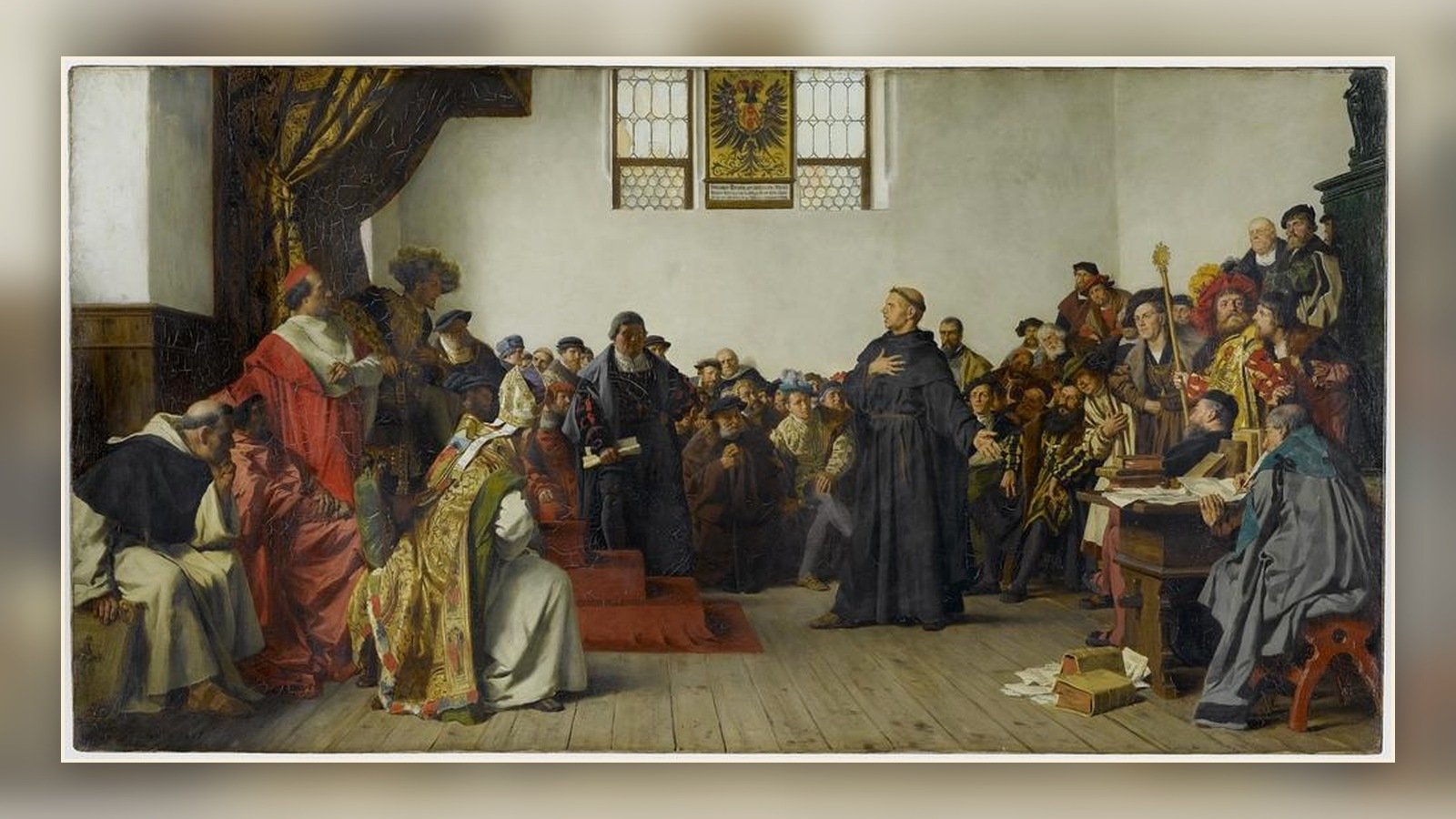
The hall at Worms was designed to make a solitary conscience appear small. Emperor, princes, church officials and legal authority surrounded Martin Luther while the books attributed to him lay before the assembly. The famous words “Here I stand” may belong more securely to later memory than to the surviving record, but the confrontation became a permanent image: the individual refusing to recant unless persuaded by scripture and reason. Spiritual independence is born in such moments, yet it carries a shadow. Once a person rejects external authority, what prevents private certainty from becoming another form of tyranny?
The Historical and Philosophical Problem
Spiritual Independence Against Religious Authority belongs to reformation conflict, mystical and radical traditions, modern individualism and the decline of exclusive ecclesiastical authority. Its central problem is the claim that spiritual judgment can belong to the person rather than to an institution with a monopoly on revelation. The article follows historical case studies, theology, political philosophy and analysis of personal revelation and keeps one contradiction in view: inner conviction can resist coercion and corruption, but it can also become unanswerable certainty detached from evidence and responsibility. The purpose is not to turn a literary or philosophical figure into an object of compulsory belief. It is to show how rebellion, knowledge and authority were argued through real texts and institutions.
The stakes concern who has authority to interpret sacred experience, define truth and command the conscience. That question is larger than the original author or event because later readers inherited the symbol under different conditions. The history must therefore distinguish initial meaning, hostile accusation, sympathetic reception and modern appropriation while allowing them to illuminate one another.
The Claim of Exclusive Authority
Religious institutions do more than preserve beliefs. They train clergy, define canons, regulate ritual, judge revelation and connect communities across generations. These functions can protect knowledge and restrain arbitrary charisma. They also create power. When an institution claims exclusive access to salvation or interpretation, disagreement becomes disobedience not only to officials but to the divine order officials represent. Spiritual independence arises when that identification is challenged.
This stage also sharpens the central tension: inner conviction can resist coercion and corruption, but it can also become unanswerable certainty detached from evidence and responsibility. The opposition cannot be resolved by declaring one side enlightened and the other benighted. The archive shows intelligence, fear, self-interest and sincere conviction operating across the conflict. A serious adversarial reading keeps those mixed motives visible.
Luther at Worms
At the Diet of Worms in 1521, Luther was asked to acknowledge and retract writings already condemned. His reported answer appealed to scripture, clear reason and conscience rather than obedience to pope or councils, which he argued could err. The exact wording has been shaped by later retelling, and the iconic phrase “Here I stand” is not secure in the earliest accounts. The historical core remains: recantation required persuasion, not command. Conscience entered public memory as a jurisdiction authority could confront but not simply occupy.
The material should be read through historical case studies, theology, political philosophy and analysis of personal revelation. Primary language establishes what the author actually constructed; reception shows how the work escaped its first context; later movements reveal which elements became usable symbols. None of these layers may silently replace the others.
The Reformation’s Unfinished Freedom
The Protestant appeal to scripture weakened clerical monopoly, but it did not create unlimited private interpretation. Reformers established confessions, churches and disciplines of their own. Radical groups who drew different conclusions were persecuted by Protestant as well as Catholic powers. Spiritual independence therefore proved unstable. The individual Bible reader could become founder of a new orthodoxy, and the conscience liberated from Rome could be bound by prince, pastor or community.
The most common distortion is romanticizing every conflict with authority as proof that the individual is right. That simplification removes the ethical pressure from the subject by making judgment automatic. The original work is stronger because it allows attraction and danger to occupy the same scene, forcing the reader to decide without the protection of a slogan.
Mystics and the Authority of Experience
Mystical traditions often claim a knowledge of the divine not reducible to institutional teaching. Visions, contemplative union and inward transformation can authorize voices excluded from formal office, including women and lay people. Yet institutions have also tested mystical claims because experience is difficult to distinguish from delusion, manipulation or poetic metaphor. The conflict is not merely reason against superstition. It concerns competing methods for determining whether an inward event deserves public authority.
At the philosophical centre lies the danger of replacing institutional dogma with charismatic, conspiratorial or purely private dogma. Rebellion is not purified merely because its opponent is oppressive. Every adversarial tradition must ask what forms of conduct it authorizes once the old command has been rejected and whether another person remains more than material for the rebel’s freedom.
The Quaker Inner Light
Early Quakers emphasized the inward light available to each person, challenging ordained ministry, compulsory tithes and fixed ritual. Their silent meetings made space for speech arising from inward prompting. The principle supported radical equality and resistance to state churches, though Quaker communities also developed procedures of discernment. The example shows that spiritual independence need not mean solitary certainty. An inner source can be tested within a community that refuses a permanent priestly class.
The section contributes to the modern ideal of spiritual autonomy and self-directed religious or nonreligious life. Cultural legacy is not evidence that later users recovered an unchanged secret tradition. It is evidence that an image or argument remained capable of organizing new conflicts. Transmission transforms, and the transformations themselves belong to history.
Blake and the Prison of Priesthood
William Blake’s prophetic works attacked priesthood when it transformed living vision into law. For Blake, imagination was a divine human capacity, while moral systems divided energy from reason and made obedience appear holy. He did not simply advocate private opinion. His illuminated books constructed an alternative symbolic world through disciplined artistic labour. Spiritual independence becomes creative responsibility: the authority to envision must be matched by the work of giving the vision form.
The conflict over who has authority to interpret sacred experience, define truth and command the conscience also explains why the subject repeatedly crosses the boundary between literature and religion. A literary figure can become a spiritual emblem; a theological accusation can become a political identity. Accuracy requires following the passage rather than deciding in advance where the “real” meaning must reside.
Modern Autonomy and the Marketplace of Belief
In modern plural societies, individuals combine traditions, reject inherited affiliations or identify as spiritual without religion. This freedom weakens coercive monopoly, but it also creates a marketplace where authority can be hidden inside branding, algorithms and charismatic entrepreneurship. The absence of a church does not guarantee independence. A person may exchange inherited doctrine for influencer certainty, commercial initiation or conspiracy. Spiritual autonomy requires examining how belief is produced and rewarded.
A darker implication is that authority often creates the adversary it fears. By forbidding a question, persecuting a book or demanding ritual assent, an institution gives dissent a shared symbol. Yet prohibition alone does not prove the dissenter correct. It proves only that power has entered the argument.
Discernment Without Submission
The strongest model of spiritual independence separates obedience from accountability. A person may refuse an institution’s command while remaining answerable to evidence, consequences, dialogue and the equal freedom of others. Discernment asks whether a revelation increases clarity or merely flatters identity, whether it survives criticism, and whether it authorizes harm. Independence is not the right never to be questioned; it is the refusal to let questioning be ended by rank alone.
The individual reader is implicated as well. It is easy to admire defiance at a historical distance while avoiding the discipline of self-critique. The adversarial method becomes serious only when it tests cherished rebellion with the same severity used against inherited authority.
Luciferian Illumination and Self-Rule
Luciferian symbolism often places light, knowledge and self-directed becoming against imposed spiritual authority. The symbol can defend freedom of inquiry and the right to reject inherited guilt. It becomes shallow when rebellion itself is treated as infallible. A serious Luciferian philosophy must include adversarial examination of its own visions. The light-bringer is credible only if illumination reveals the self’s capacity for error as clearly as it reveals institutional hypocrisy.
This is why the subject belongs to dark philosophy rather than inspirational mythology. It asks what freedom costs, what knowledge fails to repair, and how a person acts after certainty has been broken. The darkness is not decoration; it is the absence of an innocent position.
Deeper Questions
The institutional and individual poles cannot be divided into darkness and light. Institutions preserve languages and archives that make independent inquiry possible; individuals expose institutions when preservation becomes control. The history is a conflict over balance rather than a simple escape from community.
Conscience is not identical with preference. Historically, it was understood as a binding judgment that could demand sacrifice. Modern language sometimes reduces it to personal comfort. Spiritual independence becomes ethically serious when a person accepts the cost of conviction without forcing others to pay it.
The myth of the lone hero can hide networks of support. Luther survived because political powers protected him; mystics depended on scribes and communities; dissidents required printers and safe houses. Independence always has material conditions.
Private revelation becomes politically dangerous when it claims exemption from shared reality. A voice that cannot be questioned can authorize abuse as effectively as a decree from a hierarchy. The antidote is not compulsory unbelief but procedures of criticism and consent.
The deepest form of independence may be the ability to leave a belief without losing one’s dignity or community. Systems reveal their coercive character when departure is punished as betrayal rather than recognized as conscience.
A further question concerns the material form of the archive. Books, paintings, trials and institutional procedures do not merely carry ideas; they decide who may encounter them and under what conditions. The survival of spiritual independence as a searchable subject depends upon acts of preservation that earlier authorities may have intended as refutation or control.
The language of illumination should not be confused with the possession of final truth. Every figure in this history sees something the official order excludes, but partial sight can still become arrogance. The ethical measure is whether new knowledge enlarges responsibility or merely enlarges the self’s claim to rule.
Reception also changes when a work moves from scandal to canon. Once taught, collected and digitized, a forbidden text can lose the danger of its first appearance. Recovering the original conflict restores the cost paid by writers, publishers and readers without requiring modern audiences to imitate their conclusions.
The political lesson is equally unstable. Institutions need continuity, but continuity can protect error; rebels need disruption, but disruption can destroy the conditions of freedom. The archive offers no formula that removes this tension. It offers cases through which judgment can be trained.
A further question concerns the material form of the archive. Books, paintings, trials and institutional procedures do not merely carry ideas; they decide who may encounter them and under what conditions. The survival of spiritual independence as a searchable subject depends upon acts of preservation that earlier authorities may have intended as refutation or control.
The language of illumination should not be confused with the possession of final truth. Every figure in this history sees something the official order excludes, but partial sight can still become arrogance. The ethical measure is whether new knowledge enlarges responsibility or merely enlarges the self’s claim to rule.
Reception also changes when a work moves from scandal to canon. Once taught, collected and digitized, a forbidden text can lose the danger of its first appearance. Recovering the original conflict restores the cost paid by writers, publishers and readers without requiring modern audiences to imitate their conclusions.
The political lesson is equally unstable. Institutions need continuity, but continuity can protect error; rebels need disruption, but disruption can destroy the conditions of freedom. The archive offers no formula that removes this tension. It offers cases through which judgment can be trained.
A further question concerns the material form of the archive. Books, paintings, trials and institutional procedures do not merely carry ideas; they decide who may encounter them and under what conditions. The survival of spiritual independence as a searchable subject depends upon acts of preservation that earlier authorities may have intended as refutation or control.
The language of illumination should not be confused with the possession of final truth. Every figure in this history sees something the official order excludes, but partial sight can still become arrogance. The ethical measure is whether new knowledge enlarges responsibility or merely enlarges the self’s claim to rule.
Reception also changes when a work moves from scandal to canon. Once taught, collected and digitized, a forbidden text can lose the danger of its first appearance. Recovering the original conflict restores the cost paid by writers, publishers and readers without requiring modern audiences to imitate their conclusions.
The political lesson is equally unstable. Institutions need continuity, but continuity can protect error; rebels need disruption, but disruption can destroy the conditions of freedom. The archive offers no formula that removes this tension. It offers cases through which judgment can be trained.
A further question concerns the material form of the archive. Books, paintings, trials and institutional procedures do not merely carry ideas; they decide who may encounter them and under what conditions. The survival of spiritual independence as a searchable subject depends upon acts of preservation that earlier authorities may have intended as refutation or control.
The language of illumination should not be confused with the possession of final truth. Every figure in this history sees something the official order excludes, but partial sight can still become arrogance. The ethical measure is whether new knowledge enlarges responsibility or merely enlarges the self’s claim to rule.
Reception also changes when a work moves from scandal to canon. Once taught, collected and digitized, a forbidden text can lose the danger of its first appearance. Recovering the original conflict restores the cost paid by writers, publishers and readers without requiring modern audiences to imitate their conclusions.
The political lesson is equally unstable. Institutions need continuity, but continuity can protect error; rebels need disruption, but disruption can destroy the conditions of freedom. The archive offers no formula that removes this tension. It offers cases through which judgment can be trained.
What Remains
The subject leaves no painless conclusion. It preserves the modern ideal of spiritual autonomy and self-directed religious or nonreligious life while exposing the danger of replacing institutional dogma with charismatic, conspiratorial or purely private dogma. The inherited authority may be unjust, the rebel’s question may be necessary, and the rebel may still fail. Dark philosophy begins where those statements are allowed to remain true together.
SatanWorld approaches this history as an archive of contested knowledge. The task is to hear the forbidden voice without granting it automatic innocence, and to examine authority without treating opposition as a substitute for evidence. What remains is the responsibility of judgment: freedom after command, knowledge after prohibition, and the difficult refusal to become the power one resisted.