
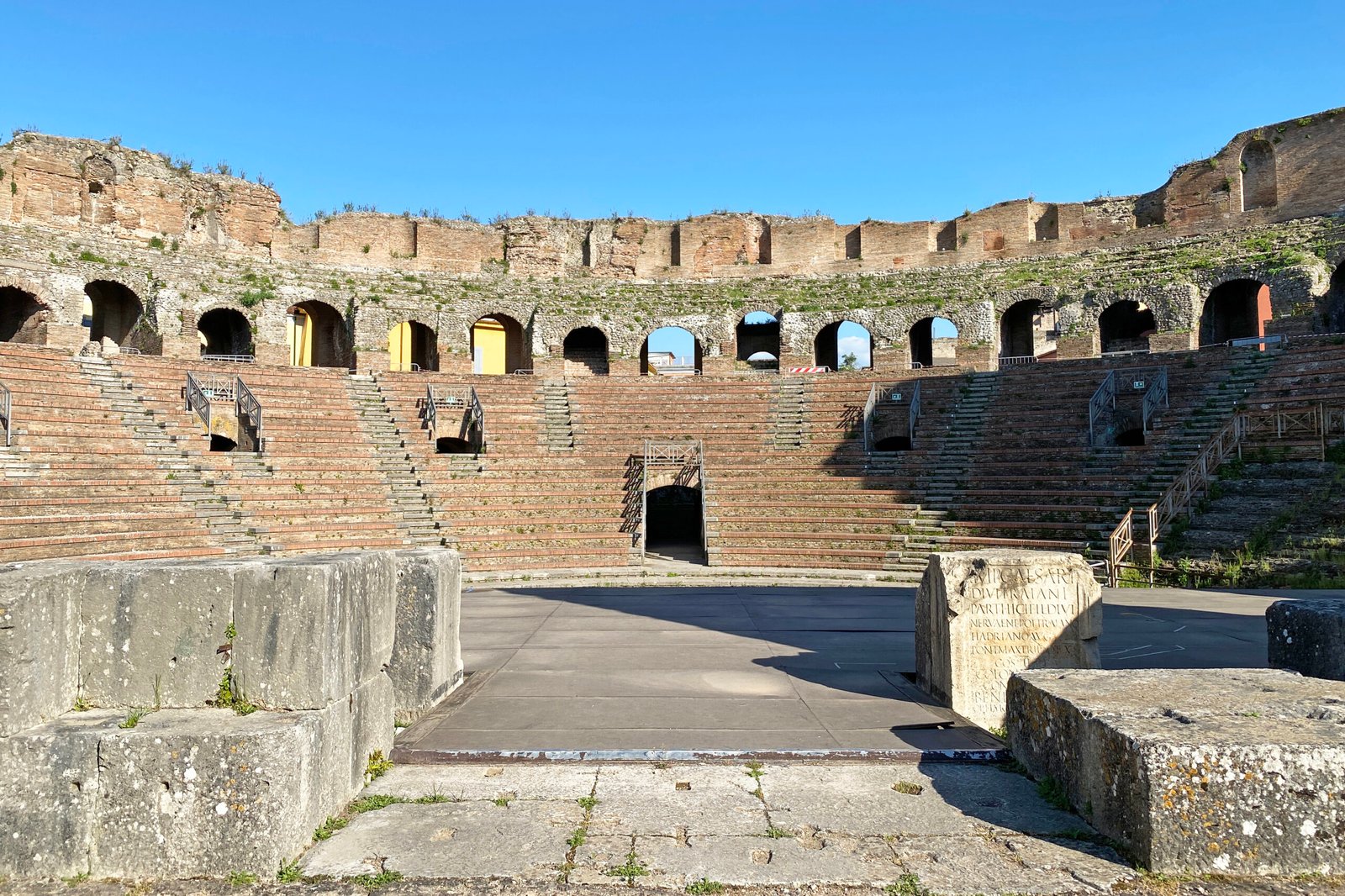
The Zoccolara is announced by sound. Long after the Roman audience has disappeared and the stone tiers of Benevento’s theatre have emptied, wooden impacts begin somewhere beyond sight. One step, then another. The rhythm is too measured for falling debris and too heavy for an animal. In the narrow streets of the Triggio quarter, the noise approaches before the woman appears: tall, thin, dressed in black, her face uncertain, her feet striking the ground in clogs. Then the figure is gone. The last thing left is not silence but laughter.
The Woman of the Wooden Shoes
Her name survives in several local spellings, including Zucculara and Zoccolara, forms linked to zoccoli, wooden clogs. Unlike a ghost named for a dead person, she is named for the evidence of her passage. The sound matters more than a biography. People know she is near because the street begins to count her steps.
Descriptions commonly give her a dark female form, sometimes old, sometimes merely gaunt and unnaturally tall. She moves around the Roman theatre and the adjoining lanes rather than occupying one room. The apparition may appear suddenly, disappear before being reached, or reveal itself only through the clatter of footwear and a mocking laugh.
No stable historical identity has been established. She is not securely tied to one documented woman, execution or burial. Later storytellers sometimes seek a tragedy beneath every apparition, but the Zoccolara’s oldest recognizable shape is more elemental: a night wanderer whose body is half-seen and whose shoes make the invisible impossible to ignore.
Triggio After Dark
The Triggio quarter lies within one of Benevento’s oldest urban layers. The Roman theatre dominates the area, but later churches, houses, workshops and streets grew around its surviving mass. Ancient masonry appears beside ordinary doors. The past is not isolated behind a fence; it interrupts the living city.
Such places generate acoustic uncertainty. Footsteps turn corners without revealing the walker. Stone carries and redirects sound. Empty passages produce echoes whose origin is difficult to locate. A wooden shoe striking pavement can seem near, then distant, then suddenly behind the listener. The physical city provides the perfect instrument for a haunting defined by approach.
Yet the legend is not simply an explanation for echoes. It teaches how to hear the quarter. Once the name Zoccolara is known, an unidentified step no longer remains neutral. It belongs to a woman who has walked there before and may choose to show herself only after the witness has followed.
The Roman Theatre as a Haunted Boundary
The theatre was built for transformation. Actors became gods, rulers, mourners and monsters before an audience gathered within an architecture designed to carry voice. Centuries later, the ruin retained an association with performance even when no play was underway. A figure who appears, vanishes and laughs behaves like a remnant of theatre stripped of explanation.
Local folklore often settles around ancient structures because their original purposes have become partially unreadable. Passages are blocked, foundations disappear under later buildings, and inscriptions survive after the people who understood them are gone. The ruin is visibly constructed yet socially mysterious. It invites the idea that something continues to use it after ordinary occupation ends.
The Zoccolara’s route near the theatre also places her at a threshold between entertainment and warning. She can be told as a frightening story, but the story changes behaviour. Children are urged to leave the streets. Night wanderers are reminded that the old quarter contains places where respectable people should not remain alone.
A Ghost Used to Bring Children Home
Several explanations of the legend emphasize its social function. Adults could invoke the Zoccolara to discourage children from roaming after dark. The threat was specific enough to be memorable: if the wooden shoes were heard, hiding might already be too late.
This does not prove that the being was invented deliberately by one parent or generation. Folklore rarely has a single author. A pre-existing apparition can become a disciplinary figure, and a warning repeated for practical reasons can acquire supernatural detail. The utility of the story helps preserve it, while repeated fear makes the presence feel older than anyone who tells it.
The warning also protected against real urban hazards: darkness, unstable ruins, strangers, traffic through narrow streets and the dangers of children entering abandoned or partially excavated spaces. By giving those hazards one audible body, the community made caution emotionally immediate.
The Inscription Against Superstition
Near the Roman theatre, the church of Santa Maria della Verità preserves an eighteenth-century inscription associated with the restoration or ordering of the sacred site. Modern interpreters have drawn attention to language concerning the expulsion of superstition. The stone does not name the Zoccolara directly, and it should not be transformed into proof of an official exorcism of one ghost. It does, however, reveal that the district was understood through a struggle between authorized religion and local belief.
A church called “of the Truth” standing beside an ancient theatre creates a powerful symbolic landscape. Theatre is appearance; truth is revelation. Superstition occupies the territory between them. The apparition in wooden clogs moves precisely there, where the city has repeatedly attempted to distinguish sacred order from inherited fear.
The inscription’s value is therefore contextual. It shows that the suppression of unauthorized belief was part of the area’s historical language. Legends like the Zoccolara survive because stone declarations cannot fully govern what residents hear after nightfall.
The Hecate Comparison
Some modern discussions compare the Zoccolara with Hecate, the ancient goddess associated with crossroads, night, ghosts and liminal places. A more specific comparison points to traditions concerning a single sandal or unusual footwear in ancient ritual imagery. The resemblance is evocative: a nocturnal female presence, an old city, a distinctive sound from the feet.
The comparison should remain a comparison. No continuous chain of worship has been demonstrated from ancient Hecatean practice to the modern Benevento apparition. Similar symbols can reappear because thresholds, women at night and abnormal footwear are powerful motifs. The Roman theatre encourages ancient interpretation, but its presence does not automatically make every later ghost a surviving deity.
Still, the Hecate comparison explains why the Zoccolara feels deeper than a recent urban anecdote. She occupies a role that ancient Mediterranean cultures already understood: the female power encountered where roads divide, daylight ends and the dead approach inhabited space.
The Woman in Black
One local retelling preserves an encounter placed in the early 1990s. A witness moving through the quarter reportedly saw a tall, thin woman in black, heard the characteristic clogs and experienced her sudden disappearance. The story has circulated as oral testimony rather than as a contemporaneous police, medical or investigative file.
That limitation should be stated plainly. The account cannot bear the weight of forensic proof. Its importance lies elsewhere: it shows that the Zoccolara was not remembered only as a tale told by distant ancestors. The figure remained available as an explanation for a modern encounter in streets illuminated by electricity and surrounded by ordinary city life.
Oral narratives often become more precise as they are repeated. Clothing darkens, height increases, laughter is placed at the final moment. The resulting scene may preserve a genuine frightening experience while also taking the form expected of the legend. Witness and tradition shape one another.
The Laugh After Disappearance
Laughter is one of the Zoccolara’s most disturbing traits because it implies awareness. A noise made by architecture has no opinion of the listener. A laugh suggests that the presence knows it has been seen and knows that the witness cannot stop it from vanishing.
The sound also reverses the normal relationship between storyteller and ghost. People laugh after a fright to recover control. The Zoccolara laughs first. She treats human fear as part of her performance.
In some versions, the clogs and laughter are enough; the figure need not appear. This produces a haunting without visual confirmation, one that cannot be photographed because its power lies in direction and distance. A camera can face the street, but the next step may come from behind the wall.
From Warning to Festival
Benevento’s modern cultural celebrations have brought the city’s witches and night figures into public performance. Events such as the Struscio delle Streghe have included dances, costumed processions and references to the Zoccolara. Wooden footwear becomes choreography. What once sent children indoors is brought deliberately into crowded streets.
This transformation does not necessarily destroy the legend. Performance can preserve details that would otherwise fade: the sound of the shoes, the black clothing, the relationship with the old quarter. It also separates public enjoyment from private belief. A person may watch the dance and still avoid walking alone beside the theatre later that night.
The Zoccolara’s survival depends on this double life. She is folklore displayed by the city and a presence that remains most effective when no audience is expected.
What the Footsteps Preserve
There may be no dead woman whose life can be reconstructed, no grave that identifies the wanderer and no unbroken ancient cult beneath the name. The case for the Zoccolara is not built from documents of one event. It is built from persistence: a location, a sound, a figure and a warning repeated until they became inseparable.
Environmental explanations can account for some experiences. Stone streets echo. People misjudge distance at night. Expectation turns ordinary pedestrians into shapes of legend. Stories told to children become memories that later adults experience as inherited certainty.
But these explanations do not replace the cultural presence. They describe how the Zoccolara can be heard; they do not explain why one particular woman walks in the imagination of Benevento and why her shoes still belong to the Roman theatre.
The theatre has lost its original crowds, but the old mechanism of performance remains. A sound enters. The listener waits. A woman in black appears at the edge of vision. Then the stage is empty again, and from somewhere beyond the arches comes the laughter of the only performer who knew the scene had begun.
Sources and Further Reading
This article reconstructs the Zoccolara from Benevento oral-history writing, local cultural reporting, discussion of the Santa Maria della Verità inscription and modern festival preservation. The Hecate comparison and the early-1990s apparition are clearly identified as later interpretations or testimony, not as proven ancient continuity or a documented criminal history.
- https://www.pontelandolfonews.com/cultura/dalla-janara-al-monaciello/
- https://beneventoceraunavolta.blogspot.com/2015/04/a-zucculara.html
- https://lapicidata.wordpress.com/2018/05/16/benevento-bn-chiesa-di-santa-maria-della-verita/
- https://www.rainews.it/tgr/campania/articoli/2025/07/a-benevento-il-5-e-6-luglio-torna-lo-struscio-delle-streghe-5df79360-664c-4570-b64c-696da62d82ae.html
- https://commons.wikimedia.org/wiki/File:Teatro_romano_(Benevento)_01.jpg
_01.jpg)