In the winter of 1928, a room inside a Franciscan convent in Earling, Iowa, became the stage for one of America’s most enduring exorcism narratives. The woman placed there was concealed behind a name: Anna Ecklund. The priest who confronted her was the German-born Capuchin Theophilus Riesinger, already known within Catholic circles for experience with exorcism. According to the account later published as Begone Satan!, the conflict continued across twenty-three days of ritual sessions. Voices spoke through the woman, her body resisted restraint, foul smells filled the room, and the witnesses believed that several hostile intelligences identified themselves from within her. The story became famous because it described not one sudden deliverance but a prolonged siege.
The Woman Behind the Protective Name
“Anna Ecklund” is generally understood as a pseudonym. Later publications identify the woman as Emma Schmidt, while other retellings use additional protective names or reduce her simply to the possessed woman of Earling. The uncertainty is not incidental. Privacy, religious discretion and the sensational power of the case all shaped how her identity was transmitted.
The surviving narrative presents a long history of affliction beginning in adolescence. It attributes the origin partly to a curse pronounced by the woman’s father and partly to harmful influence from an aunt described as a witch. These claims belong to the theological interpretation of the witnesses. Independent family records establishing the supernatural events have not been published as a complete archive.
The woman is said to have experienced earlier relief through exorcism before the symptoms returned. By 1928 she was in her forties and had become associated with aversion to sacred objects, inability to receive communion, violent reactions during prayer and unusual knowledge. The account presents these signs as evidence that the case exceeded illness or fraud. A modern reader must remember that the diagnosis was made within a religious framework already prepared to recognize possession.
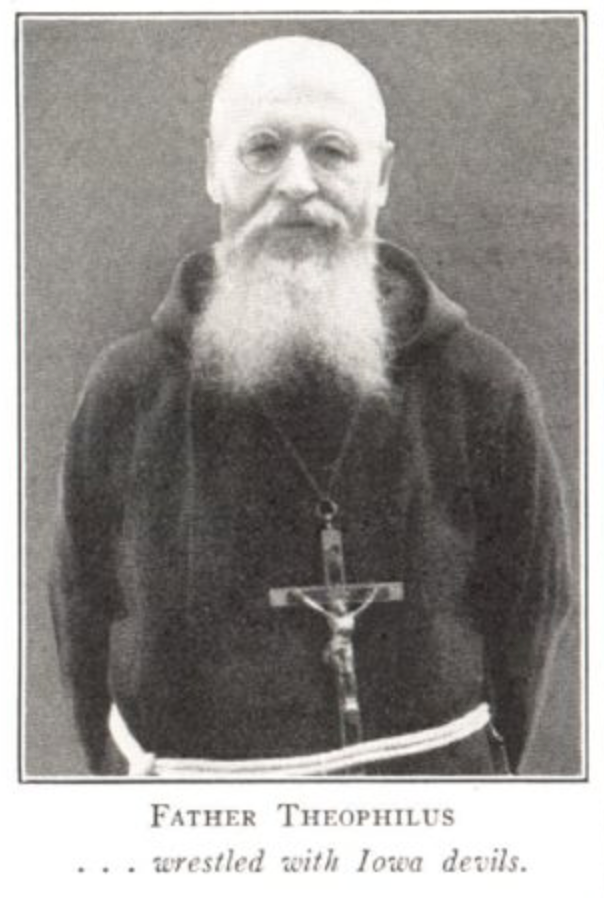
Father Theophilus Riesinger
Riesinger was a Capuchin friar born in Germany who served in the United States. His reputation as an exorcist did not arise only after Earling; the case was brought to him because Church authorities believed he had already dealt with possession. The surviving portrait shows an elderly cleric with a severe, composed expression. Later retellings turn him into an almost legendary combatant, but his role in the source narrative is disciplined rather than theatrical. He relies upon the authorized rite, prayer, endurance and the conviction that the voices must submit to sacred authority.
The local priest, Father Joseph Steiger, helped arrange the location. A convent offered privacy, religious personnel and distance from public curiosity. The woman could be housed away from family and from a parish community that might spread the story before the rites concluded.
The choice of a convent also changed the atmosphere of the event. The alleged manifestations unfolded among nuns whose daily life was ordered by bells, prayer and service. The intrusion was interpreted not merely as an attack upon one woman but as an invasion of consecrated space.
The Source Called Begone Satan
Most detailed modern versions descend from a German account by the priest Carl Vogl, later translated into English by the Benedictine Celestine Kapsner. The pamphlet was published with ecclesiastical permission and promoted as a spiritually useful warning. It is not a stenographic transcript of every session. It is a devotional narrative written to demonstrate the reality of evil, the authority of the Church and the power of sacramental life.
That purpose shapes the text. Scenes are arranged as moral conflict. The voices expose sins, mock religious authority and reveal hatred of sacred things. The priest’s perseverance becomes an example of spiritual discipline. The woman’s suffering is interpreted through temptation, curse, sacrilege and deliverance.
This does not make the account worthless. It is the principal historical witness to what participants believed occurred. It does mean that later writers should not convert every sentence into neutral laboratory data. The source is strongest when read as religious testimony: people who were present understood themselves to be confronting multiple demonic personalities over an extended period.
Arrival at Earling
The narrative describes obstacles before the rites fully began. Travel and arrangements were interpreted as subject to interference. Once the woman entered the convent, her reaction to the religious environment allegedly intensified. Sacred objects, prayers and the presence of the priest provoked hostility.
The room was prepared for safety and privacy. Nuns assisted with care and restraint when the woman became violent. Food was limited not as a deliberate punishment but because the account says she frequently refused or was unable to eat normally during the sessions. The prolonged physical strain affected everyone involved.
The first stage established the pattern that would dominate the following weeks: prayer began, the woman’s ordinary voice altered, bodily resistance increased and the priests understood the response as an intelligence attempting to obstruct the rite.
The Body as Contested Territory
Begone Satan! describes convulsions, swelling, distorted posture, vomiting, spitting and movements considered impossible under ordinary strength. The woman was said to rise or become difficult for several people to control. At points, the body seemed to change in weight or shape. These are among the claims most often repeated in sensational summaries.
No continuous film, medical chart or independently controlled observation survives publicly to establish the physical events. The descriptions come through believers who were interpreting the body during a highly charged ritual. Illness, trauma, dissociation, neurological conditions, expectation and restraint can all produce dramatic effects. The source itself rejects such explanations because its purpose is to identify possession.
The disturbing power of the narrative comes from the loss of bodily ownership. Whether understood spiritually or psychologically, the woman’s body is described as acting against her conscious welfare. Hands become instruments of resistance, the mouth carries voices she does not claim, and ordinary needs such as sleep and food are absorbed into the conflict.
Voices and Names
The hostile voices allegedly identified several presences, including Lucifer, Beelzebub, Judas Iscariot and spirits connected with the woman’s family. Their speech varied in tone and sometimes in language. The account emphasizes knowledge the woman supposedly could not have acquired and responses to commands issued in Latin or German.
Naming is central to exorcistic literature. A concealed presence is thought to gain power through anonymity, while a name allows authority to address it directly. In the Earling story, the multiplication of names transforms one case into a hierarchy. The woman is not portrayed as occupied by a single voice but by a hostile assembly with different motives and ranks.
The family-related names also give the account a moral genealogy. Harm is said to pass through curse, resentment and occult involvement. The possession becomes the final form of conflicts that began long before the convent room. Such claims should not be used as factual accusations against people who cannot answer them; they belong to the source’s religious interpretation.
The Smell in the Room
Witnesses reported odors of decay and filth appearing without a physical source. Foul smell is common in possession narratives because it expresses corruption in sensory form. The presence is not only heard through blasphemy; it alters the air.
The nuns’ testimony, as presented by Vogl, gives these odors importance because they were said to occur during moments of intensified resistance and then disappear. The smell became one of the signs that the event extended beyond the woman’s body.
Odor is also difficult evidence. Memory exaggerates unpleasantness, enclosed rooms concentrate bodily smells, and prolonged fasting or illness can affect breath and digestion. Yet for the participants, the timing transformed a physical sensation into communication. The room smelled as they believed the voices wished spiritual corruption to smell.
Twenty-Three Days Rather Than One
The phrase “twenty-three-day exorcism” can mislead readers into imagining one uninterrupted performance. The account describes repeated sessions across a longer period, with pauses for rest, prayer, Mass and basic care. The duration matters because it removed the possibility of a quick dramatic conclusion. The participants had to return to the same room knowing what the previous session had demanded.
Fatigue can deepen conviction. After days of disrupted sleep, fear and ritual repetition, every sound acquires significance. It can also expose deception if events cannot be sustained. The Earling witnesses believed persistence confirmed the reality of the possession: the voices continued, the woman’s reactions remained violent and the priest refused to abandon the rite.
For the woman, the duration meant repeated restraint and repeated confrontation. Modern discussions should not romanticize that suffering. Whatever caused her condition, she endured an extreme physical and emotional ordeal under the authority of people convinced that resistance came from demons rather than from her own distress.
The Final Crisis
The narrative builds toward a final period in December. Sacred commands are intensified. The possessing voices announce or resist departure. The woman reportedly undergoes violent convulsions before a sudden change: the hostility recedes, her body quiets and she is able to participate normally in religious life.
The source presents liberation as unmistakable. The convent atmosphere changes. The exhausted assistants recognize peace not as an emotion but as the absence of the invasive will that had dominated the room.
Later accounts often end there, creating a complete victory. Historical research complicates that certainty. Some materials associated with the Earling case suggest that symptoms or further rites continued beyond the famous conclusion. The neat ending may reflect the devotional structure of the published pamphlet more than a complete lifetime record.
TIME Magazine and Public Legend
By 1936, the story had become public enough for TIME magazine to profile Riesinger. The article helped fix the Earling exorcism in American memory and supplied the portrait now widely associated with the case. Its reporting repeated the extraordinary claims while also noting that Catholics were not required to accept every private possession account as an article of faith.
That qualification is significant. Ecclesiastical permission to publish does not transform a narrative into dogma or scientific proof. It indicates that authorities found the text permissible and spiritually useful within its context.
Popular culture later stripped away many of these distinctions. Websites merged names, altered dates and expanded the phenomena. “Anna Ecklund” became a stable horror character, while the woman behind the name receded. The more famous the case became, the easier it was to repeat details without returning to Vogl’s actual text.
Illness, Trauma and Religious Interpretation
A modern source-critical approach must allow several possibilities. The woman may have experienced psychiatric illness, trauma-related dissociation, neurological symptoms, culturally shaped distress, deliberate performance, or some combination. The observers may have misinterpreted natural events, or they may have encountered phenomena they could not explain. The historical record does not permit a confident retrospective diagnosis.
The religious interpretation should not be mocked or automatically accepted. It governed the actions of everyone in the room and therefore belongs to the facts of the event. Riesinger acted as an exorcist because he believed an external evil was present. The nuns assisted because they shared that framework. The woman’s responses occurred within a ritual that gave every gesture cosmic meaning.
The case is most responsibly told when experience and explanation are separated. We can say what the source reports. We can identify the purpose and delay of the publication. We cannot claim access to the private medical and personal history required to resolve the cause.
The Woman the Legend Concealed
The title Begone Satan! directs attention toward the priest’s command and the enemy he addressed. It risks reducing the afflicted woman to a battlefield. Her own sustained voice is largely absent. She appears through symptoms, accusations and moments of relief recorded by others.
That absence is the darkest part of the archive. A woman lived for years under a name not her own, interpreted by family, clergy and later writers. If the religious account is true, she endured prolonged spiritual invasion. If another condition caused the symptoms, she endured that condition inside a culture unable to hear it except as possession. In either case, the suffering was real to those who witnessed it.
The Earling story survives because it describes evil as patient. It can resist for days, use memory as accusation and turn a convent room into a place where every breath appears contested. But behind the demon names and the exorcist’s portrait remains the person whose history was never fully returned to her.
Sources and Further Reading
This article is based primarily on Carl Vogl’s Begone Satan!, the English translation associated with Celestine Kapsner, bibliographic records, contemporary TIME coverage and the public-domain portrait of Father Theophilus Riesinger. The article distinguishes the pamphlet’s devotional testimony from independently preserved clinical evidence and avoids treating later internet additions as contemporary facts.
- https://openlibrary.org/books/OL33113518M/Begone_Satan%21
- https://archive.org/details/begonesatansouls00vogl
- https://time.com/archive/6820778/religion-exorcist-energumen/
- https://search.worldcat.org/title/1041062201
- https://commons.wikimedia.org/wiki/File:Father_Theophilus…_wrestled_with_Iowa_devils.png