
Historical Ritual Archive
A royal evocation of forbidden science, dignity, memory and the overwhelming music of an infernal court.
This rebuilt dossier preserves the entire operative substance of the earlier SatanWorld draft: the tools, sigil work, timings, purifications, chants, offerings, petitions, manifestations, dismissals and warnings remain present. The material has been reorganized so the rite unfolds as one deliberate descent rather than a loose list of instructions.
The Power Being Addressed
Paimon is approached as Ninth spirit of the Ars Goetia, a Great King commanding an immense retinue. The operation is structured around that rank, office and manifestation.
Paimon is majestic, intellectually expansive and ceremonially demanding. He responds to precise language, hierarchy and composure. Casual familiarity is considered an insult because his presence is described as a procession, not a private whisper.
Daemonology profile: Read the complete Daemonology profile of Paimon
Why the Rite Exists
The rite creates a threshold between ordinary life and the domain attributed to Paimon. Preparation separates the practitioner from distraction. The sigil, name and chant establish a centre. The petition shapes the encounter. The offering acknowledges exchange. Dismissal restores the chamber to ordinary time.
A summoning without preparation is only demand. A summoning without closure is pressure without boundary.
Personality and Ritual Conduct
Paimon is majestic, intellectually expansive and ceremonially demanding. He responds to precise language, hierarchy and composure. Casual familiarity is considered an insult because his presence is described as a procession, not a private whisper.
The practitioner should speak with precision and avoid contradictory motives. The entity's traditional temperament determines the tone of the operation. Royal spirits are not approached like marquises, teachers are not addressed like destroyers, and powers of love, invisibility, storm, war or revelation do not answer through the same atmosphere.
The Atmosphere of Manifestation
Trumpets, cymbals or distant music may seem to approach before any figure appears. The room feels larger and hotter, speech becomes difficult beneath an inner roar, and manifestation may arrive as a crowned rider upon a dromedary surrounded by ministers and spirits.
Manifestation may begin through changes in sound, heat, dream, pressure, candle behavior, animal imagery or internal speech. The legend of the rite does not require a full visible apparition before contact is recognized.
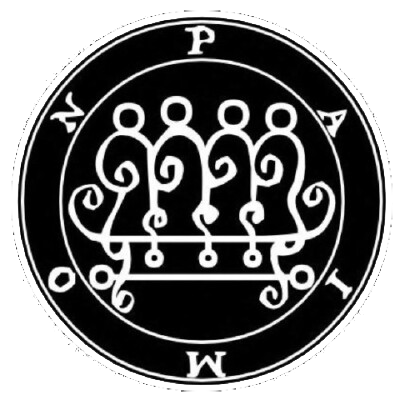
Sigil of Paimon
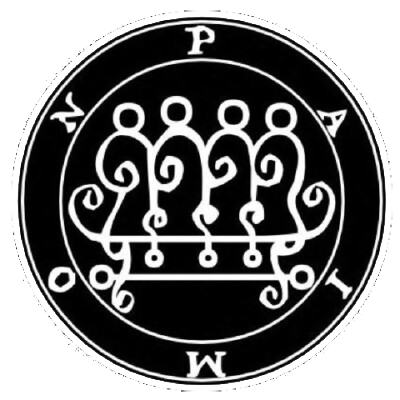
Sigil of Paimon. Traditionally drawn on parchment and placed at the centre of the rite as the principal visual focus for the invocation.
The Rite: Full Ceremonial Sequence
The following section preserves the original article's ritual content without omitting its operative details.
Who is Paimon?
Preparation for Summoning
Traditional Goetic evocation requires meticulous setup to "compel" the spirit safely. Key steps from the Lesser Key include:
Purification and Fasting: Abstain from food, sex, and impure thoughts for 3–9 days. Bathe in consecrated water (salt + herbs like hyssop). This "purifies" the summoner.
Protective Circle: Draw a nine-foot circle on the ground using chalk, flour, or blood (symbolic, not literal). Inside, inscribe the names of God (e.g., Tetragrammaton, Adonai) and angelic seals from the grimoire. Stand within it to avoid harm. Outside, place a triangle of art for the spirit to manifest.
Tools Needed
Black-handled knife (athame) for tracing pentagrams.
Incense: Frankincense and myrrh.
Virgin parchment with Paimon's sigil (seal) drawn in ink mixed with your blood or saffron.
A brass vessel or lamp for offerings.
The grimoire itself, open to Paimon's entry.
Timing: Perform during the hour of Paimon (planetary hour of Mercury, Wednesday dawn/dusk). Lunar phase: Waxing moon for obedience.
The Summoning Ritual
This is a condensed version based on the Lesser Key of Solomon and related texts like the Pseudomonarchia Daemonum. Recite in a commanding tone; use Latin if possible for authenticity.
Preliminary Invocation: Enter the circle at the appointed time. Light incense. Trace the circle with your athame, invoking: "I conjure thee, O Circle of Art, by the power of the Most High, that thou shalt protect me from all harm."
Call the Spirit: Hold Paimon's sigil. Chant the conjuration three times, escalating intensity: "Paimon, King of the East, I conjure thee by the power of the Almighty, by the names El, Adonai, Tetragrammaton, and by the seal which I hold, appear before me in the triangle, visible and affable, without deformity or terror. Come peaceably, and answer truly my questions. I command thee by the virtue of these holy names!" (Full Latin version in grimoires: "Ego te invoco, Paimon…")
Manifestation: Expect visual/auditory signs (shadows, voices, temperature drops). If he appears (often crowned, with trumpets sounding), greet him: "Welcome, King Paimon, most noble and powerful." Offer gifts like art supplies or books to honor his domains.
Binding and License to Depart: Once summoned, state your request clearly (e.g., "Teach me the secrets of [skill]"). Bind him: "By the power of this circle, thou shalt not harm me nor depart without fulfilling my will." After, dismiss: "I license thee to depart, Paimon, to thy place, peaceably and without noise." Extinguish incense counterclockwise.
Paimon's Sigil
For the seal, draw this traditional symbol (described textually; visualize or sketch it)
text
/\
/ \
/____\
| |
| [] |
\__/
(Actual sigil: A crowned figure with a lion's face, camel, and curved horns—search grimoires for precise diagram.)
Warnings and Variations
Risks: Grimoires warn of madness or attack if protections fail. Modern practitioners (e.g., in chaos magic) adapt with visualization only, skipping tools.
Ethical Note: Treat as psychological archetype work, not literal. If seeking knowledge, books like The Goetia by Aleister Crowley provide full texts.
Historical Image and Ritual Figure
BLACK PLACEHOLDER — replace with a verified historical image, sigil manuscript or ritual object before publication.
Ritual Architecture
Separation from Ordinary Time
Bathing, fasting, abstinence, silence, darkness or isolation prepare the body and mind to recognize the threshold. The preparation should be completed as a single coherent discipline rather than as scattered gestures.
Construction of the Chamber
Candles, incense, circle, water, salt, metal, herbs, stones and offerings organize the room around the office of Paimon. Every item should have a purpose. A crowded altar weakens the central image when objects are added only for display.
Establishing Contact
The sigil, name, chant, enn or invocation becomes the fixed point of the operation. Repetition is intended to narrow awareness until the name no longer feels like ordinary language.
The Petition
One principal request should be stated. The request must include a boundary, a desired form of result and a clear completion condition. Ambiguous wishes invite expansion.
Recognition of Presence
The central phase begins when the atmosphere changes in a sustained way. Pressure, heat, cold, altered flame, internal speech, animal forms, dreams or sudden certainty may mark the transition.
Offering and Exchange
The offering expresses reciprocity. It may carry the spirit's color, office, appetite or symbolic domain. Promises should never be made casually because the rite treats them as binding.
Dismissal
The operation ends only when Paimon is thanked or dismissed according to the preserved method. Candles are extinguished safely, windows opened where appropriate, offerings removed according to the rite and the chamber returned to ordinary order.
Instruments and Their Symbolism
The sigil is the visual body of the name. The candle establishes color, rank and duration. Incense gives the atmosphere density. Salt and the circle define limits. Water reflects and carries emotional force. Metal, stone, herb or coin embodies the entity's office.
The instrument is complete when it performs its function. More objects do not automatically create greater force.
Timing and Planetary Current
When several correspondences appear, one coherent system should govern the night. Combining every possible timing creates confusion rather than power.
Manifestation Signs
Signs traditionally associated with Paimon include:
- a stable change in emotional pressure;
- dreams repeating the traditional form;
- candle movement without a matching draft;
- sounds, smells or bodily sensations linked to the spirit's office;
- a complete phrase arising inside thought;
- external events beginning to mirror the petition;
- fear or fascination intensifying at the exact point of contact.
One isolated sign may pass unnoticed. A pattern repeating across chamber, dream and aftermath carries greater weight.
The Frightening Edge of the Rite
Paimon's knowledge can intensify ambition until ordinary life feels beneath the seeker. Dignity may become domination, scholarship may become fixation, and the sense of being chosen may eclipse practical judgment.
The deepest danger is transformation that feels useful. The practitioner may begin to imitate the spirit's temperament, reorganize life around the petition or interpret every event through the operation.
Failure Patterns
Failure appears when preparation is abandoned, the request changes repeatedly, symbols are mixed randomly, fear replaces attention, impossible offerings are promised or the practitioner refuses to close because no dramatic apparition appeared.
Failure may also appear as excess success: the requested force enters ordinary life faster than expected. The completion condition should therefore be written before the rite begins.
Completion and Aftermath
The operation is complete when the petition has been spoken, the exchange acknowledged, the presence dismissed and the chamber returned to ordinary order.
Record:
- date and exact timing;
- preparation completed;
- tools and offerings;
- words spoken;
- signs observed;
- dreams in the following nights;
- first external movement;
- emotional or behavioral changes;
- fulfillment of any promised offering.
The aftermath belongs to the rite. Results may arrive as opportunity, conflict, warning, sudden knowledge, disappearance of an obstacle or an intensification that reveals the true shape of the request.
Boundaries of the Petition
The petition should identify what is requested, where the result may operate, what form the result may take and what event marks completion. Wealth can arrive through loss. Truth can destroy a relationship. Protection can become isolation. Love can become possession. Invisibility can become moral evasion.
The wording is therefore part of the danger.
The Return to Ordinary Life
After closure, eat, drink, wash, change clothing, step outside or speak with another person. These actions declare that ritual time has ended.
Do not immediately repeat the operation because silence feels uncomfortable. Strong results reveal their own pattern.
Final Warning
Paimon's knowledge can intensify ambition until ordinary life feels beneath the seeker. Dignity may become domination, scholarship may become fixation, and the sense of being chosen may eclipse practical judgment.
Do not leave the altar active indefinitely. Do not continue chanting after formal dismissal. Do not add a second petition during the closing stage.
The Inner Ordeal
The rite of Paimon is also an ordeal of resemblance. The chamber is not only built to attract a power; it is built to reveal where that power already exists in the seeker's life.
The frightening moment is often not the apparition but recognition. The seeker realizes that the request has already shaped behavior, memory and desire before the first candle was lit. The entity's traditional office becomes a mirror: storm reveals instability, love reveals possession, invisibility reveals avoidance, truth reveals fear and knowledge reveals the burden of consequence.
The first impression should be written before interpretation grows around it. Record the first sound, image, sentence, physical sensation or emotional shift. Later drama may be less important than the instant the room stopped feeling ordinary.
When the Rite Is Truly Complete
A rite is not complete because the candles have burned down. It is complete when the petition has reached a defined result, the promised exchange has been honored and the seeker's ordinary life no longer remains suspended around the operation.
If the result never arrives, the record should still be closed. An unfinished petition should not become a permanent altar.