
Historical Ritual Archive
This rite is treated as a serious occult operation. Traditional accounts warn that careless work may lead to obsession, deceptive signs, nightmares, spiritual attachment, conflict or the sense of being cursed by the power addressed. Ordinary hazards involving flame, smoke and exhaustion remain real. Enter with one purpose, keep the chamber orderly and close the operation completely.
The Power Being Addressed
Amdusias is approached as the sixty-seventh spirit of the Ars Goetia, a Great Duke commanding twenty-nine legions. The spirit is described as a unicorn that may assume human shape, traditionally accompanied by trumpets, music and the violent movement of trees.
The Goetic description of Amdusias is unusually sensory. His arrival is announced through music that has no visible musician, while trees are said to bend at his command. The unicorn form joins ferocity, purity and impossible singularity; the trumpet adds proclamation, breath and authority. In later occult practice, these images made Amdusias a patron of musicians, composers and those who seek to command a room through sound rather than argument. His office is not gentle inspiration alone. It concerns the power by which rhythm reorganizes bodies, attention and the living environment.
Daemonology profile: Read the complete Daemonology profile of Amdusias
Purpose of the Rite
This rite is used for musical inspiration, disciplined composition, the discovery of a distinctive voice, the strengthening of performance and the transformation of a stagnant creative atmosphere. It may also be used when a project must break through resistance with the force of sound. The petition should identify a work, instrument, performance or creative blockage rather than asking vaguely for talent.
The operation is built around a single petition. A second request introduced during manifestation weakens the boundary and invites contradictory results. The rite should therefore be prepared in writing before the first candle is lit.
Personality and Ritual Conduct
Amdusias is proud, dramatic and responsive to disciplined sound. He favors practitioners who have prepared material rather than those who expect inspiration to replace labor. His temperament can move from majestic stillness to overwhelming force without warning. He may answer through melody, pressure in the chest, sudden rhythmic certainty or a violent dislike of weak and unfinished work. The danger lies in escalation: volume, intensity and ambition can become ends in themselves.
The correct posture is controlled, direct and attentive. The practitioner does not plead, boast or improvise threats. The spirit’s offices determine the limits of the request: music, inspired sound, invisible instruments, the bending or falling of trees, creative force and the transformation of atmosphere through rhythm. The rite becomes coherent only when the petition remains within those domains.
The Atmosphere of Manifestation
The chamber may seem to acquire an impossible acoustic depth. A faint trumpet note, distant percussion, vibrating furniture or the creak of branches may occur without a clear source. Shadows bend as though moved by wind while the air remains still. Some practitioners describe a pale horned silhouette at the limit of vision or the sensation that an unseen orchestra is waiting for a signal.
Manifestation may begin as sound, pressure, memory, dream, altered flame, symbolic coincidence or a complete thought arriving without visible preparation. A dramatic apparition is not required. The transition is recognized when several signs converge and remain consistent with the spirit’s office.
Sigil of Amdusias
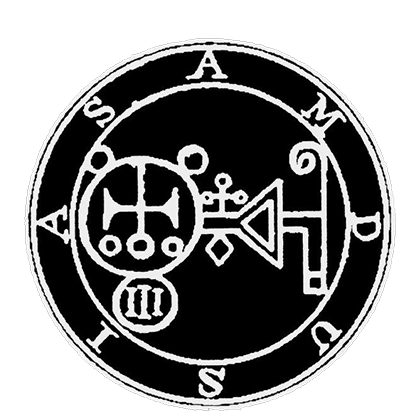
Sigil of Amdusias. Traditionally drawn on parchment and placed at the centre of the rite as the principal visual focus for the invocation.
Timing and Correspondences
- Correspondence: Wednesday
- Correspondence: the planetary hour of Mercury
- Correspondence: night during a waxing moon
- Correspondence: east, where breath and sound are first directed
These correspondences organize the rite; they do not replace preparation. Choose one coherent timing system and keep it throughout the operation rather than mixing several incompatible schemes.
Tools, Materials and Offerings
- the supplied sigil on parchment
- one white candle and one dark-green candle
- frankincense and myrrh
- a musical instrument or written score
- a clean glass of wine or water
- bread or fruit as a simple offering
- a recording device or notebook for melodies received after the rite
Offering: a completed piece of music, a disciplined hour of practice, bread, wine or the public performance of a work dedicated after completion
Every object should have one clear function. The sigil establishes identity. Candles establish duration and rank. Incense changes the atmosphere. The written petition fixes the purpose. The offering defines reciprocity. Unrelated objects divide attention and make the chamber difficult to close.
The Rite: Full Ceremonial Sequence
Step 1: Define the Petition
Write one principal request in a single paragraph. Name the desired result, the domain in which it may operate and the event that will mark completion. Remove vague phrases such as “give me power” or “show me everything.” The petition must be narrow enough that the answer can be recognized.
Name the composition, performance or creative obstacle. Ask for a melody, structure, endurance, confidence or decisive transformation. Do not ask for fame without naming the work that must earn it.
Step 2: Prepare the Body and Mind
On the day of the rite, avoid intoxication and unnecessary conflict. Bathe, change into clean clothing and spend at least twenty minutes in silence. Read the petition aloud once before entering the chamber. If the words sound confused, rewrite them before continuing.
Step 3: Construct the Chamber
Place the candles so they frame the working space without obstructing the sigil. Set the incense behind or beside the figure, never directly over it. Place the offering beyond the sigil and the written petition within reach. Keep water nearby and ensure that every flame can be extinguished safely.
A circle may be drawn or marked according to the practitioner’s established tradition. The sigil is placed beyond the inner boundary or at the central point assigned to manifestation. The arrangement should remain unchanged once the opening begins.
Step 4: Establish the Boundary
Stand facing the opening direction. Move clockwise around the chamber and state that only Amdusias is invited through the name and seal prepared for this rite. At each quarter, pause and acknowledge the boundary. Return to the center and remain silent until breathing is steady.
Speak:
This place is appointed, measured and closed against every unnamed presence. Let only the power called through the seal of Amdusias approach, and let that power remain within the purpose written before it.
Step 5: Place and Awaken the Sigil
Set the parchment where it can be seen without strain. Pass it once through the incense smoke without scorching it. Touch the lower edge of the figure and speak the name Amdusias slowly three times. Do not rush the pronunciation. Between each repetition, observe the flame, the smoke and the pressure of the room.
Step 6: Speak the Conjuration
Read the following address in a low, deliberate voice. Face the sigil. Do not shout unless the inherited ritual explicitly requires escalation; authority is carried by precision, not volume.
Amdusias, Duke of the unseen orchestra, horned power before whom the trees bend, enter this chamber through ordered sound. Awaken the music that has not yet found its instrument. Break the silence that has become stagnation. Let rhythm take form, let melody reveal its hidden path, and let the work named before you rise with force enough to be heard.
Repeat the address once if the atmosphere remains unchanged. After the second recitation, wait in silence. Do not continue repeating indefinitely. Repetition without recognition turns the rite into agitation.
Step 7: Recognize the Presence
Look for a sustained pattern rather than one isolated event. Note changes in temperature, sound, smell, memory, bodily pressure, dreamlike imagery or the behavior of smoke and flame. Ask aloud: “Are you Amdusias, called through this seal and within this appointed purpose?”
Wait for a response through the form already emerging. If the signs become chaotic, unrelated or hostile to the stated purpose, end the operation rather than forcing it forward.
Step 8: Deliver the Petition
Read the written petition exactly as prepared. Do not add names, promises or secondary desires. When the petition has been spoken, place the paper before the sigil and ask for one clear sign of acceptance, refusal or required correction.
If questions are part of the rite, ask them one at a time. Write the answer before speaking again. Silence is also an answer and should not be filled with improvised demands.
Step 9: Make the Offering and Seal the Exchange
Present the offering only after the petition has been heard. State what it represents and when any promised act will be completed. Never promise an offering that cannot be fulfilled.
Speak:
Amdusias, receive this sign of exchange. Let it mark the work requested, and let no further claim remain when the petition has reached its defined end.
Step 10: License to Depart
Thank the presence without abandoning authority. State that the operation is complete and that no aspect of the spirit, its attendants or the opened atmosphere may remain in the chamber.
Amdusias, the petition has been spoken and the exchange acknowledged. Depart now to your proper place in peace and order. Let every attendant withdraw, let every opened passage close, and let this chamber return wholly to ordinary time.
Repeat the dismissal once. Wait until the atmosphere noticeably changes before moving any object.
Step 11: Close and Record
Extinguish the candles in reverse order from the opening. Remove the offering according to its nature. Wash the hands and face, open the room to fresh air and write the first record immediately. Include the date, timing, exact petition, physical signs, thoughts, dreams and any event that follows during the next several days.
Manifestation Signs
- music heard at the edge of sleep
- a recurring melodic phrase that returns intact
- branches moving or wood creaking during still weather
- a sudden ability to hear the structural weakness in a composition
- dreams of trumpets, unicorns, forests or instruments playing without hands
A sign becomes meaningful when it repeats, corresponds to the spirit’s office and moves the petition toward a recognizable result. One unusual flame or one disturbing dream should not be treated as complete confirmation.
The Frightening Edge of the Rite
Amdusias magnifies sound and ambition. The practitioner may become intolerant of silence, obsessed with repetition or convinced that every noise contains a command. His current can make ordinary creative frustration feel like an enemy that must be broken. The rite must end with a defined piece of work, not an endless chase for greater intensity.
The deepest danger is often transformation that feels useful. The practitioner may begin to imitate the spirit’s temperament, organize daily life around the petition or interpret every coincidence as an order. The result must remain subordinate to the completion condition written before the rite.
Failure Patterns and Distortions
The operation weakens when the petition changes repeatedly, when symbols from unrelated systems are added without purpose, when fear becomes performance or when the practitioner refuses to close because no apparition appeared. Another failure is excess success: the requested current enters ordinary life more quickly and broadly than expected.
If the rite produces confusion, close it. Do not reopen the chamber the same night. Review the written petition, identify the ambiguous phrase and decide whether the operation should be repeated at all.
Completion and Aftermath
The rite is complete only when the petition has reached its defined result, the promised offering has been fulfilled and the practitioner is no longer waiting in suspended attention. Results may appear as information, opportunity, conflict, dream, correction, discovery, creative breakthrough or the removal of an obstacle.
Record what actually occurred rather than rewriting the event to resemble the expectation. When the work is complete, store or dispose of the sigil according to the practitioner’s established tradition. Do not leave the altar active indefinitely. A closed operation should look and feel closed.