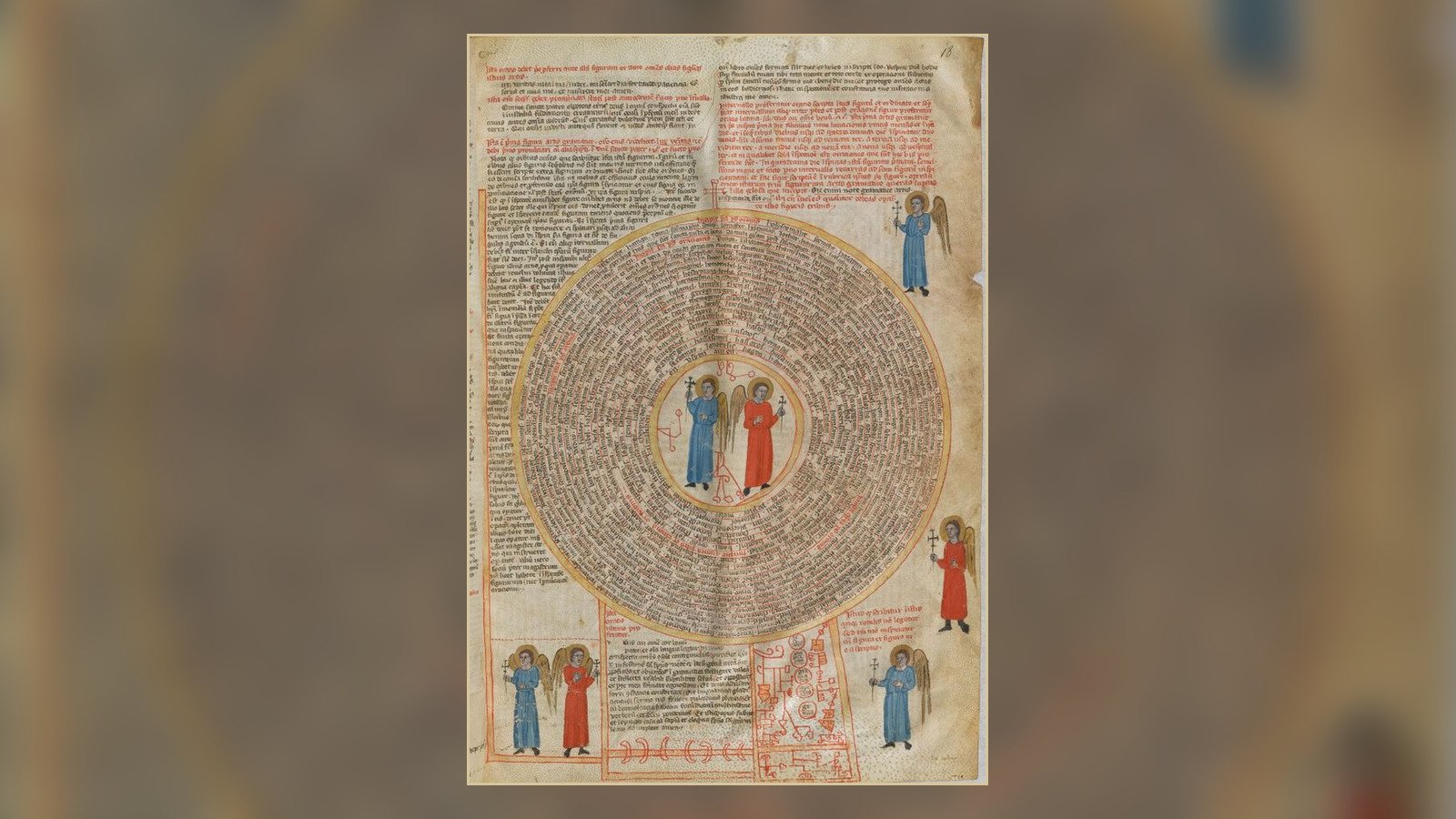
The image is almost impossible to read at once. Rings of words turn around angelic figures; red lines cross the parchment; sacred names gather into a diagram that seems part manuscript, part instrument. The Ars Notoria promised that such figures, approached through disciplined prayer, could open the arts and sciences to the human mind.
The Notory Art
Ars Notoria means the Notory Art, an art of sacred notes or figures. It belongs to the Solomonic ritual tradition but seeks intellectual transformation rather than command over a fixed catalogue of demons. The core texts developed in the twelfth and thirteenth centuries. Many manuscript versions survive. The result is a body of evidence that must be read through manuscripts, catalogues and the material history of the object rather than through later legend alone.
The surviving record places this material within a precise historical world. Prayers and figures promise memory, eloquence and rapid mastery of learning.. Every copied name, altered diagram, ownership mark or change of sequence records a decision made by a reader who believed the text deserved preservation. Those decisions are often as revealing as the stated operation itself.
Its ambition is among the most radical in medieval magic. The student does not ask for one answer but for the mind to be remade. In the culture that produced it, sacred language, natural philosophy, astrology, law and ritual were not always separated by the boundaries used today. The manuscript therefore speaks from a world in which knowledge could be devotional, technical and forbidden at the same time.
Read closely, this section also explains why the subject continued to generate fear. Its authority does not depend upon a modern claim that every operation worked exactly as promised. It rests on the historical fact that scribes, collectors, judges or practitioners treated the words as consequential—important enough to copy, hide, condemn, transport or preserve across generations.
Solomon and the Angelic Gift
The tradition claims that Solomon received the art from an angel, often named Pamphilius, and used it to obtain wisdom. This origin story binds magical technique to the biblical king’s divinely granted understanding. Manuscript front matter may depict the angel presenting a book. Prayers invoke the God of wisdom. The result is a body of evidence that must be read through manuscripts, catalogues and the material history of the object rather than through later legend alone.
The manuscript becomes clearer when its physical details are read beside its claims. The art is framed as revelation rather than invention.. Every copied name, altered diagram, ownership mark or change of sequence records a decision made by a reader who believed the text deserved preservation. Those decisions are often as revealing as the stated operation itself.
The legend makes knowledge itself a transmitted object. The angel gives not information but a method by which the limits of learning can be crossed. In the culture that produced it, sacred language, natural philosophy, astrology, law and ritual were not always separated by the boundaries used today. The manuscript therefore speaks from a world in which knowledge could be devotional, technical and forbidden at the same time.
Read closely, this section also explains why the subject continued to generate fear. Its authority does not depend upon a modern claim that every operation worked exactly as promised. It rests on the historical fact that scribes, collectors, judges or practitioners treated the words as consequential—important enough to copy, hide, condemn, transport or preserve across generations.
The Notae
The most distinctive elements are the notae: complex figures formed from circles, names, letters, crosses, angels and dense bands of text. They are contemplated in conjunction with prayers. Different notae correspond to arts or disciplines. Some occupy an entire page. The result is a body of evidence that must be read through manuscripts, catalogues and the material history of the object rather than through later legend alone.
What appears at first to be a single mystery is actually a chain of copying, use and reinterpretation. Colours and geometry organise sacred language into visual fields.. Every copied name, altered diagram, ownership mark or change of sequence records a decision made by a reader who believed the text deserved preservation. Those decisions are often as revealing as the stated operation itself.
A nota is neither illustration nor ordinary diagram. It is a ritual surface intended to be looked at, spoken around and mentally entered. In the culture that produced it, sacred language, natural philosophy, astrology, law and ritual were not always separated by the boundaries used today. The manuscript therefore speaks from a world in which knowledge could be devotional, technical and forbidden at the same time.
Read closely, this section also explains why the subject continued to generate fear. Its authority does not depend upon a modern claim that every operation worked exactly as promised. It rests on the historical fact that scribes, collectors, judges or practitioners treated the words as consequential—important enough to copy, hide, condemn, transport or preserve across generations.
Grammar, Logic and the Liberal Arts
The art addresses the medieval curriculum: grammar, rhetoric, dialectic, arithmetic, geometry, music and astronomy, with theology and philosophy appearing in expanded traditions. Specific prayers and figures correspond to disciplines. The practitioner seeks understanding, retention and eloquence. The result is a body of evidence that must be read through manuscripts, catalogues and the material history of the object rather than through later legend alone.
The archive preserves both the ambition of the text and the limitations of what can now be known. Education is imagined as a hierarchy that can be opened through divine assistance.. Every copied name, altered diagram, ownership mark or change of sequence records a decision made by a reader who believed the text deserved preservation. Those decisions are often as revealing as the stated operation itself.
The manuscript turns the school into a sacred cosmos. Each art has a gate, and each gate has names that must be approached in order. In the culture that produced it, sacred language, natural philosophy, astrology, law and ritual were not always separated by the boundaries used today. The manuscript therefore speaks from a world in which knowledge could be devotional, technical and forbidden at the same time.
Read closely, this section also explains why the subject continued to generate fear. Its authority does not depend upon a modern claim that every operation worked exactly as promised. It rests on the historical fact that scribes, collectors, judges or practitioners treated the words as consequential—important enough to copy, hide, condemn, transport or preserve across generations.
Prayer as Intellectual Technology
The Ars Notoria is saturated with prayers, many containing long sequences of sacred or nonstandard words. Repetition, timing and purity structure their use. The operator recites at appointed hours. Preparatory confession and fasting appear in some versions. The result is a body of evidence that must be read through manuscripts, catalogues and the material history of the object rather than through later legend alone.
The surviving record places this material within a precise historical world. Prayers are repeated in cycles tied to the chosen art.. Every copied name, altered diagram, ownership mark or change of sequence records a decision made by a reader who believed the text deserved preservation. Those decisions are often as revealing as the stated operation itself.
Speech becomes an instrument for shaping memory. The desired miracle is not spectacle before witnesses but a transformation inside the mind. In the culture that produced it, sacred language, natural philosophy, astrology, law and ritual were not always separated by the boundaries used today. The manuscript therefore speaks from a world in which knowledge could be devotional, technical and forbidden at the same time.
Read closely, this section also explains why the subject continued to generate fear. Its authority does not depend upon a modern claim that every operation worked exactly as promised. It rests on the historical fact that scribes, collectors, judges or practitioners treated the words as consequential—important enough to copy, hide, condemn, transport or preserve across generations.
The Discipline of Days and Hours
The ritual may extend across weeks or months. Calendrical order regulates when figures are viewed and prayers spoken, making knowledge dependent upon endurance. Some versions distinguish general prayers from those for specific arts. Lunar or liturgical timing can matter. The result is a body of evidence that must be read through manuscripts, catalogues and the material history of the object rather than through later legend alone.
The manuscript becomes clearer when its physical details are read beside its claims. Failure to follow sequence threatens the operation.. Every copied name, altered diagram, ownership mark or change of sequence records a decision made by a reader who believed the text deserved preservation. Those decisions are often as revealing as the stated operation itself.
The promise of instant knowledge is therefore misleading. The art replaces years of ordinary study with an equally severe regime of sacred attention. In the culture that produced it, sacred language, natural philosophy, astrology, law and ritual were not always separated by the boundaries used today. The manuscript therefore speaks from a world in which knowledge could be devotional, technical and forbidden at the same time.
Read closely, this section also explains why the subject continued to generate fear. Its authority does not depend upon a modern claim that every operation worked exactly as promised. It rests on the historical fact that scribes, collectors, judges or practitioners treated the words as consequential—important enough to copy, hide, condemn, transport or preserve across generations.
Suspicion and Condemnation
The tradition’s Christian language did not protect it from criticism. Theologians feared that unknown names and visual figures concealed demonic assistance beneath apparent devotion. Thomas Aquinas discussed an ars notoria as illicit. Church authorities could treat noncanonical prayers as superstition. The result is a body of evidence that must be read through manuscripts, catalogues and the material history of the object rather than through later legend alone.
What appears at first to be a single mystery is actually a chain of copying, use and reinterpretation. Manuscripts sometimes omit or alter controversial material.. Every copied name, altered diagram, ownership mark or change of sequence records a decision made by a reader who believed the text deserved preservation. Those decisions are often as revealing as the stated operation itself.
The accusation cut to the heart of the system: if knowledge arrived beyond ordinary study, what intelligence had truly delivered it? In the culture that produced it, sacred language, natural philosophy, astrology, law and ritual were not always separated by the boundaries used today. The manuscript therefore speaks from a world in which knowledge could be devotional, technical and forbidden at the same time.
Read closely, this section also explains why the subject continued to generate fear. Its authority does not depend upon a modern claim that every operation worked exactly as promised. It rests on the historical fact that scribes, collectors, judges or practitioners treated the words as consequential—important enough to copy, hide, condemn, transport or preserve across generations.
Sloane MS 1712 and the Visual Archive
British Library Sloane MS 1712 preserves two Ars Notoria texts with prayers, angelic names, rituals and elaborate figures. Other witnesses in Paris, Oxford and elsewhere reveal multiple recensions. BnF Latin 9336 contains a celebrated figure of grammar. Bodleian manuscripts preserve variant notae. The result is a body of evidence that must be read through manuscripts, catalogues and the material history of the object rather than through later legend alone.
The archive preserves both the ambition of the text and the limitations of what can now be known. Colours, captions and textual rings differ across copies.. Every copied name, altered diagram, ownership mark or change of sequence records a decision made by a reader who believed the text deserved preservation. Those decisions are often as revealing as the stated operation itself.
The art cannot be understood from transcription alone. Its argument is visual, and every surviving page is a map of how knowledge was imagined to descend. In the culture that produced it, sacred language, natural philosophy, astrology, law and ritual were not always separated by the boundaries used today. The manuscript therefore speaks from a world in which knowledge could be devotional, technical and forbidden at the same time.
Read closely, this section also explains why the subject continued to generate fear. Its authority does not depend upon a modern claim that every operation worked exactly as promised. It rests on the historical fact that scribes, collectors, judges or practitioners treated the words as consequential—important enough to copy, hide, condemn, transport or preserve across generations.
From Manuscript Secrecy to Printed Art
Robert Turner published an English Ars Notoria in 1657, bringing a transformed version into print. Modern scholarship has continued to identify manuscript families and ritual layers. Print removed many material differences. Occult revivals treated the work as a Solomonic classic. The result is a body of evidence that must be read through manuscripts, catalogues and the material history of the object rather than through later legend alone.
The surviving record places this material within a precise historical world. Digital facsimiles now restore access to the notae.. Every copied name, altered diagram, ownership mark or change of sequence records a decision made by a reader who believed the text deserved preservation. Those decisions are often as revealing as the stated operation itself.
The pages remain difficult because they were designed to exceed reading. The Ars Notoria asks the eye to encounter language as image and the mind to become worthy of what the image withholds. In the culture that produced it, sacred language, natural philosophy, astrology, law and ritual were not always separated by the boundaries used today. The manuscript therefore speaks from a world in which knowledge could be devotional, technical and forbidden at the same time.
Read closely, this section also explains why the subject continued to generate fear. Its authority does not depend upon a modern claim that every operation worked exactly as promised. It rests on the historical fact that scribes, collectors, judges or practitioners treated the words as consequential—important enough to copy, hide, condemn, transport or preserve across generations.
The Manuscript as Witness
The enduring importance of Ars Notoria lies in the convergence of text and object. A title alone cannot show how the work changed: one must examine handwriting, parchment or paper, pigments, bindings, ownership notes, omissions and the order in which separate texts were placed together. These details reveal whether a copy was made for use, collection, instruction, defence or concealment. They also show why modern printed editions, however valuable, can create the illusion of a stable book where the historical record preserves a family of changing witnesses.
Institutional catalogues have become essential to this reconstruction. Shelf marks that appear dry or technical are the coordinates of survival. They identify the exact volume, distinguish one recension from another and prevent famous titles from absorbing unrelated material. For SatanWorld, those catalogue identities are treated as part of the story: the route from private hand to royal cabinet, confiscated collection, antiquarian sale or national library explains how forbidden knowledge crossed the centuries.
The visual record is equally important. A circle, initial, seal, table or miniature cannot be replaced by a verbal summary without loss. Images determine the pace of reading and often carry information that the words do not explain. For that reason, this article presents historical images with their holding institution and reuse status, while original editorial diagrams are clearly identified as modern explanatory work rather than manuscript facsimiles.
What the Darkness Preserved
The Ars Notoria and the Forbidden Art of Perfect Knowledge belongs to forbidden history because the work survived a repeated conflict over who could possess knowledge and by what authority. The danger attributed to it changed with time: demonic assistance, unauthorised revelation, unlawful prosecution, secret communication, intellectual pride or the fear that a diagram might make inaccessible power portable. Yet each generation that feared the material also helped define and preserve it.
The final mystery is therefore not only whether a spirit appeared, a talisman received celestial force or a prayer transformed memory. It is why human beings continued to copy these instructions when copying was slow, possession could be dangerous and many of the names were barely understood. The answer lies somewhere between faith, ambition and the refusal to accept that the visible world contains all available knowledge.