Every five years, near the summer solstice, visitors climb into Montebello Castle to listen for a child who vanished in 1375. The recording played in the darkness is brief and indistinct. Some hear a voice. Others hear crying, wind, a name or nothing more than the mind forming language inside noise. The legend says the sound belongs to Guendalina, an albino girl called Azzurrina because dye placed on her white hair gave it blue reflections. She disappeared while chasing a ball toward the castle’s ice chamber. Her guards found no body, no exit and no explanation. History cannot confirm that the child existed. The castle, however, has made her absence one of the most enduring ghosts in Italy.
Montebello Above the Marecchia Valley
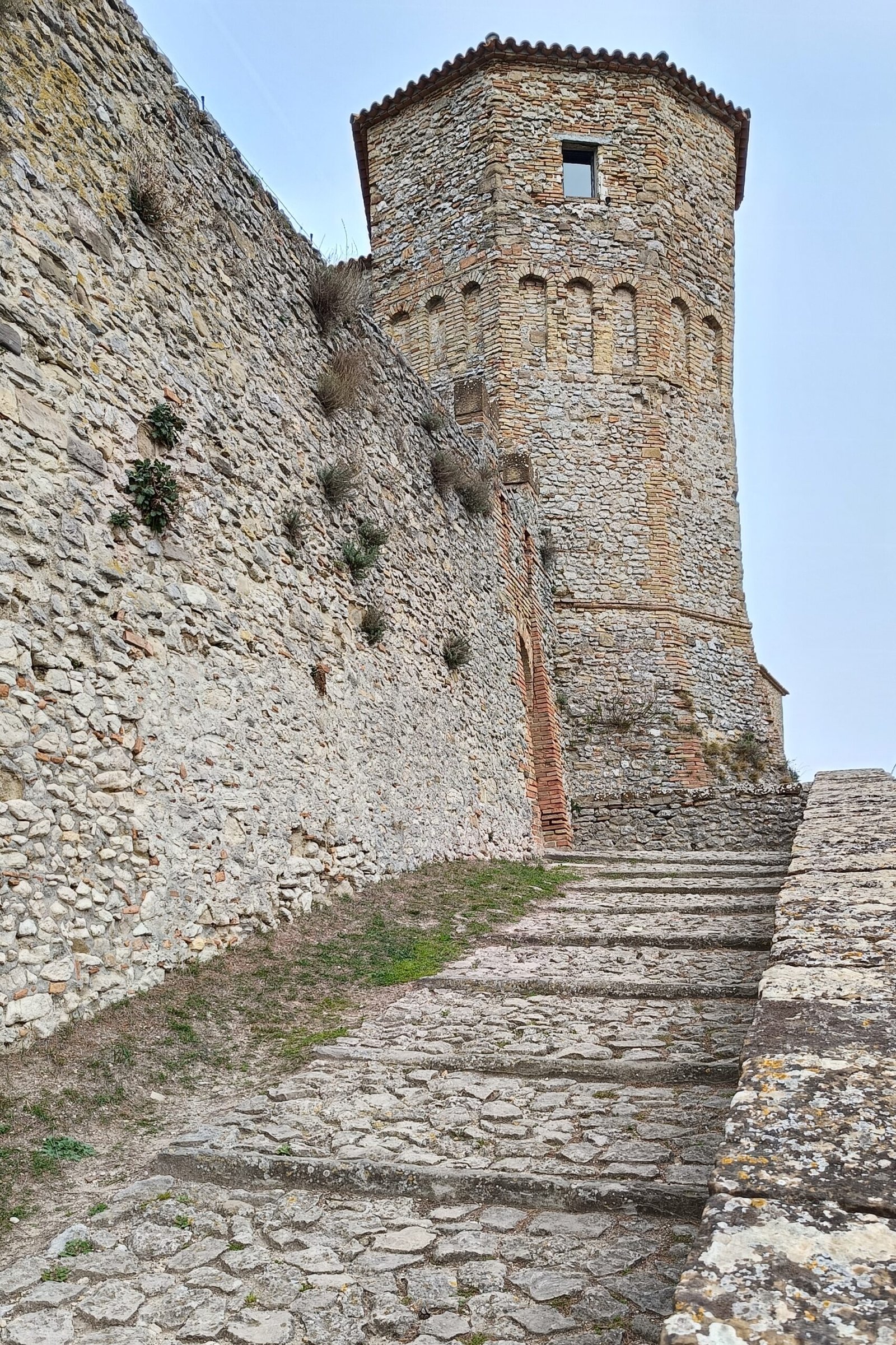
The castle stands above the Marecchia valley in the territory of Poggio Torriana, Emilia-Romagna. Its position is defensive: stone walls crown a height from which routes through the landscape can be watched. The site developed across centuries, passing through noble families and periods of conflict. Its surviving rooms contain the layered atmosphere expected of a fortress altered into a residence—narrow passages, heavy walls, steep descents and chambers whose original purposes are difficult for modern visitors to read.
The Azzurrina story is now inseparable from the castle’s identity, but it does not appear securely in medieval chronicles. Official tourism sources present it as legend, sometimes allowing for an uncertain historical core. Critical investigations emphasize that no known fourteenth-century document confirms Guendalina’s birth, disappearance or family.
That absence does not end the story. It defines it. A child said to have vanished without a body also vanished from the archive.
The Girl Called Guendalina
According to the most familiar version, Guendalina was the daughter of Ugolinuccio or Uguccione Malatesta, lord of Montebello. She was born with albinism, a condition that would have made her pale skin, light-sensitive eyes and white hair conspicuous in a medieval household.
The legend says her mother feared the superstition surrounding such appearance and attempted to darken the child’s hair. The dye did not take normally. Mixed with the natural white, it produced pale blue or azure reflections. From this came the name Azzurrina—“the little blue one.”
This detail is perfect folklore. It gives the ghost a colour, a visual signature and a reason to be hidden. It also reflects modern ideas about medieval persecution that may be exaggerated when applied to one undocumented child. People with albinism could certainly experience danger, stigma and misunderstanding, but no source proves that Guendalina was concealed for this reason.
The name turns difference into destiny. Before the disappearance occurs, the story has already marked the girl as someone the world does not know how to hold.
The Solstice of 1375
The date traditionally given is 21 June 1375. It was the summer solstice and, in later popular imagination, a day already charged with thresholds, light and hidden forces. Guendalina was playing inside the castle while two guards watched her. A ball or cloth toy rolled away. She followed it down a staircase toward the nevaio, the chamber where snow and ice were stored to preserve food.
The guards heard a cry. They descended and found the chamber empty. The toy was gone or abandoned, depending on the version. The child could not be found in the ice pit, corridors, wells, walls or surrounding grounds.
A real disappearance inside a fortress would have produced search, accusation and political consequence. The absence of a contemporary record is therefore significant. The story survives through later oral tradition, not through a documented investigation from 1375.
Yet the scene is built with extraordinary force. A child runs downward on the brightest day of the year. The guards remain above. A cry rises from a chamber designed to keep winter inside summer. Then there is no body.
The Ice Chamber
The nevaio functions as the legend’s underworld. Such chambers were practical structures, often deep, cold and difficult to access. Snow collected in winter could be compacted and insulated for use through warmer months. To a child, the descent might have been dangerous. To later storytellers, it offered a place where disappearance could occur without an open gate.
Some versions suggest hidden passages, a collapsed tunnel or a shaft through which Guendalina fell. Architectural surveys have not produced a universally accepted mechanism. The chamber’s physical reality gives the legend enough plausibility to resist complete dissolution. Castles contain sealed spaces, rebuilt floors and forgotten voids. A vanished child seems possible wherever the building itself remains incomplete to knowledge.
The cold also changes the emotional texture. Azzurrina is not imagined wandering through sunlit courtyards. She is heard beneath stone, near a place where ice was stored and darkness preserved.
The Missing Chronicle
Supporters of the legend sometimes cite a seventeenth-century text called “Mons Belli et Deline” or a similar title, said to have collected the story after approximately three centuries of oral transmission. The document is difficult to verify independently. Its location, authorship and exact contents are not available in a manner that allows historians to examine it as a secure source.
Other accounts attribute the first written version to later local historians, including an early twentieth-century work associated with Tommaso Molari. The bibliography shifts according to the storyteller. This uncertainty suggests that the legend’s documentary foundation was constructed after oral tradition had already changed it.
A three-hundred-year silence is not impossible in folklore. Stories can survive locally without official preservation. But oral survival does not protect names, dates and relationships from alteration. The exact date of 21 June 1375 may be an old memory, a later calculation or a literary choice.
The castle’s official presentation preserves the legend. Critical writers ask where the first verifiable text begins. Between those positions lies the space in which Azzurrina became real to generations who never saw a medieval record.
The Five-Year Return
The ghost is said to make herself heard every five years, in years ending in zero or five, near the anniversary of the disappearance. The interval gives the haunting a calendar and creates periods of expectation. Visitors know when the next return should occur. Recording sessions can be planned. Silence itself becomes suspense.
Why five years? The legend offers no securely ancient explanation. The pattern may have developed through modern investigation and publicity. Once repeated, it becomes self-reinforcing. A sound captured in the expected year is evidence; an uneventful year between cycles does not count against the story because the ghost was not due.
This rhythm transformed Azzurrina from a continuously wandering spirit into an appointed voice. She does not merely haunt the castle. She returns according to a schedule the living can anticipate.
The 1990 Recording
The modern legend expanded after the castle opened more fully to visitors near the end of the 1980s. A recording made in 1990, often associated with a RAI television investigation, captured sounds interpreted by some listeners as a child’s voice or cry. Later sessions produced additional audio. These recordings became central to tours and media coverage.
Electronic voice phenomena occupy an uncertain territory. Recorders capture echoes, handling noise, radio interference, distant visitors, animals, wind and the movement of buildings. Human hearing is highly responsive to suggestion. Once a listener is told that a child’s name can be heard, ambiguous sound begins to organize itself around that expectation.
Different listeners hear different words in the Azzurrina recordings. That disagreement is not a minor problem. It is the mechanism by which the audio becomes participatory. Every person completes the voice.
The recordings are authentic objects in the history of the modern haunting. Their supernatural source remains unproved.
A Voice Manufactured by Expectation?
Pareidolia is the mind’s tendency to find meaningful patterns in uncertain stimuli. In audio, it can make random noise resemble language. This does not require foolishness. The human brain is designed to detect voices, especially the cry of a child. Survival depends upon hearing significance quickly.
The tour environment strengthens the effect. Visitors enter an old castle, hear the disappearance story, descend toward dark rooms and then listen together. The emotional preparation is intense. A faint sound does not arrive neutrally. It arrives as the possible answer to six centuries of absence.
Sceptical analysis can explain why people hear a voice without proving that every sound has been identified. Believers can accept acoustic uncertainty while maintaining that the timing and quality are meaningful. The recording remains effective because it cannot be cleanly resolved by ordinary listening.
The Growth of the Legend After 1989
Critical reporting notes that Azzurrina’s national fame increased dramatically after the castle’s museum and tour activity developed around 1989. Television brought the story to a mass audience. The recordings gave visitors something more immediate than an old legend: a sound they could hear themselves.
This chronology does not prove that the story was invented for tourism. It does show that modern presentation shaped the form in which most people now know it. The five-year cycle, the listening sessions and the emphasis on audio are features of the contemporary haunting culture surrounding the castle.
Tourism can preserve architecture and local memory. It can also standardize folklore. A story repeated several times each day becomes polished. Contradictions disappear. The most emotional details survive because they hold attention.
Azzurrina’s white hair, blue reflections, rolling ball and final cry form a narrative so complete that the missing evidence becomes easy to overlook.
The Medieval Child Behind a Modern Ghost
Whether Guendalina existed, the legend speaks to real historical vulnerabilities. Children in noble households could be used in marriage alliances, hidden during conflict and disciplined under structures that left little personal testimony. Disability and visible difference could expose a person to fear or protective concealment. Castles contained hazards modern visitors encounter only behind barriers.
The story also reflects the grief of a disappearance without burial. A body allows ritual, accusation and memory to settle. A missing child creates endless return. Every noise below the stairs can be the moment before discovery.
Azzurrina is therefore less like a ghost who seeks revenge than a child whose story cannot reach an ending. She is always chasing the object that rolled away. The guards are always one flight above. The cry is always about to be understood.
Attempts to Identify the Sound
Paranormal investigators have analysed the recordings through filtering, slowing and amplification. Such processing can reveal low-volume features, but it can also create artefacts and increase the temptation to hear words. Without a controlled baseline recorded under identical conditions, it is difficult to distinguish unusual sound from the castle’s normal acoustic behaviour.
A rigorous investigation would require repeated recordings across expected and non-expected years, environmental monitoring, controlled access, microphone mapping and blind listening tests in which participants receive no suggested phrase. Publicly available evidence does not satisfy all these conditions.
This does not make the recordings worthless. They document how the modern legend sounds. They preserve the moment when a medieval story acquired an electronic voice.
What Remains
No known medieval document proves that Guendalina Malatesta disappeared at Montebello on 21 June 1375. The alleged later manuscript is not independently secure. The details of albinism, dye and the five-year return may have evolved through oral and modern storytelling. The recordings are ambiguous and strongly affected by expectation.
Yet Azzurrina has become one of Italy’s most recognizable child ghosts because the legend is built around a perfect absence. There is no tomb to visit, no portrait to identify and no body to contradict the story. The castle contains only the route downward and the belief that a voice sometimes rises back.
At Montebello, scepticism does not silence the recording. It changes what the listener fears. Perhaps the sound is only stone, air and human expectation. But expectation itself has occupied the castle so completely that every five years, people gather to hear a child whom history forgot to record.
Sources and Further Reading
This article uses the official Castello di Montebello presentation of the legend, Emilia-Romagna tourism material, critical reporting on the missing documentary foundation and modern growth of the story, discussions of the 1990 and later recordings, and the authentic exterior photograph credited below. The article does not present the alleged medieval biography or supernatural origin of the audio as established historical fact.
- https://www.castellodimontebello.com/la-leggenda
- https://www.wired.it/play/cultura/2014/07/04/il-castello-di-montebello-e-il-fantasma-di-azzurrina/
- https://www.cicap.org/articolo/il-cicap-rende-pubbliche-le-registrazioni-dei-suoni-del-castello-di-azzurrina-nessun-fantasma
- https://castelliemiliaromagna.it/en/s/poggio_torriana/6051-castello_di_montebello/
- https://commons.wikimedia.org/wiki/File:Poggio_Torriana_-_Castello_di_Montebello_di_Torriana_-_2024-09-10_20-17-27_001.jpg