
The Duke Was Feared at Sea because Wind and Death Were Joined in His Office
Focalor is one of the seventy-two spirits of the Ars Goetia, where it is described as a duke whose office commands winds and seas, overturns ships and is linked with drowning or maritime destruction.
In the SatanWorld archive, the article treats Focalor as a historical Goetic figure shaped by the Lemegeton manuscript tradition, by earlier demonological catalogues, and by later occult printing and interpretation. The name therefore belongs to a living chain of transmission rather than to one isolated book page.
Name and Identity
The canonical name is Focalor, but the record preserves aliases such as Forcalor, Focalor the Duke, Forty-First Spirit. Those forms are part of the transmission history and help trace how copyists, translators and editors reshaped the same spirit across centuries.
The Ars Goetia does not present Focalor as a free-floating mythological creature. It presents a ranked spirit with a title, a numerical host, a defined office and a recognizable drawn sign. That combination of rank, office and drawing is what gave the entry its enduring authority in later ceremonial magic.
Traditional Ars Goetia Drawing
!Traditional Ars Goetia drawing or seal of Focalor
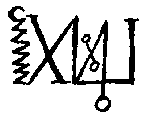
Traditional drawing associated with Focalor, reproduced from the historical Goetic seal collection preserved by Esoteric Archives. The drawing is included for documentary and iconographic study.
The traditional Ars Goetia drawing or seal associated with Focalor belongs to the manuscript and print history of the Ars Goetia itself. In older copies of the Lemegeton, the drawing is not mere decoration. It functions as the identifying mark by which the spirit is recognized, differentiated from its neighbors and linked to a chain of textual transmission.
For Focalor, the historical drawing survives through manuscript copying, later print stabilization and modern occult republication. The design often changes in line weight, curvature, orientation or spacing, but its core pattern remains stable enough to mark continuity. In many cases the Weyerian tradition records the spirit before the seal is fully standardized, so the drawing became most familiar through the Lemegeton and through nineteenth- and twentieth-century editions.
This archive includes the corresponding Ars Goetia drawing as a historical reference point, not as a practical working instruction. The drawing matters because it reveals how grimoire culture preserved identity visually, how editors regularized unstable manuscripts, and how modern occultism often mistakes one late printed form for the totality of the tradition.
The Oldest Recoverable Record
The oldest widely cited textual layer for Focalor is the sixteenth-century demonological tradition associated with Johann Weyer, followed by the seventeenth-century Lemegeton manuscripts in which the spirit receives a clearer Goetic framing. The Lemegeton does not emerge from nowhere; it inherits, reorganizes and ritualizes earlier catalogues.
The first surviving document is not assumed to mark the beginning of belief. It marks the beginning of securely traceable evidence. That distinction matters because the history of Focalor is a history of copying, interpretation, omission and revival, not a simple invention on one date.
Chronology of the Tradition
1563: Weyer’s Pseudomonarchia Daemonum helps establish the wider demonological milieu from which many Goetic names, including Focalor, are transmitted or stabilized.
Seventeenth century: Lemegeton manuscripts circulate with a more defined rank, legion count, office and drawn sign for Focalor.
Nineteenth to early twentieth century: ceremonial and occult editions make the spirit widely accessible to English-speaking readers and standardize the modern printed seal.
Contemporary period: websites, handbooks and popular media detach Focalor from its manuscript context, often simplifying the spirit into a one-line stereotype.
Chronology prevents late occult certainty from replacing the historical record.
Rank, Legions and Office
In the standard Ars Goetia sequence, Focalor is a duke who rules thirty legions. The numerical host signals rank and authority inside a Solomonic hierarchy. The office is concise but dense: commands winds and seas, overturns ships and is linked with drowning or maritime destruction.
Goetic offices should not be read as abstract fantasy alone. They reveal what the compilers believed spirits could govern: language, love, strategy, illness, reputation, treasure, invisibility, movement, the dead, learning or destruction. Each office exposes a part of the social imagination that produced the grimoire.
Manifestation and Iconography
He appears as a man with griffin wings, often standing above turbulent water or carrying the atmosphere of a storm.
The iconography of Focalor is never just aesthetic. It is evidence. When later artists make the body more theatrical, more cinematic or more monstrous, the change tells us something about how modern readers want the spirit to look. The article therefore distinguishes manuscript-supported form from later dramatic embellishment.
Powers and Knowledge
The attributed powers of Focalor follow directly from the office: commands winds and seas, overturns ships and is linked with drowning or maritime destruction. Within Goetic literature, these powers are not presented as poetic metaphors only. They are presented as claims of spirit authority that later readers systematized, doubted, reinterpreted or sensationalized.
The archive records those claims historically. It does not flatten them into either naive belief or dismissive skepticism. Instead, it asks what sort of world had to be imagined for such powers to become intelligible, feared and desirable.
Recorded Encounters and Later Legends
The tradition says Focalor hoped for restoration to the seventh throne after a thousand years, another fragment of fallen celestial memory.
Unlike some folkloric beings, Focalor is not sustained by a vast cycle of village tales. The strongest record is textual: lists, descriptions, translated editions and the interpretive layer added by ceremonial commentators. That does not make the presence weak. It makes the archive different. A grimoire spirit lives through written transmission, visual repetition and specialist commentary.
Manuscript Variations and Seal Transmission
Some copies preserve incorrect legion counts, and the wording about warships and drowning changes between Weyer and the Goetia.
With Goetic spirits, the question of variation always includes the drawn sign. A name may shift, a rank may wobble, a legion count may be copied incorrectly, and the seal may gain or lose minor strokes across editions. These changes do not automatically produce a new entity. Often they reveal exactly how a tradition is preserved under the pressure of manuscript copying and print regularization.
Hierarchy and Relationships
Focalor belongs within the larger architecture of the seventy-two spirits and is best read in relation to neighboring entries, parallel offices and the wider Solomonic myth of command. The spirit is therefore linked with related Goetic entities, not because all such spirits are interchangeable, but because comparison clarifies how a specific office was positioned.
The nearest relationships are both textual and functional. Some spirits govern knowledge, others reconciliation, others love, war, treasure, rhetoric or the dead. Reading Focalor beside those neighboring offices gives a more accurate picture than isolating the spirit as a modern standalone icon.
Rites, Customs and Historical Use
Historical ceremonial use forms part of the source context, but this archive does not reproduce operational conjurations, names of authority, timings, circle procedure or practical instructions. What matters here is the cultural logic of the Ars Goetia: ranked spirits, visual seals, prescribed hierarchy, and the expectation that knowledge and danger arrive together.
The associated drawing is discussed as a historical artifact of recognition. The article does not encourage operational use of the drawing, and it does not treat the seal as a piece of neutral decorative design detached from grimoire history.
Signs, Recognition and Misrecognition
Focalor is recognized historically through the convergence of four elements: the name, the rank, the office and the drawing. When one of those is altered beyond recognition, later readers may misidentify the spirit or project a different entity onto the same seal.
Misrecognition is one of the chief problems in modern occult culture. A popular image, a horror film or a loosely copied internet sigil can quickly replace the actual manuscript line of transmission. The article therefore keeps the historical identity of Focalor anchored to the older record.
Dangers and Misreadings
The principal danger around Focalor is not only the spirit’s attributed office but the ease with which later readers romanticize or simplify it. A spirit of love becomes a romance icon, a spirit of destruction becomes a horror mascot, a spirit of learning becomes an ahistorical wise guide. The older texts are rarely that simple.
Another danger lies in operationalizing corrupted material. Late copies, invented seals and false historical claims can circulate faster than accurate manuscript information. The responsible approach is historical literacy, not theatrical certainty.
Later Transformation and Cultural Afterlife
From the nineteenth century onward, Focalor passed out of restricted manuscript culture into a wider occult and popular sphere. Printed grimoires, ceremonial orders, paperback demonologies and digital compilations gave the spirit a second life. In that process, certain features became exaggerated: the dramatic body, the promise of specialized power, the supposed fixity of one standardized seal.
The modern afterlife of Focalor therefore matters as much as the early record. It shows how old grimoires are remade by each generation. What SatanWorld preserves is the distinction between the earliest recoverable layer and the later myth of universal occult certainty.
Related Entities
Sources
- Ars Goetia, in The Lesser Key of Solomon. https://www.sacred-texts.com/grim/lks/index.htm
- Johann Weyer, Pseudomonarchia Daemonum. https://www.esotericarchives.com/solomon/weyer.htm
- Sloane Manuscripts and the Lemegeton Tradition. https://search.worldcat.org/search?q=Lemegeton+Sloane+manuscripts
- The Lesser Key of Solomon and Goetic Transmission. https://search.worldcat.org/search?q=Lesser+Key+of+Solomon+Goetia+scholarship