In April 1662, the sound of a drum began inside John Mompesson’s house at Tedworth. The instrument had been confiscated from a wandering drummer named William Drury, but no hand touched it. Night after night the beats moved through the chambers, answered military signals and gathered scratching, panting and footsteps around the children’s beds. The house had taken possession of the drum.
The Magistrate and the Wandering Drummer
John Mompesson was a Wiltshire landowner, magistrate and militia officer. In March 1662, while away from his home at Tedworth, he received complaints about a wandering drummer who travelled with a document that authorities considered false. Mompesson ordered the man’s drum seized.
The drummer was William Drury. He demanded the instrument’s return and reportedly spoke words later remembered as a threat. The drum was sent to Mompesson’s house. The man continued on his troubled road through the legal system.
A few weeks later, the household heard knocking outside. The sounds shifted to the roof, doors and chambers. Then the confiscated drum began to beat.
The Drum Without a Hand
The instrument sounded at night while lying untouched. It produced familiar military patterns and answered signals made by those in the room. Mompesson, trained through the militia to recognize drum calls, heard rhythms too organized to be random vibration.
Sometimes the drumming rose with enough force to shake the house. At other times it moved from place to place, receding when searched and beginning again after the family returned to bed.
The connection with Drury was immediate. A confiscated object associated with a threatened man had become the centre of an invisible retaliation. The household understood the disturbance as witchcraft or the action of a spirit sent through the drum.
The Children Under Attack
The disturbances concentrated around Mompesson’s children. Their beds shook. Scratching came from beneath mattresses and along the wooden frames. A panting sound, like a dog or large animal breathing close by, filled the darkness.
Bedclothes were pulled. A force seemed to press or strike. The children heard movement around them while adults searched the room. The haunting used the vulnerability of sleep, returning after candles were extinguished.
Joseph Glanvill’s later account described the family enduring these attacks over many months. The drum had opened the story, but the unseen visitor no longer required the instrument. It had entered the chambers.
Scratching, Panting and the Smell of Sulphur
The Tedworth phenomena developed a broad sensory range. There were knocks, drumming, footsteps, rustling and scratching. Witnesses reported foul smells associated with brimstone or sulphur, substances linked in Christian imagination with infernal presence.
Invisible movement passed through rooms. Chairs and objects were disturbed. At times a light appeared or something flashed through the darkness. The entity seemed capable of imitating animals and using the walls as a surface for communication.
The sounds could be playful, mocking or violent. They answered challenges. They intensified when observed. The intelligence appeared to understand the attention directed toward it.
A House Opened to Witnesses
Mompesson invited neighbours, clergy and gentlemen to observe. The case spread through Restoration England because the witnesses were not confined to servants or children. Visitors entered expecting to catch a trick and heard the disturbance themselves.
Some sat beside the beds with hands placed where movement could be felt. Others searched adjoining rooms. The sounds shifted beyond reach. The haunting appeared to perform under inspection while refusing to reveal a body.
The openness of the house strengthened Mompesson’s reputation. He did not hide the family or sell secret access. He allowed sceptical guests to test what they had heard.
Joseph Glanvill at Tedworth
Joseph Glanvill was a clergyman, philosopher and defender of belief in spirits and witchcraft. He visited Tedworth in January 1663. His account became the foundation of the case’s enduring fame.
Glanvill examined rooms and questioned the family. During the night, he heard scratchings near the children’s bed. A dog placed in the room reacted with fear. The disturbance seemed to move in response to investigation.
For Glanvill, Tedworth supplied evidence against the rising confidence of those who denied the invisible world. He believed rejection of spirits threatened religion itself. If no spirits existed, biblical miracles and demonic encounters could be dismissed. The drummer’s house became part of a larger defence of Christianity.
The Invisible Thing Beneath the Bed
One experiment involved searching below the children’s mattress while the scratching continued. Hands found no animal or mechanism. The sounds travelled, sometimes occurring near a witness’s fingers and then moving away.
The entity appeared to occupy an impossibly narrow space between body, bedding and frame. It could touch without being grasped. The closer the observers came, the more precisely it demonstrated absence.
The same pattern appears throughout the case. Every sound suggested a physical cause—a drummer, dog, rat or hidden servant—but the source vanished at the moment of contact.
William Drury in Custody
While the Mompesson household suffered, William Drury faced prosecution for unrelated offences. He was accused of theft and brought before authorities in 1663. Reports tied his fortunes to the haunting: when he was restrained or transported, disturbances altered; when his situation changed, they returned.
At his trial on 31 March 1663, Drury was convicted of stealing pigs. He claimed benefit of clergy, a legal privilege that could spare certain offenders from execution, and was sentenced to transportation.
Stories circulated that he had boasted of plaguing Mompesson or arranged the disturbance through witchcraft. The exact words vary in the sources, but his identity became inseparable from the drum. The alleged curse supplied the haunting with a human origin while leaving its mechanism invisible.
The Restoration World
Tedworth occurred only two years after the restoration of Charles II. England had passed through civil war, regicide, republic and the return of monarchy. Religious and political certainties had been violently overturned.
Debate over witchcraft and spirits carried more than folkloric interest. Learned men argued whether invisible agents could act upon matter. The new experimental philosophy encouraged observation; Glanvill used observation to defend supernatural reality.
The drummer therefore entered a world divided not simply between belief and reason, but between competing claims to evidence. The scratches beside the bed were offered as facts witnessed and tested.
The Minister Who Could Not Silence It
Prayers were said within the house. Clergy attempted to confront the disturbance. At times the noises ceased, only to return later. The spirit seemed willing to mock religious intervention rather than flee permanently.
Accounts describe it reacting to sacred language and making sounds during devotion. The family interpreted such hostility as evidence of an evil origin. A neutral ghost might seek recognition; the Tedworth presence tormented children and profaned prayer.
The absence of a final exorcism gave the case no clean victory. The household endured until the activity gradually declined.
The Drum as a Cursed Object
The drum is one of the most effective objects in supernatural history because it was designed to summon attention. In military life, it transmitted commands across distance. At Tedworth, it transmitted the presence of an absent man.
Even after the sound moved beyond the instrument, the drum remained the symbolic heart. Mompesson had used official power to seize it. The haunting returned that act as nightly invasion. An object taken into the house became the channel through which the outside grievance entered.
The drum also gave the invisible force rhythm. Random knocks can be dismissed as settling wood; a recognized tattoo implies intention. Mompesson heard a language he knew.
Publication and Saducismus Triumphatus
Glanvill first published material on the case in the 1660s and later incorporated it into Saducismus Triumphatus, issued after his death. The work gathered witchcraft and apparition cases to prove the existence of spirits.
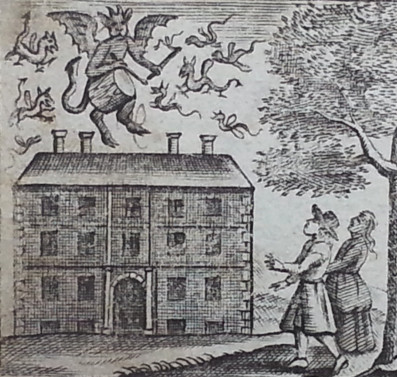
Tedworth became its central English haunting. Editions included illustrations showing the household and infernal disturbances. The story travelled far beyond Wiltshire and influenced later poltergeist literature.
Because Glanvill was connected with the intellectual culture of his age, the case did not remain a village legend. It entered philosophical controversy and the printed history of psychical phenomena.
The New Manuscripts and the Old Story
Modern historical research has examined manuscript versions and the chronology behind Glanvill’s published narrative. These materials refine names, dates and the legal history of Drury. They show how the case was recorded while memories were fresh and how later editions shaped its dramatic form.
That source work does not empty the story of darkness. It restores the sequence: the seizure of the drum, the first noises in April 1662, Glanvill’s visit, Drury’s prosecution and the printed defence of the haunting.
Extreme accuracy makes the curse more immediate. The drum was not a generic relic found in an attic. It belonged to a named travelling musician whose conflict with a named magistrate preceded the first beat.
The Nights at Tedworth
For the Mompesson family, the philosophical consequences came later. The immediate reality was sleep interrupted by sound. Adults entered the children’s room again and again, lifting bedding, searching corners and hearing the scratching continue within reach.
The house became alert to rhythm. A knock might be the first signal. A dog panting might not be a dog. The drum could begin without movement. The family lived inside an acoustic trap in which every familiar noise might announce the return.
That is the terror preserved by the early accounts: not one spectacular apparition, but months of listening for an instrument that no living person was playing.
The Curse That Learned the House
Tedworth began with a portable object and grew into a presence that knew the rooms. It found the children, answered military beats, mocked investigators and persisted when the drum itself was watched.
William Drury was carried away by law, but the sounds continued long enough to separate the alleged sender from the force. Whatever entered through the grievance no longer seemed dependent upon him.
The drum eventually fell silent. The printed case did not. Every later poltergeist narrative involving intelligent knocks and persecuted families stands in the shadow of Tedworth. The first great beat remains the simplest: a seized instrument sounding inside a magistrate’s house as if the man who lost it had sent something to reclaim its voice.
The First Night of Knocking
The initial disturbance reportedly began outside the house with powerful knocking at the doors. Servants opened them and searched the grounds, expecting travellers, pranksters or men with business for the magistrate. No visitor stood in the darkness. The blows then appeared at another entrance, forcing the household to move from place to place.
When the family attempted to ignore the sound, it travelled upward. It struck the roof and walls, occupying points difficult to reach without ladders or detection. The movement suggested that the agent understood the search and always chose the surface just beyond it.
Only after this progression did the drum establish itself as the unmistakable voice of the haunting. The house had been tested at its boundaries before the seized instrument sounded within.
The Drum Answers Its Own Signals
Mompesson ordered or performed known military beats near the instrument, and the unseen drummer answered them. Specific tattoos used to command soldiers were reportedly repeated. The response gave the sound structure, memory and skill.
A chance contraction of wood could not learn a signal. The household heard call and response, with silence between them. This exchange made the presence resemble Drury himself, a travelling musician whose livelihood depended upon rhythm.
The invisible player sometimes changed volume as witnesses approached. The beating could sound close enough to touch and then shift elsewhere. The drum became less an object than a mouth through which the grudge spoke.
The Children Lifted and Struck
Glanvill’s narrative describes more than noise around the children. Their beds and bedsteads moved. Something tugged at their clothes, scratched beneath them and at times seemed to beat against the floor in deliberate patterns. Adults sat nearby and felt the vibration.
The focus upon children gave the events the character of persecution. They had played no role in the confiscation of the drum, yet the alleged curse selected their sleep as its principal stage. Every night forced Mompesson to confront the possibility that an official act of his had endangered the family.
Witnesses tried placing the children in different rooms. The disturbance followed, implying attachment to persons rather than one defective chamber.
The Blacksmith and the Hidden Device
Searches were made for wires, concealed musicians and people in adjoining spaces. Doors and windows were watched. The family’s willingness to permit examination was essential to Glanvill’s use of the case as evidence.
The house offered no mechanical source capable of producing the variety of effects. Even when the drum was removed or secured, scratchings and panting continued. The alleged agent had announced itself through the instrument but was not trapped inside it.
Visitors who expected village deception confronted a phenomenon that changed form under scrutiny. The more narrowly one cause was watched, the activity appeared in another part of the house.
The Dog in Glanvill’s Room
During Glanvill’s visit, a dog was brought near the place where scratching sounded. Animals were often used in haunting narratives because their reactions appeared free from human expectation. The dog became agitated and frightened, responding to something the men could hear but not see.
Glanvill also felt movement near the bed and listened as the scratching travelled. His personal experience allowed him to write not merely as a collector of Mompesson’s testimony but as a participant.
For a philosopher concerned with evidence, the combination mattered: sensory observation, animal response, physical search and multiple witnesses. Tedworth became his experiment in the reality of spirits.
The Political Cost to Mompesson
The haunting damaged Mompesson beyond the nights themselves. Crowds visited. Satirists and doubters accused him of credulity or conspiracy. His position as magistrate made the public embarrassment sharper, because he had initiated the conflict through an act of authority.
He reportedly suffered financial cost while maintaining the household and receiving investigators. Rather than gaining an easy profit, the family acquired notoriety that could not be controlled.
The case therefore placed Mompesson between two dangers. To deny the phenomena was to abandon what his children and guests experienced. To affirm them was to become a national emblem of belief in witchcraft.
The Infernal Smell
Several descriptions associate the disturbances with offensive odours, sometimes compared to sulphur. In Christian imagery, brimstone belonged to judgment and Hell. A smell without visible smoke added another invisible layer to the attack.
Odour is difficult to preserve in testimony because it leaves no mark. Yet multiple early supernatural accounts treat it as a sign of presence. At Tedworth, it accompanied a phenomenon already hostile to prayer and children.
The house could therefore announce the intruder before the first beat: a foul air, a movement in darkness, then the disciplined rhythm of the drum.
Sources and Further Reading
- Joseph Glanvill, accounts of the Tedworth disturbance and Saducismus Triumphatus.
- Contemporary and newly examined manuscript narratives of the Mompesson household.
- Legal records concerning William Drury’s 1663 prosecution and transportation.
- Historical Research study, “The Drummer of Tedworth: a reassessment.”
- University of Michigan Early English Books Online edition of Glanvill’s work.