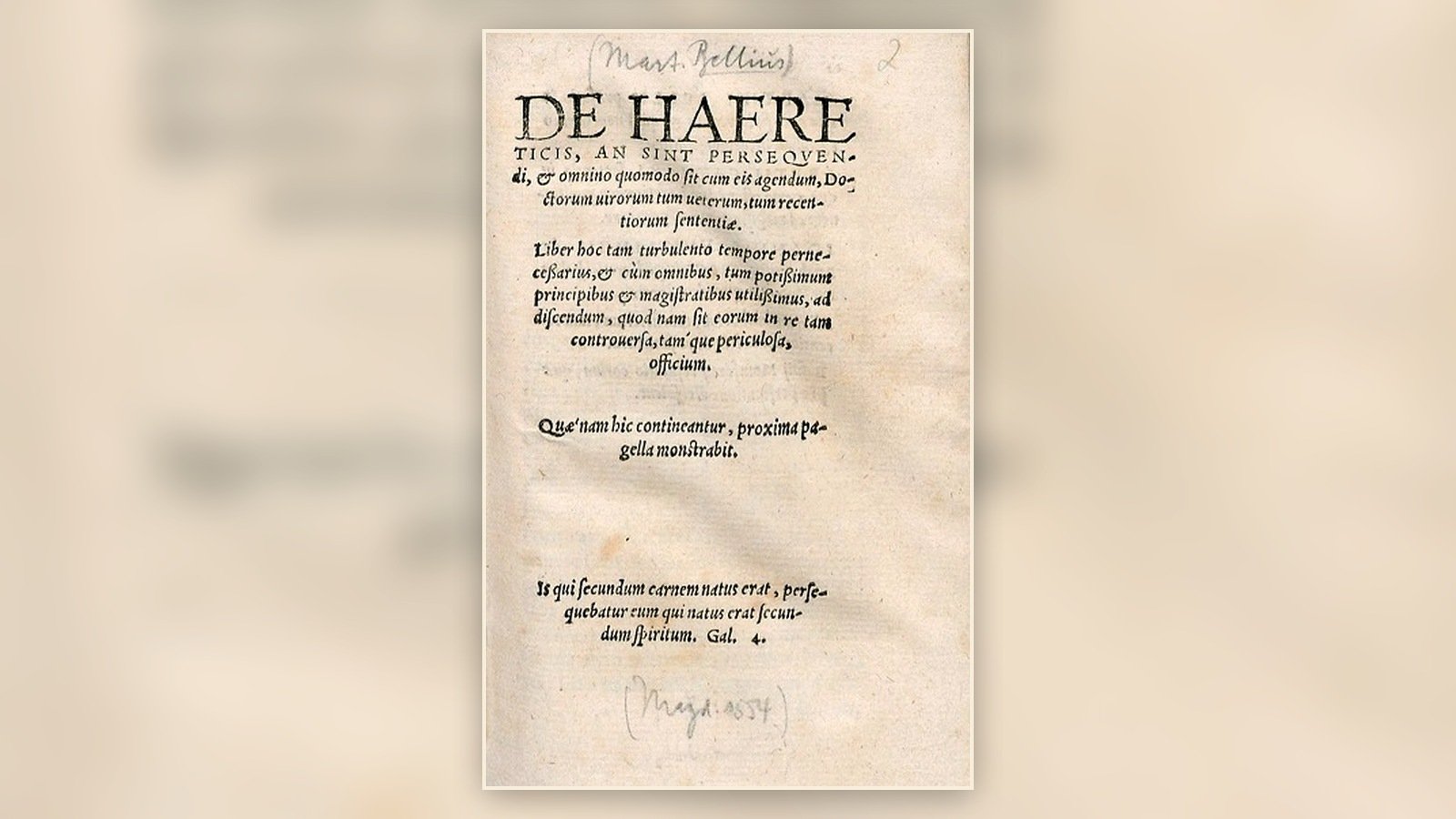
In October 1553, Michael Servetus was burned outside Geneva with one of his books chained to his body. He had escaped Catholic imprisonment only to be arrested in the Reformed city governed by opponents of Catholic power. The execution revealed a truth often hidden by simple stories of progress: those who break an authority can reproduce its methods when their own doctrine becomes sacred. Sebastian Castellio answered with a book asking whether heretics should be persecuted. From such conflicts emerged a principle that now appears obvious only because so many institutions resisted it—the conscience cannot be made true by force.
The Historical and Philosophical Problem
Freedom of Conscience and the History of Heresy belongs to late antique and medieval orthodoxy, the Reformation, confessional violence and early modern arguments for toleration. Its central problem is the gradual separation of spiritual conviction from the coercive authority of church and state. The article follows historical analysis of persecution, dissenting texts, legal change and the philosophical development of toleration and keeps one contradiction in view: communities seek to protect truth and order, yet coercion corrupts belief and turns doctrinal disagreement into political crime. The purpose is not to turn a literary or philosophical figure into an object of compulsory belief. It is to show how rebellion, knowledge and authority were argued through real texts and institutions.
The stakes concern whether any institution may punish a person merely for an inward conviction or interpretation. That question is larger than the original author or event because later readers inherited the symbol under different conditions. The history must therefore distinguish initial meaning, hostile accusation, sympathetic reception and modern appropriation while allowing them to illuminate one another.
Heresy as Choice and Threat
The Greek root hairesis could mean choice or school, but Christian institutions gradually used heresy for obstinate doctrinal error within the community. Once salvation, public order and political loyalty were joined, incorrect belief could appear more dangerous than ordinary crime. Heresy threatened souls, fractured unity and challenged the authority to define truth. Persecution was therefore defended not simply as cruelty but as correction, protection and spiritual medicine. Understanding that logic is necessary because coercion rarely presents itself as evil; it speaks in the language of rescue.
The individual reader is implicated as well. It is easy to admire defiance at a historical distance while avoiding the discipline of self-critique. The adversarial method becomes serious only when it tests cherished rebellion with the same severity used against inherited authority.
From Persuasion to Coercion
Early Christian writers sometimes emphasized that faith must be voluntary. After Christianity gained imperial power, church and state increasingly developed legal mechanisms against dissent. Augustine’s conflict with the Donatists became especially influential: he moved toward defending coercion as a means that might return the erring to truth. Medieval inquisitorial systems later formalized investigation and punishment. Practices varied across time and place, but the central structure endured—the institution claiming truth also claimed jurisdiction over error.
This is why the subject belongs to dark philosophy rather than inspirational mythology. It asks what freedom costs, what knowledge fails to repair, and how a person acts after certainty has been broken. The darkness is not decoration; it is the absence of an innocent position.
The Reformation Breaks Unity but Not Persecution
The Reformation fractured Western Christendom and elevated scripture and conscience against ecclesiastical authority. Yet Protestant territories also enforced confessions, punished radicals and treated religious unity as a condition of civil peace. Catholic and Protestant powers differed in doctrine while sharing assumptions about the danger of uncontrolled belief. The reformer’s conscience could become the magistrate’s new orthodoxy. This contradiction forced a harder question: is freedom valid only while one is dissenting, or does it belong to the opponent as well?
The historical value of the reformation breaks unity but not persecution is that it exposes the gradual separation of spiritual conviction from the coercive authority of church and state. Later summaries often preserve the dramatic conclusion and lose the route by which it was reached. Restoring publication, audience and argument makes the subject more disturbing rather than less: the symbol was produced through real conflicts over whether any institution may punish a person merely for an inward conviction or interpretation.
Servetus in Geneva
Michael Servetus rejected orthodox Trinitarian doctrine and had already been condemned by Catholic authorities. Passing through Geneva, he was arrested, tried and burned in 1553. John Calvin supported the prosecution, though the political council imposed the sentence. Servetus’s death became a decisive scandal because it showed a persecuted reform movement using lethal power against its own heretic. The issue was no longer simply which theology was true, but whether truth could authorize execution for belief.
This stage also sharpens the central tension: communities seek to protect truth and order, yet coercion corrupts belief and turns doctrinal disagreement into political crime. The opposition cannot be resolved by declaring one side enlightened and the other benighted. The archive shows intelligence, fear, self-interest and sincere conviction operating across the conflict. A serious adversarial reading keeps those mixed motives visible.
Castellio’s Answer
Sebastian Castellio, a humanist and former associate of Calvin, responded through De haereticis, an sint persequendi, published in 1554 under the name Martinus Bellius. The volume assembled arguments from earlier and contemporary writers against persecution. Castellio insisted on the difficulty of defining heresy and on the limits of human certainty. Killing a person did not defend a doctrine; it killed a person. His position joined moral restraint to epistemic humility: fallible interpreters must not punish as though they possessed divine certainty.
The material should be read through historical analysis of persecution, dissenting texts, legal change and the philosophical development of toleration. Primary language establishes what the author actually constructed; reception shows how the work escaped its first context; later movements reveal which elements became usable symbols. None of these layers may silently replace the others.
Radical Dissenters and the Cost of Conscience
Anabaptists, anti-Trinitarians, spiritualists, Quakers and other dissenters expanded the practical meaning of conscience, often under severe pressure. Some rejected oaths, compulsory worship or state churches. Their communities were not uniformly tolerant, and dissent could produce new orthodoxies. Yet their survival demonstrated that religious plurality did not necessarily destroy society. The lived persistence of disagreement gradually weakened the claim that uniform belief was politically indispensable.
The most common distortion is imagining a simple march from medieval darkness to modern tolerance, or treating toleration as complete equality. That simplification removes the ethical pressure from the subject by making judgment automatic. The original work is stronger because it allows attraction and danger to occupy the same scene, forcing the reader to decide without the protection of a slogan.
Locke’s Letter and Its Boundaries
John Locke’s Letter Concerning Toleration, written in exile and published in 1689, offered a principled distinction between civil government and the care of souls. The magistrate could protect life, liberty and property but could not produce saving faith. Churches were voluntary societies. Locke’s argument was foundational, yet incomplete: he excluded atheists and treated Catholics with suspicion as agents of foreign power. The history of conscience advances through principles that often exceed the boundaries their authors placed around them.
At the philosophical centre lies the ease with which defenders of liberty exclude the unbeliever, foreigner or radical dissenter from the freedom they claim. Rebellion is not purified merely because its opponent is oppressive. Every adversarial tradition must ask what forms of conduct it authorizes once the old command has been rejected and whether another person remains more than material for the rebel’s freedom.
Bayle and the Erring Conscience
Pierre Bayle radicalized the problem by arguing that even an erring conscience carries moral claims. If only the person who possesses truth may act according to conscience, the principle offers no protection because every persecutor believes himself correct. Coercion justified by sincere conviction becomes reciprocal violence. Bayle’s argument makes toleration depend not upon approval of another belief but upon recognition of human fallibility and the moral danger of force.
The section contributes to conscience as a protected inner jurisdiction that authority must persuade rather than command. Cultural legacy is not evidence that later users recovered an unchanged secret tradition. It is evidence that an image or argument remained capable of organizing new conflicts. Transmission transforms, and the transformations themselves belong to history.
From Toleration to Equal Freedom
Toleration originally implied a superior power permitting what it disliked. Modern freedom of conscience moves toward equality: the state should not distribute civil standing according to belief. This development entered constitutional law, human rights and the separation of religious and political authority, but it remains contested. Blasphemy laws, forced conversion, discrimination and social punishment show that inner freedom depends upon material protections. Conscience survives only when institutions are restrained from making dissent impossible.
The conflict over whether any institution may punish a person merely for an inward conviction or interpretation also explains why the subject repeatedly crosses the boundary between literature and religion. A literary figure can become a spiritual emblem; a theological accusation can become a political identity. Accuracy requires following the passage rather than deciding in advance where the “real” meaning must reside.
Deeper Questions
The history is not exclusively European or Christian, but this article follows a particular Western legal and theological genealogy. Other traditions developed their own arguments, permissions and restrictions. Comparison should enlarge the archive rather than convert one regional story into a universal template.
Heresy preserved knowledge because trials, refutations and confiscated books recorded what authorities wished to eliminate. The archive is often written by the persecutor. Reading it requires attention to the asymmetry between the accused voice and the institutional summary.
Freedom of conscience does not mean that every action motivated by belief is immune from law. The distinction between inner conviction, expression and harmful conduct remains difficult. What the principle rejects is punishment merely for the mind’s failure to conform.
Castellio’s importance lies not in modern perfection but in his refusal to let his own Protestant commitments excuse Protestant violence. The adversarial test is most meaningful when applied to one’s allies and one’s own sacred cause.
For Luciferian thought, heresy represents the right to examine forbidden questions. Yet the historical lesson is ethical as well as heroic: the dissenter who gains power must protect the conscience of those who reject the dissenter’s truth.
A further question concerns the material form of the archive. Books, paintings, trials and institutional procedures do not merely carry ideas; they decide who may encounter them and under what conditions. The survival of freedom of conscience history as a searchable subject depends upon acts of preservation that earlier authorities may have intended as refutation or control.
The language of illumination should not be confused with the possession of final truth. Every figure in this history sees something the official order excludes, but partial sight can still become arrogance. The ethical measure is whether new knowledge enlarges responsibility or merely enlarges the self’s claim to rule.
Reception also changes when a work moves from scandal to canon. Once taught, collected and digitized, a forbidden text can lose the danger of its first appearance. Recovering the original conflict restores the cost paid by writers, publishers and readers without requiring modern audiences to imitate their conclusions.
The political lesson is equally unstable. Institutions need continuity, but continuity can protect error; rebels need disruption, but disruption can destroy the conditions of freedom. The archive offers no formula that removes this tension. It offers cases through which judgment can be trained.
A further question concerns the material form of the archive. Books, paintings, trials and institutional procedures do not merely carry ideas; they decide who may encounter them and under what conditions. The survival of freedom of conscience history as a searchable subject depends upon acts of preservation that earlier authorities may have intended as refutation or control.
The language of illumination should not be confused with the possession of final truth. Every figure in this history sees something the official order excludes, but partial sight can still become arrogance. The ethical measure is whether new knowledge enlarges responsibility or merely enlarges the self’s claim to rule.
Reception also changes when a work moves from scandal to canon. Once taught, collected and digitized, a forbidden text can lose the danger of its first appearance. Recovering the original conflict restores the cost paid by writers, publishers and readers without requiring modern audiences to imitate their conclusions.
The political lesson is equally unstable. Institutions need continuity, but continuity can protect error; rebels need disruption, but disruption can destroy the conditions of freedom. The archive offers no formula that removes this tension. It offers cases through which judgment can be trained.
A further question concerns the material form of the archive. Books, paintings, trials and institutional procedures do not merely carry ideas; they decide who may encounter them and under what conditions. The survival of freedom of conscience history as a searchable subject depends upon acts of preservation that earlier authorities may have intended as refutation or control.
The language of illumination should not be confused with the possession of final truth. Every figure in this history sees something the official order excludes, but partial sight can still become arrogance. The ethical measure is whether new knowledge enlarges responsibility or merely enlarges the self’s claim to rule.
Reception also changes when a work moves from scandal to canon. Once taught, collected and digitized, a forbidden text can lose the danger of its first appearance. Recovering the original conflict restores the cost paid by writers, publishers and readers without requiring modern audiences to imitate their conclusions.
The political lesson is equally unstable. Institutions need continuity, but continuity can protect error; rebels need disruption, but disruption can destroy the conditions of freedom. The archive offers no formula that removes this tension. It offers cases through which judgment can be trained.
A further question concerns the material form of the archive. Books, paintings, trials and institutional procedures do not merely carry ideas; they decide who may encounter them and under what conditions. The survival of freedom of conscience history as a searchable subject depends upon acts of preservation that earlier authorities may have intended as refutation or control.
The language of illumination should not be confused with the possession of final truth. Every figure in this history sees something the official order excludes, but partial sight can still become arrogance. The ethical measure is whether new knowledge enlarges responsibility or merely enlarges the self’s claim to rule.
What Remains
The subject leaves no painless conclusion. It preserves conscience as a protected inner jurisdiction that authority must persuade rather than command while exposing the ease with which defenders of liberty exclude the unbeliever, foreigner or radical dissenter from the freedom they claim. The inherited authority may be unjust, the rebel’s question may be necessary, and the rebel may still fail. Dark philosophy begins where those statements are allowed to remain true together.
SatanWorld approaches this history as an archive of contested knowledge. The task is to hear the forbidden voice without granting it automatic innocence, and to examine authority without treating opposition as a substitute for evidence. What remains is the responsibility of judgment: freedom after command, knowledge after prohibition, and the difficult refusal to become the power one resisted.