
Historical Ritual Archive
A Goetic operation of concealment, dominion and the terrifying intelligence that speaks through several forms at once.
This rebuilt dossier preserves the entire operative substance of the earlier SatanWorld draft: the tools, sigil work, timings, purifications, chants, offerings, petitions, manifestations, dismissals and warnings remain present. The material has been reorganized so the rite unfolds as one deliberate descent rather than a loose list of instructions.
The Power Being Addressed
Bael is approached as First spirit of the Ars Goetia, a Great King commanding sixty-six legions. The operation is structured around that rank, office and manifestation.
Bael is regal, secretive and strategically patient. He tests whether the seeker can hold attention while his form and meaning shift. He is said to dislike mockery, uncontrolled fear and careless speech.
Daemonology profile: Read the complete Daemonology profile of Bael
Why the Rite Exists
The rite creates a threshold between ordinary life and the domain attributed to Bael. Preparation separates the practitioner from distraction. The sigil, name and chant establish a centre. The petition shapes the encounter. The offering acknowledges exchange. Dismissal restores the chamber to ordinary time.
A summoning without preparation is only demand. A summoning without closure is pressure without boundary.
Personality and Ritual Conduct
Bael is regal, secretive and strategically patient. He tests whether the seeker can hold attention while his form and meaning shift. He is said to dislike mockery, uncontrolled fear and careless speech.
The practitioner should speak with precision and avoid contradictory motives. The entity's traditional temperament determines the tone of the operation. Royal spirits are not approached like marquises, teachers are not addressed like destroyers, and powers of love, invisibility, storm, war or revelation do not answer through the same atmosphere.
The Atmosphere of Manifestation
The chamber may become unnaturally silent. A croaking undertone appears beneath thought, cats stare toward empty corners, and the sense of several faces occupying one point becomes difficult to dismiss. Manifestation may alternate between man, cat, toad and a composite form.
Manifestation may begin through changes in sound, heat, dream, pressure, candle behavior, animal imagery or internal speech. The legend of the rite does not require a full visible apparition before contact is recognized.
Sigil of Bael
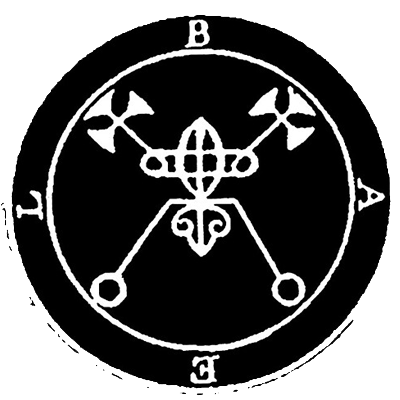
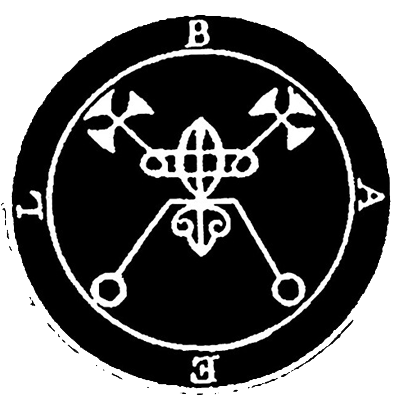
Sigil of Bael. Traditionally drawn on parchment and placed at the centre of the rite as the principal visual focus for the invocation.
The Rite: Full Ceremonial Sequence
The following section preserves the original article's ritual content without omitting its operative details.
Who is Bael?
Historical Context and Sources
The primary method comes from the Lesser Key of Solomon, with variations in texts like Johann Weyer's Pseudomonarchia Daemonum (1577). Modern adaptations appear in works by Aleister Crowley or Anton LaVey, but I'll stick to the classical Goetia ritual. No "guaranteed" success exists—these are ritual frameworks for invocation.
Preparation for Summoning
Before any ritual, traditional grimoires stress purification and safeguards
Timing and Location
Perform during a waxing moon (for manifestation) or on a Tuesday (Mars' day, linked to Bael's martial energy).
Choose a secluded, clean space: a circle drawn on the ground in chalk or salt, at least 9 feet in diameter. Face east (direction of invocation).
Tools and Materials (Sigils and Implements)
Bael's Sigil: Draw this on virgin parchment using red ink or blood (symbolic; use red marker today). The sigil resembles a crowned toad with serpentine lines—search for "Bael Goetia sigil" for visuals.
text
[Imagine here: A central circle with a toad-like head, horns, and interlocking curves; exact design from Goetia plates.]
Black-handled knife (athame) for tracing boundaries.
Incense: Frankincense and myrrh (for purification); dragon's blood for compulsion.
Candles: Three black ones for Bael's heads, lit counterclockwise.
Protective circle: Inscribe with names of power like "Adonai," "Elohim," and the "Triangle of Art" outside it—a small triangle where the demon manifests.
Offerings: Wine, tobacco, or a serpent image (Bael's affinity); avoid blood or life force.
Mental and Physical Prep
Fast for 24 hours; bathe in saltwater.
Meditate on your intent (e.g., "Grant me invisibility in [specific situation]").
Wear white robes; anoint with olive oil mixed with hyssop.
Step-by-Step Summoning Ritual
This is the Goetic method, adapted for clarity. It takes 1-2 hours. Speak firmly, without fear—Bael reportedly respects confidence.
Cast the Circle
Stand outside the circle. Trace it clockwise with the athame, reciting
"I conjure thee, O Circle of Art, that thou be a stronghold and fortress to me, and to shut out all spirits, so that none shall be able to enter within except those whom I shall desire to enter."
Invoke the Divine Names
Enter the circle. Light incense and candles. Recite the Preliminary Invocation (from Lesser Key):
"O Lord God, Who hast created all things, and hast power over all spirits, I beseech Thee to send unto me Bael, the King, who shall appear before this circle in a fair and comely shape, without harm to me or any creature."
Conjuration of Bael
Hold the sigil aloft. Chant the specific call three times, increasing volume
"Bael, Bael, Bael! I do invocate and conjure thee, O thou mighty and powerful Prince Bael! By the power of the Most High, and by the name of the Living God, appear thou here before this circle in thy true form! Come peaceably, visibly, and without deformity or terror. I command thee by the seal of thy obedience, and by the most great and powerful names of God: Adonai, El, Elohim, Elohe, Ehyeh Asher Ehyeh, Zabaoth, Elion, Iah, Tetragrammaton. Obey my commands, and fulfill my desires!"
If no appearance (visualization or sensation), burn the sigil in the triangle and repeat with added threats:
"By the torment thou shalt suffer if thou comest not, I adjure thee! Appear now!"
Manifestation and Dialogue
Bael may appear as smoke, a voice, or a vision in the triangle. Greet: "Welcome, Prince Bael. I thank thee for appearing."
State your request clearly, e.g., "Teach me the art of invisibility."
Negotiate: Offer respect or a pact (written on parchment, signed in symbolic blood). He may demand a token (e.g., a secret oath).
License to Depart
End firmly: "I thank thee, Bael, for thy presence and wisdom. Depart in peace, and harm none on thy way. By the power of the Most High, go now!"
Extinguish candles clockwise. Erase the circle counterclockwise.
Banishing
Recite the Lesser Banishing Ritual of the Pentagram (from Golden Dawn tradition) to clear residues:
Face east, trace pentagram: "Before me Raphael."
Continue for south (Michael), west (Gabriel), north (Uriel).
"For about me flames the pentagram, and in the column stands the six-rayed star. Amen."
Variations and Modern Takes
Crowley’s Method (The Book of the Goetia, 1904): Emphasizes evocation via the Bornless Ritual—replace divine names with Thelemic ones like "IAO" for a more psychedelic vibe.
LaVeyan Satanism (Satanic Bible, 1969): Treats it as psychodrama; no real demon, just role-play for catharsis. Use the sigil in meditation, no circle needed.
Safety Tips from Occultists: Always have a "safety word" (e.g., "Depart!") If overwhelmed, smash a mirror or spill salt to "break" the ritual.
Potential Outcomes and Cautions
Success is subjective—expect psychological insights, synchronicities, or nothing. Historical accounts (e.g., in The Magus by Francis Barrett, 1801) warn of backlash: obsession, misfortune, or "demonic contracts" binding the soul.
Historical Image and Ritual Figure
BLACK PLACEHOLDER — replace with a verified historical image, sigil manuscript or ritual object before publication.
Ritual Architecture
Separation from Ordinary Time
Bathing, fasting, abstinence, silence, darkness or isolation prepare the body and mind to recognize the threshold. The preparation should be completed as a single coherent discipline rather than as scattered gestures.
Construction of the Chamber
Candles, incense, circle, water, salt, metal, herbs, stones and offerings organize the room around the office of Bael. Every item should have a purpose. A crowded altar weakens the central image when objects are added only for display.
Establishing Contact
The sigil, name, chant, enn or invocation becomes the fixed point of the operation. Repetition is intended to narrow awareness until the name no longer feels like ordinary language.
The Petition
One principal request should be stated. The request must include a boundary, a desired form of result and a clear completion condition. Ambiguous wishes invite expansion.
Recognition of Presence
The central phase begins when the atmosphere changes in a sustained way. Pressure, heat, cold, altered flame, internal speech, animal forms, dreams or sudden certainty may mark the transition.
Offering and Exchange
The offering expresses reciprocity. It may carry the spirit's color, office, appetite or symbolic domain. Promises should never be made casually because the rite treats them as binding.
Dismissal
The operation ends only when Bael is thanked or dismissed according to the preserved method. Candles are extinguished safely, windows opened where appropriate, offerings removed according to the rite and the chamber returned to ordinary order.
Instruments and Their Symbolism
The sigil is the visual body of the name. The candle establishes color, rank and duration. Incense gives the atmosphere density. Salt and the circle define limits. Water reflects and carries emotional force. Metal, stone, herb or coin embodies the entity's office.
The instrument is complete when it performs its function. More objects do not automatically create greater force.
Timing and Planetary Current
When several correspondences appear, one coherent system should govern the night. Combining every possible timing creates confusion rather than power.
Manifestation Signs
Signs traditionally associated with Bael include:
- a stable change in emotional pressure;
- dreams repeating the traditional form;
- candle movement without a matching draft;
- sounds, smells or bodily sensations linked to the spirit's office;
- a complete phrase arising inside thought;
- external events beginning to mirror the petition;
- fear or fascination intensifying at the exact point of contact.
One isolated sign may pass unnoticed. A pattern repeating across chamber, dream and aftermath carries greater weight.
The Frightening Edge of the Rite
Bael's concealment can become self-erasure. The wish to remain unseen may produce isolation, evasiveness and the loss of relationships that depend upon being known.
The deepest danger is transformation that feels useful. The practitioner may begin to imitate the spirit's temperament, reorganize life around the petition or interpret every event through the operation.
Failure Patterns
Failure appears when preparation is abandoned, the request changes repeatedly, symbols are mixed randomly, fear replaces attention, impossible offerings are promised or the practitioner refuses to close because no dramatic apparition appeared.
Failure may also appear as excess success: the requested force enters ordinary life faster than expected. The completion condition should therefore be written before the rite begins.
Completion and Aftermath
The operation is complete when the petition has been spoken, the exchange acknowledged, the presence dismissed and the chamber returned to ordinary order.
Record:
- date and exact timing;
- preparation completed;
- tools and offerings;
- words spoken;
- signs observed;
- dreams in the following nights;
- first external movement;
- emotional or behavioral changes;
- fulfillment of any promised offering.
The aftermath belongs to the rite. Results may arrive as opportunity, conflict, warning, sudden knowledge, disappearance of an obstacle or an intensification that reveals the true shape of the request.
Boundaries of the Petition
The petition should identify what is requested, where the result may operate, what form the result may take and what event marks completion. Wealth can arrive through loss. Truth can destroy a relationship. Protection can become isolation. Love can become possession. Invisibility can become moral evasion.
The wording is therefore part of the danger.
The Return to Ordinary Life
After closure, eat, drink, wash, change clothing, step outside or speak with another person. These actions declare that ritual time has ended.
Do not immediately repeat the operation because silence feels uncomfortable. Strong results reveal their own pattern.
Final Warning
Bael's concealment can become self-erasure. The wish to remain unseen may produce isolation, evasiveness and the loss of relationships that depend upon being known.
Do not leave the altar active indefinitely. Do not continue chanting after formal dismissal. Do not add a second petition during the closing stage.