
Historical Ritual Archive
The Power Being Addressed
Caim is approached as Fifty-third spirit in common Ars Goetia numbering, a Great President commanding thirty legions.
Caim is sharp, argumentative and highly attentive to language. He is linked with birds, animal voices, prophecy through sound and the settlement of disputes.
Daemonology profile: Read the complete Daemonology profile of Caim
Why the Rite Exists
The rite creates a controlled threshold between ordinary life and the domain attributed to Caim. Preparation separates the practitioner from ordinary noise. The sigil and name establish the centre. The petition directs the encounter. The offering defines exchange. Dismissal restores the chamber to ordinary time.
A rite without preparation is only demand. A rite without closure is pressure without a boundary.
Personality and Ritual Conduct
Caim is sharp, argumentative and highly attentive to language. He is linked with birds, animal voices, prophecy through sound and the settlement of disputes.
The practitioner should enter with one clear purpose and avoid contradictory requests. The entity's rank and temperament determine the tone. Respect does not mean submission, and command does not mean theatrical aggression.
The Atmosphere of Manifestation
Bird calls may become unnaturally patterned, the room may echo with speechlike fragments, and a black bird or armed human form may appear at the edge of vision.
Manifestation may begin before any full figure is seen. Sound, temperature, dream, bodily pressure, altered flame, animal imagery or a complete inner sentence may mark the transition from preparation into contact.
Historical Image and Ritual Figure
BLACK PLACEHOLDER — replace with a verified historical image, sigil manuscript or ritual object before publication.
Sigil of Caim
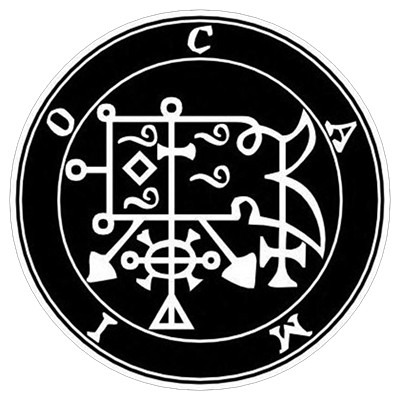
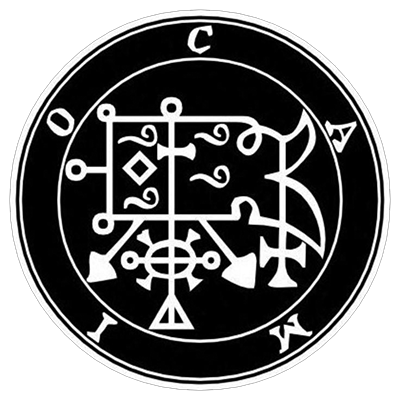
Sigil of Caim. Traditionally drawn on parchment and placed at the centre of the rite as the principal visual focus for the invocation.
The Rite: Full Ceremonial Sequence
The following material preserves the original SatanWorld article's ritual content without omitting its operative details.
Caim (also spelled Caim or Camio) is the 72nd spirit listed in the Ars Goetia, the first section of the 17th-century grimoire The Lesser Key of Solomon. He is described as a Great President of Hell, appearing as a black bird that can transform into a human form with a sharp sword. Caim grants knowledge of the liberal sciences, birdsong, and the ability to understand the languages of animals and birds. He also settles disputes between adversaries and is said to command 30 legions of demons.
These descriptions stem from medieval occult traditions, where demons like Caim are invoked for specific purposes. Summoning rituals are symbolic and ritualistic, rooted in ceremonial magic, but they carry inherent risks in lore—such as possession, madness, or backlash if mishandled.
Traditional Summoning Ritual for Caim
The following is a synthesis of methods from the Ars Goetia and related grimoires like Pseudomonarchia Daemonum. This is presented for historical and educational purposes only; it is not an endorsement or guarantee of efficacy. Modern practitioners often adapt these with psychological or meditative intent rather than literal belief.
Preparation
Timing: Perform during a Wednesday (day of Mercury, associated with knowledge and communication) at dawn or midnight. Avoid full moons if seeking clarity, as they amplify chaos.
Location: A secluded space, ideally outdoors near water (symbolizing Caim's bird form). Draw a protective circle on the ground using chalk, salt, or flour—minimum 9 feet in diameter.
Tools
Black candle (for his bird form).
Incense of myrrh or frankincense.
A sword or dagger (symbolic; represents his weapon).
Parchment with Caim's sigil (seal).
Offerings: Seeds or feathers (for his avian nature); avoid blood or live animals.
Caim's Sigil
Draw or print this sigil on the parchment and place it inside the circle facing east
/\
/ \
/____\
| |
| [] |
\__/
(This is a textual approximation; authentic versions appear in grimoires as a complex interlocking geometric design resembling a stylized bird with a sword.)
The Ritual Steps
Purification: Bathe in salt water. Fast for 24 hours prior. Recite a banishing prayer, such as the Lesser Banishing Ritual of the Pentagram, to clear negative energies.
Casting the Circle
Stand outside the circle. Use the sword to trace the perimeter clockwise, invoking the four archangels (Raphael east, Michael south, Gabriel west, Uriel north) for protection.
Say: "By the power of the divine names Adonai, Elohim, and Tetragrammaton, I seal this circle against all harm."
Invocation
Light the candle and incense inside the circle.
Hold the sigil and chant the conjuration from the Ars Goetia (adapted for brevity)
"I do invocate and conjure thee, O Spirit Caim; and being with power armed from the Supreme Majesty, I do strongly command thee, by Beralanensis, Baldachiensis, Paumachia, and Apologiae Sedes; by the most Powerful Princes, Genii, Liachidae, and Ministers of the Tartarean Abode; and by the Chief Prince of the Seat of Apologia in the Ninth Legion, I do invoke thee, and by invocating conjure thee. And being armed with power from the Supreme Majesty, I do strongly command thee, by Him Who spake and it was done, and unto whom all creatures be obedient. Appear thou therefore before this Circle in a fair human shape, without any deformity or tortuosity. Come thou in and from any quarter of the world, and make rational answers unto all things I shall demand of thee. Come peaceably, visibly, and affably, now, and without delay, manifesting that which I shall desire."
Repeat three times, visualizing a black thrush alighting and transforming.
Communication
Once manifested (in vision or sensation), state your request clearly—e.g., "Caim, teach me the tongues of birds" or "Resolve this dispute between [names]."
Offer the seeds/feathers as tribute.
Listen for responses via inner voice, automatic writing, or environmental signs (bird calls).
Dismissal
Thank Caim: "Depart in peace, O Caim, and harm none on thy way."
Extinguish the candle counterclockwise. Erase the circle with the sword.
Bury the sigil and offerings.
Warnings from the Tradition
Protection: Never step outside the circle during invocation; lore claims demons test boundaries.
Consequences: If Caim appears hostile, recite Psalm 91 for banishment.
Ethics: Grimoires emphasize intent—malicious use invites retribution.
Ritual Architecture
Separation
Bathing, silence, fasting, abstinence, darkness or isolation signal that ordinary time has been left behind. The preparation should be coherent rather than assembled from random gestures.
Construction of the Chamber
Candles, incense, circle, salt, water, metals, herbs, stones and offerings organize the room around the office of Caim. Each item should perform one function.
Establishing Contact
The sigil, name, chant or enn becomes the visual and verbal axis of the operation. Repetition narrows attention until the chamber feels organized around one intelligence.
The Petition
The petition should contain one principal request, one boundary and one completion condition. Ambiguous wishes invite expansion.
Recognition of Presence
The central phase begins when the atmosphere changes in a sustained way. Pressure, heat, cold, altered flame, internal speech, animal forms or dreamlike imagery may mark the crossing.
Offering and Exchange
The offering represents reciprocity. It may carry the entity's color, office, appetite or symbolic domain. A promise should never be made casually.
Dismissal and Return
The operation ends only when Caim is thanked or dismissed according to the preserved method. Candles are extinguished safely, the chamber aired where appropriate and the result written before sleep or distraction changes memory.
Instruments and Their Symbolism
The sigil acts as the visual body of the name. The candle establishes color, rank and duration. Incense gives density to the air. Salt or the circle defines limits. Water reflects and carries emotional force. Metal, stone, herb or coin embodies office.
More objects do not automatically create more power. A crowded altar can divide attention.
Timing and Correspondence
Where several systems appear, one coherent system should govern the operation.
Manifestation Signs
Signs associated with Caim include:
- a sustained shift in the chamber's emotional pressure;
- dreams repeating the spirit's form or office;
- unusual candle movement without a matching draft;
- sounds, smells or bodily sensations consistent with the entity;
- a complete phrase arising inside thought;
- external events beginning to mirror the petition;
- fear, attraction or resistance intensifying at the moment of contact.
A repeated pattern across chamber, dream and aftermath carries greater weight than one isolated sign.
The Frightening Edge of the Rite
Understanding every voice can become inability to tolerate silence. Dispute resolution may turn into constant argument and suspicion of hidden meaning.
The deepest danger is transformation that feels useful. The practitioner may begin to imitate the spirit's temperament, organize life around the petition or interpret every event as part of the operation.
Failure Patterns
Failure appears when preparation is abandoned, the request changes repeatedly, symbols are mixed without purpose, panic replaces attention, impossible offerings are promised or the practitioner refuses to close because no dramatic apparition appeared.
Failure can also appear as excess success: the requested current enters ordinary life faster than expected.
Boundaries of the Petition
The petition should state what is requested, where the result may operate, what form the result may take and what event marks completion. Knowledge can destroy innocence. Protection can become isolation. Transformation can become instability. Treasure can become obsession.
The wording is therefore part of the danger.
Completion and Aftermath
The rite is complete when the petition has been spoken, the exchange acknowledged, the presence dismissed and the chamber returned to ordinary order.
Record the date, timing, preparation, tools, words, signs, dreams, first external movement, emotional changes and fulfillment of any promised offering.
The aftermath belongs to the rite. Results may arrive as opportunity, conflict, warning, sudden knowledge, disappearance of an obstacle or an intensification that reveals the true shape of the request.
The Inner Ordeal
The rite of Caim is also an ordeal of resemblance. The chamber reveals where the spirit's office already exists inside the seeker's life.
The frightening moment is often recognition rather than apparition. The seeker discovers that the request has already shaped behavior before the first candle was lit.
The Return to Ordinary Life
After closure, eat, drink, wash, change clothing, step outside or speak with another person. These acts declare that ritual time has ended.
Do not repeat the operation immediately because silence feels uncomfortable.
Final Warning
Understanding every voice can become inability to tolerate silence. Dispute resolution may turn into constant argument and suspicion of hidden meaning.
Do not leave the altar active indefinitely. Do not continue chanting after dismissal. Do not add a second petition during closure.
When the Rite Is Truly Complete
A ritual is not complete because the candles have burned down. It is complete when the petition has reached a defined result, the promised exchange has been honored and ordinary life is no longer suspended around the operation.
If no result arrives, the record must still be closed. An unanswered petition should not become a permanent altar.
The Weight of the Name
The name of Caim is repeated because repetition changes the relation between sound and meaning. At first it is a word. Later it becomes an atmosphere, then a pressure, then a point around which expectation gathers.
The rite becomes dangerous when that point remains active after dismissal. This is why the final acts of extinguishing, washing, recording and leaving the room are part of the operation rather than an afterthought.