
Historical Ritual Archive
This rite is treated as a serious occult operation preserved within the historical and living traditions of ceremonial magic. Traditional accounts warn that careless work may produce obsession, deceptive signs, nightmares, spiritual attachment, conflict or the sense of being pursued by the power addressed. Ordinary hazards involving flame, smoke, exhaustion and emotional distress remain real. Enter with one purpose, keep the chamber orderly and close the operation completely. Nothing in this archive replaces ordinary judgment, consent, evidence or lawful conduct.
The Power Being Addressed
Raum is approached as the fortieth spirit of the Ars Goetia, bearing the rank of Great Earl and commanding thirty legions. The spirit is described as a crow who takes human form at the command of the conjurer, retaining the watchful, scavenging intelligence of the bird.
Raum occupies one of the most paradoxical positions in the Goetic catalogue. He steals treasure from kings, carries it where commanded, destroys cities and dignities, reveals past, present and future and creates love between friends and enemies. The crow form links him with battlefields, abandoned wealth, memory and the conversion of ruin into opportunity. Earlier catalogues preserve the same offices, making him a spirit of redistribution whose gifts are never separated from collapse.
Daemonology profile: Read the complete Daemonology profile of Raum
Purpose of the Rite
This rite is used to recover neglected resources, expose wealth obtained through false authority, understand what remains valuable after loss, reconcile opponents after pride has fallen or examine the past and future of a material decision. It should not be used to justify theft. The petition is strongest when treasure is defined as knowledge, opportunity, lost work, lawful property or personal power surrendered to an unworthy authority.
The operation is built around one written petition and one completion condition. A second desire introduced during manifestation divides the work and makes every later sign difficult to interpret. Before the first candle is lit, write what is requested, what is forbidden and what event would count as a sufficient answer. The petition should remain within the offices traditionally attributed to the spirit rather than treating the name as a source of unlimited power.
Personality and Ritual Conduct
Raum is clever, ironic and attracted to structures already weakened from within. He may reveal where value has been hidden, but he also reveals what the petitioner is willing to call treasure. His reconciliation office is inseparable from humiliation: enemies sometimes become capable of affection only after status and pride have collapsed. He favors direct language and notices greed immediately.
The correct posture is controlled, direct and observant. The practitioner does not plead, flatter, boast or improvise threats. Authority is expressed through order: a prepared chamber, a stable petition, a clear boundary and a complete dismissal. Emotional intensity is not proof of manifestation. A useful response remains coherent with the spirit’s historical office and can be recorded without changing its meaning after the rite.
The Atmosphere of Manifestation
A dry fluttering sound may pass above the working area. Black shapes gather at the edge of sight, and small metallic noises seem to come from closed drawers or distant rooms. Memories of lost objects, money or opportunities return with unusual detail. The presence can feel curious rather than overtly hostile, but there is often an undertone of ruins being searched after everyone else has left.
Manifestation may begin as sound, pressure, memory, dream, altered flame, symbolic coincidence or a complete thought arriving without visible preparation. A dramatic apparition is not required. The transition is recognized only when several signs converge, persist and remain relevant to the written petition. One flickering candle, one intrusive thought or one ordinary coincidence is not enough.
Sigil of Raum
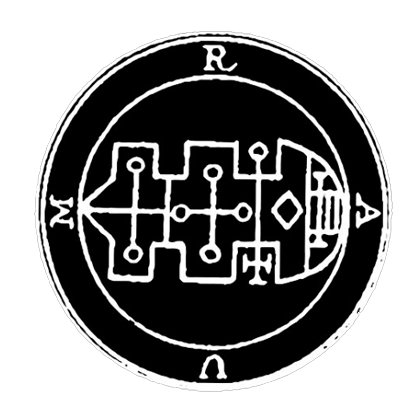
Sigil of Raum. Traditionally drawn on parchment and placed at the centre of the rite as the principal visual focus for the invocation.
Timing and Correspondences
- Correspondence: Saturday for dignity, ruin and recovery, or Wednesday for messages and hidden value
- Correspondence: the planetary hour of Saturn for stripping false rank, Mercury for locating information
- Correspondence: a waning moon for dismantling corruption; a waxing moon for lawful recovery
- Correspondence: dawn or late evening, facing northwest
These correspondences organize the rite; they do not replace preparation. Choose one coherent timing system and keep it throughout the operation rather than mixing several incompatible schemes. The operation may be postponed without consequence if the practitioner is exhausted, ill, intoxicated or emotionally unstable.
Tools, Materials and Offerings
- the supplied sigil on parchment
- one black candle and one gold or white candle
- frankincense, cedar or patchouli incense
- a key, coin or written inventory representing the lost resource
- a sealed envelope containing the exact lawful claim
- dark bread, seeds or a donation made from recovered value
Offering: a portion of recovered value donated lawfully, food for birds, or the restoration of an object to its rightful owner
Every object should have one clear function. The sigil establishes identity. Candles establish duration and rank. Incense changes the atmosphere. The written petition fixes the purpose. The offering defines reciprocity. Unrelated objects divide attention and make the chamber difficult to close.
The Rite: Full Ceremonial Sequence
Step 1: Define the Petition
Write one principal request in a single paragraph. Name the result sought, the domain in which it may operate and the event that will mark completion. Add one sentence defining what the rite is not permitted to do. Remove vague demands such as “give me power,” “make everything change” or “show me all secrets.” A petition that cannot be evaluated cannot be closed.
Read the petition aloud once in ordinary daylight. If it contains coercion, revenge, hidden targets or promises that cannot be fulfilled, rewrite it. The written statement remains visible during the entire operation and is not altered after the boundary is established.
Step 2: Prepare the Body and Mind
On the chosen day, avoid intoxication, unnecessary conflict and prolonged sleep deprivation. Bathe, change into clean clothing and spend at least twenty minutes in silence. Eat enough to remain physically steady. Review the historical offices of the spirit and the exact purpose of the work. The goal is not to create fear but to prevent excitement from replacing memory.
Place a notebook outside the central working area. Record the time, physical condition and emotional state before beginning. This baseline makes it easier to distinguish a later change from the mood brought into the chamber.
Step 3: Construct the Chamber
Place the candles so they frame the working space without obstructing the sigil. Set incense behind or beside the figure, never directly over it. Put the offering beyond the sigil and the petition within reach. Keep fresh water nearby and ensure that every flame can be extinguished safely. No object should be present merely because it looks occult.
A circle or marked boundary may be used according to the practitioner’s established tradition. The sigil belongs at the point assigned to manifestation, not underfoot and not hidden beneath unrelated tools. Once the opening begins, the arrangement remains unchanged.
Step 4: Establish the Boundary
Stand facing the appointed direction. Move clockwise around the chamber and state that only the named spirit is invited through the seal prepared for this rite. At each quarter, pause and acknowledge the boundary. Return to the center and remain silent until breathing is steady.
Speak:
This place is appointed, measured and closed against every unnamed presence. Let only the power called through the prepared seal approach, and let that power remain within the purpose written before it. Nothing outside that purpose is welcomed, promised or permitted.
Step 5: Place and Awaken the Sigil
Set the parchment where it can be seen without strain. Pass it once through incense smoke without scorching it. Touch only the lower edge of the figure and speak the spirit’s name slowly three times. Between each repetition, observe the flame, smoke, temperature and pressure of the room.
The seal is not treated as decoration. It establishes identity and focus. Do not rotate it, redraw it or add invented letters during the operation. If the figure becomes damaged or obscured, stop and close rather than improvising a replacement while the rite is open.
Step 6: Speak the Conjuration
Read the following address in a low, deliberate voice while facing the sigil. Authority is carried by precision rather than volume. The words are an editorial ceremonial address constructed for this archive from the traditional offices of the spirit; they are not presented as a verbatim quotation from a historical manuscript.
Raum, crow-formed Earl who searches the fallen house and carries hidden treasure from the seat of false kings, approach through this seal. Reveal what has been lost, stolen, neglected or concealed. Strip dignity only where it stands upon fraud. Return value through lawful paths, show the consequence of each choice and reconcile only after pride has yielded to truth.
Repeat the address once if the atmosphere remains unchanged. After the second recitation, wait in silence. Repetition without recognition turns attention into agitation and makes later impressions unreliable.
Step 7: Recognize the Presence
Look for a sustained pattern rather than one isolated event. Note changes in temperature, sound, smell, memory, bodily pressure, dreamlike imagery or the behavior of smoke and flame. Ask aloud whether the presence is the spirit named through the seal and whether it stands within the appointed purpose.
Wait for a response through the form already emerging. If the signs become chaotic, unrelated, coercive or hostile to the written boundary, end the operation. Do not reward confusion with louder demands or endless repetition.
Step 8: Deliver the Petition
Read the petition exactly as prepared. Do not add names, promises or secondary desires. When it has been spoken, place the paper before the sigil and ask for one clear sign of acceptance, refusal or required correction.
If questions are part of the rite, ask them one at a time. Record the answer before speaking again. Silence is also an answer and should not be filled with improvised demands. Never make an immediate life-changing decision while the chamber remains open.
Step 9: Make the Offering and Seal the Exchange
Present the offering only after the petition has been heard. State what it represents and when any promised act will be completed. Never promise an offering that cannot be fulfilled, and never escalate to bodily harm, blood, illegal acts or cruelty.
Speak:
Receive this sign of exchange. Let it mark the work requested, and let no further claim remain when the petition has reached its defined end. What was not promised is not owed; what was not invited may not remain.
Step 10: License to Depart
Thank the presence without abandoning authority. State that the operation is complete and that no aspect of the spirit, its attendants or the opened atmosphere may remain in the chamber.
Speak:
The petition has been spoken and the exchange acknowledged. Depart now to your proper place in peace and order. Let every attendant withdraw, let every opened passage close, and let this chamber return wholly to ordinary time.
Repeat the dismissal once. Wait until the atmosphere noticeably changes before moving any object.
Step 11: Close and Record
Extinguish the candles in reverse order from the opening. Remove the offering according to its nature. Wash the hands and face, open the room to fresh air and write the first record immediately. Include the date, timing, exact petition, physical signs, thoughts, dreams and any event that follows during the next several days.
Do not reopen the rite the same night. Sleep, eat and return to ordinary responsibilities. Evaluate results against the written completion condition rather than against fear, excitement or the desire for continued contact.
Manifestation Signs
- crows appearing repeatedly near relevant places
- the sound of wings or small metallic movement
- a lost document, object or financial detail resurfacing
- an authority figure exposing their own weakness
- unexpected reconciliation following the collapse of pride
A sign becomes meaningful only when it repeats, corresponds to the spirit’s office and moves the petition toward a recognizable result. One unusual flame, one disturbing dream or one coincidence should not be treated as complete confirmation. Record first; interpret later.
The Frightening Edge of the Rite
Raum’s danger is moral corrosion through the idea of deserved theft. The practitioner may begin believing that anything held by an unjust person is available to take. His office over ruined dignity can also turn every humiliation into entertainment. Material recovery becomes destructive when greed replaces the original petition or when lawful boundaries are ignored.
The deepest danger is often transformation that feels useful. The practitioner may begin to imitate the spirit’s temperament, organize daily life around the petition or interpret every coincidence as an order. The result must remain subordinate to the completion condition written before the rite. Ordinary evidence and the freedom of other people remain outside the authority of any vision.
Failure Patterns and Distortions
The rite fails when the petitioner refuses to define ownership, when recovery becomes revenge or when every crow is treated as a command. Raum’s signs must lead toward verifiable information, lawful restitution or a clear internal correction. If they lead toward trespass, fraud or coercion, the operation has been distorted and should be closed.
The operation also weakens when symbols from unrelated systems are added without purpose, when fear becomes performance or when the practitioner refuses to close because no apparition appeared. Another failure is excess success: the requested current enters ordinary life more quickly and broadly than expected. In that case, stop additional work and return to the original boundary.
Completion and Aftermath
The rite is complete when the defined answer has been received, the requested movement has occurred or the petition has been clearly refused. Do not keep the operation open because contact itself has become compelling. Complete the promised offering, archive the notes and leave the sigil inactive when it is not in use.
For work involving the recovery or removal of treasure, the destruction of false dignities, knowledge of past, present and future and the reconciliation of enemies, allow several days before deciding whether a sign belongs to the rite. Compare events with the written petition, not with later fantasies. If fear, fixation, sleeplessness or the feeling of being commanded continues, suspend all further ritual work, remove the working materials from view and seek grounded support from trusted people or a qualified professional.