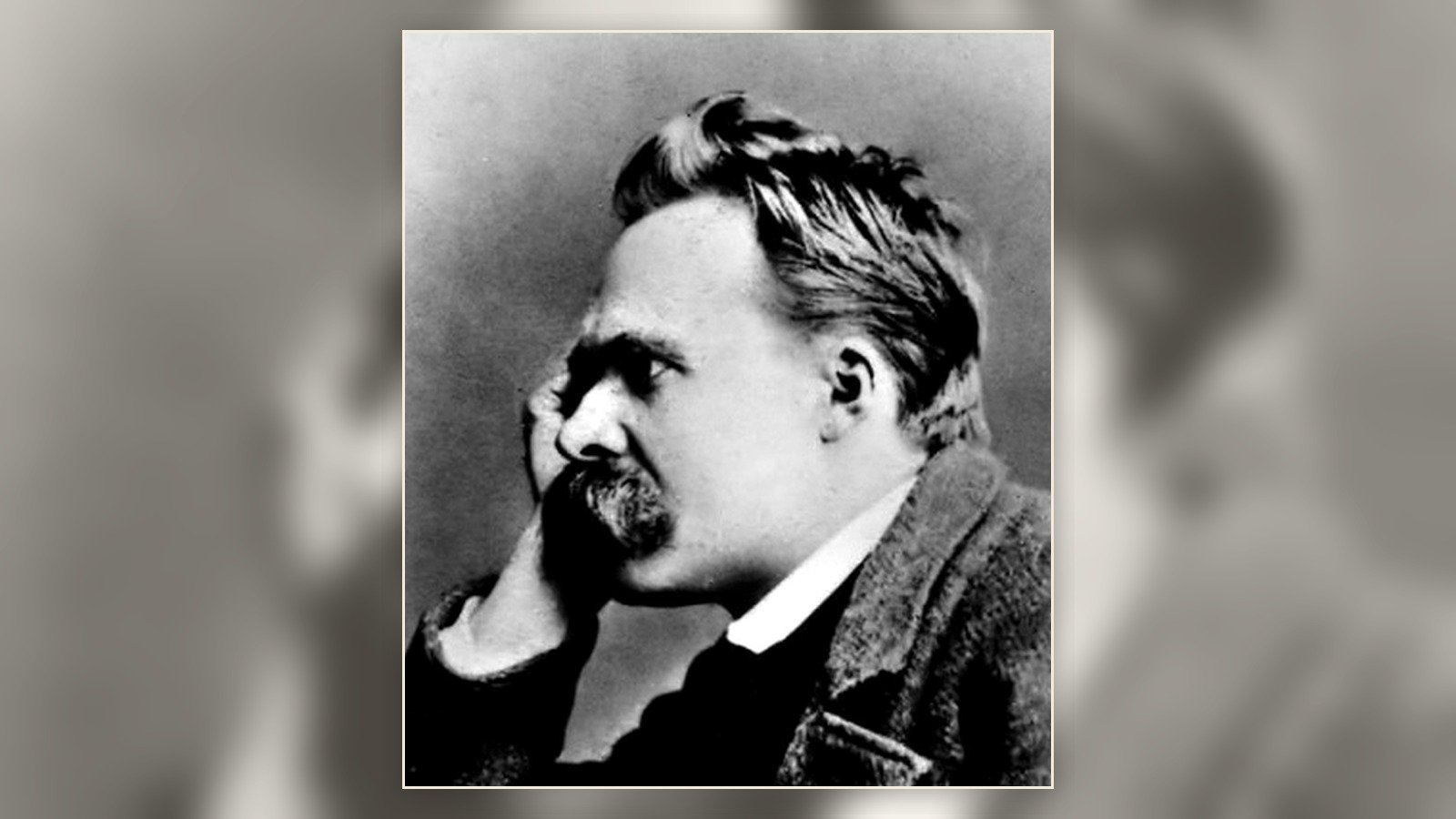
The madman enters the marketplace carrying a lantern in daylight and announces that God is dead. The crowd laughs because many already consider themselves unbelievers. They do not understand the accusation. Nietzsche’s declaration is not simply that one supernatural being does not exist. It is that European culture has destroyed the credibility of its highest authority while continuing to live from the morality, language and hopes that authority sustained. The event has happened; its shadow has not yet finished falling.
The Historical Problem
Nietzsche After the Death of God stands at the intersection of nineteenth-century European secularization, philology, moral psychology and cultural crisis. Its central problem is the collapse of Christian metaphysical authority creates nihilism and demands a revaluation of inherited values. The subject has often been reduced to a slogan, but the surviving texts and images preserve a more difficult history in which meanings changed as they crossed languages, institutions and conflicts.
The article follows a method of close reading of Nietzsche’s published works, intellectual context and reception history. It keeps the central tension in view: liberation from old belief can produce creative freedom or a vacuum filled by resentment and new idols. That approach allows the material to remain dark, compelling and philosophically serious without treating later legend as though it were the only meaning the sources ever possessed.
What the Madman Announces
The famous scene appears in The Gay Science. The madman says that “we” have killed God and asks how humanity will cleanse itself of the act. The language is collective and catastrophic. The death is not a biological event or a proof against theology. It describes the loss of a culturally binding horizon.
The surviving record also reveals a struggle over classification. Terms later used as proper names or fixed schools often began as descriptions, insults or interpretive conveniences. Once repeated in sermons, editions and reference books, the classification appeared older and more coherent than the evidence allowed. Careful history reopens that closure.
This uncertainty does not produce an empty conclusion. It directs attention toward existentialism, genealogy, modern atheism and adversarial philosophies of self-overcoming. Cultural afterlives can be historically real even when they transform their sources. What people believed a text meant shaped art, persecution, devotion and resistance, sometimes more powerfully than the earliest recoverable meaning.
The Long Shadow of Belief
Nietzsche argues that even after explicit faith declines, habits formed by Christianity remain embedded in morality, truth and equality. Secular people may reject doctrine while preserving assumptions about universal value and disinterested reason. The death of God therefore unfolds slowly. Institutions outlive the beliefs that once justified them.
For the reader, the decisive movement is from inherited answer to conscious judgment. The source demands that its claims be heard in their own language before they are turned into modern slogans. That discipline is especially important in a field where rebellion can become another unquestioned identity and darkness can be used as decoration instead of inquiry.
The section also explains why the subject belongs to Luciferian thought and dark philosophy without being reduced to religious devotion. It concerns illumination under prohibition, the testing of command and the moral risk of becoming one’s own authority. The symbolic vocabulary is occult, but the problem reaches ethics, politics and the structure of knowledge.
Nihilism as the Coming Danger
Nihilism appears when the highest values devalue themselves and life seems to lack purpose. Passive nihilism seeks comfort, distraction and minimal suffering. More destructive forms tear down values without creating stronger ones. Nietzsche does not celebrate this condition. He treats it as a historical danger that must be passed through without pretending the old certainties remain intact.
Historical readers did not encounter the material as a neutral online summary. They met it in scripture, expensive books, clandestine editions, lectures, ritual groups, classrooms or public controversy. The medium shaped the meaning. A verse heard in worship, a plate coloured by hand or a philosophical aphorism read during cultural crisis carries a different force from an isolated quotation.
That material history protects the discussion from simplification. It reminds us that the collapse of Christian metaphysical authority creates nihilism and demands a revaluation of inherited values was built through concrete acts of copying, publishing, preaching, censoring and interpretation. Ideas become traditions only when communities give them bodies and transmit them.
Genealogy Instead of Eternal Morality
On the Genealogy of Morality asks how values were produced. Moral concepts have histories shaped by conflict, class, psychology and institutions. By tracing those histories, Nietzsche does not prove that every value is false. He exposes the human interests hidden behind claims of timeless neutrality.
There is also a moral danger in every reversal. To expose an oppressive command does not prove that its opposite is wise; to praise knowledge does not make every secret liberating; to reject dogma does not guarantee freedom from self-deception. The strongest adversarial traditions retain the power to examine their own rebellion.
This is why liberation from old belief can produce creative freedom or a vacuum filled by resentment and new idols should remain visible rather than resolved too quickly. The enduring figure is neither a mascot for obedience nor a convenient hero of refusal. It is a pressure placed upon certainty, forcing the reader to ask what kind of freedom is being defended and what kind of person that freedom creates.
Master, Slave and Ressentiment
Nietzsche contrasts value creation that begins from affirmation with morality that begins by condemning an enemy. Ressentiment transforms powerlessness into moral superiority and labels the strength of another as evil. These categories are diagnostic tools, not a simple programme for domination. Their force lies in asking whether a morality grows from abundance or revenge.
The importance of this section lies in its relationship to the collapse of Christian metaphysical authority creates nihilism and demands a revaluation of inherited values. In nineteenth-century European secularization, philology, moral psychology and cultural crisis, a word or image could carry several levels at once: literal description, inherited myth, political accusation and spiritual claim. Later readers often preserve only the most dramatic layer. Restoring the earlier contexts does not weaken the symbol. It shows why the symbol was able to survive repeated transformations.
The evidence must therefore be handled through close reading of Nietzsche’s published works, intellectual context and reception history. Primary texts establish what a writer actually said; translations reveal where meanings shifted; later art and institutions show which interpretation became memorable. The archive rarely offers a single uncontested line. Its value lies in making visible the moments where one meaning was chosen over another and then treated as ancient certainty.
Christianity and the Ascetic Ideal
Nietzsche attacks forms of Christianity that turn suffering into accusation against life, elevate self-denial and promise compensation in another world. The ascetic ideal gives pain meaning, which is why it is powerful. But its meaning may preserve life by teaching the sufferer to despise the conditions of living.
At the centre of the argument is liberation from old belief can produce creative freedom or a vacuum filled by resentment and new idols. That tension gave the subject its durability. A completely stable doctrine would belong only to its original setting, but an unresolved symbol can cross religious and political boundaries. Each age discovers a different enemy in it and a different form of freedom.
The historical stakes concern whether human beings can create values without disguising will as eternal law. These are not abstract questions added by modern readers; they are already present in the decisions to translate, accuse, obey, rebel or reinterpret. The dark-philosophical power comes from refusing to let authority define its own innocence without examination.
Revaluation of Values
To revalue values is not merely to reverse every command. An inversion remains dependent on the old table. Nietzsche seeks a more difficult creation arising from knowledge of psychology, embodiment and historical contingency. The new value must be able to affirm existence rather than justify itself through hatred of an opposite.
The surviving record also reveals a struggle over classification. Terms later used as proper names or fixed schools often began as descriptions, insults or interpretive conveniences. Once repeated in sermons, editions and reference books, the classification appeared older and more coherent than the evidence allowed. Careful history reopens that closure.
This uncertainty does not produce an empty conclusion. It directs attention toward existentialism, genealogy, modern atheism and adversarial philosophies of self-overcoming. Cultural afterlives can be historically real even when they transform their sources. What people believed a text meant shaped art, persecution, devotion and resistance, sometimes more powerfully than the earliest recoverable meaning.
Self-Overcoming and the Higher Type
Nietzsche’s higher human being is often reduced to domination. The published works place greater emphasis on discipline, intellectual honesty, style, endurance and the ability to transform one’s drives. Self-overcoming is not the fantasy of becoming free from all limits; it is the art of giving form to conflict without denying it.
For the reader, the decisive movement is from inherited answer to conscious judgment. The source demands that its claims be heard in their own language before they are turned into modern slogans. That discipline is especially important in a field where rebellion can become another unquestioned identity and darkness can be used as decoration instead of inquiry.
The section also explains why the subject belongs to Luciferian thought and dark philosophy without being reduced to religious devotion. It concerns illumination under prohibition, the testing of command and the moral risk of becoming one’s own authority. The symbolic vocabulary is occult, but the problem reaches ethics, politics and the structure of knowledge.
Nietzsche and Luciferian Appropriation
Later adversarial and Luciferian writers found obvious affinities in enlightenment, rebellion and rejection of imposed morality. Nietzsche himself did not found Luciferianism and was hostile to many occult and religious movements. The connection is a reception history: his critique supplied language for paths that interpret self-creation through Luciferian symbols.
Historical readers did not encounter the material as a neutral online summary. They met it in scripture, expensive books, clandestine editions, lectures, ritual groups, classrooms or public controversy. The medium shaped the meaning. A verse heard in worship, a plate coloured by hand or a philosophical aphorism read during cultural crisis carries a different force from an isolated quotation.
That material history protects the discussion from simplification. It reminds us that the collapse of Christian metaphysical authority creates nihilism and demands a revaluation of inherited values was built through concrete acts of copying, publishing, preaching, censoring and interpretation. Ideas become traditions only when communities give them bodies and transmit them.
No Easy Dawn After God
The death of God does not automatically produce freedom. New absolutes—nation, race, ideology, market or leader—can inherit the abandoned throne. Nietzsche’s warning remains dark because disbelief is only the beginning. The harder task is to live without metaphysical guarantees while refusing both passive emptiness and the worship of replacement gods.
There is also a moral danger in every reversal. To expose an oppressive command does not prove that its opposite is wise; to praise knowledge does not make every secret liberating; to reject dogma does not guarantee freedom from self-deception. The strongest adversarial traditions retain the power to examine their own rebellion.
This is why liberation from old belief can produce creative freedom or a vacuum filled by resentment and new idols should remain visible rather than resolved too quickly. The enduring figure is neither a mascot for obedience nor a convenient hero of refusal. It is a pressure placed upon certainty, forcing the reader to ask what kind of freedom is being defended and what kind of person that freedom creates.
The language of this tradition should also be distinguished from proof. A symbol can organize centuries of thought without establishing the literal existence of every being imagined through it. Historical seriousness requires neither mockery nor automatic assent. It requires an accurate account of what the sources say, how communities used them and why the questions remained powerful.
Another layer is the politics of memory. Institutions preserve some versions and neglect others; artists select the moment that can be seen; translators choose the word that future readers inherit. The received tradition is therefore not a transparent window into an origin. It is a structure built through selection, and every selection reveals a theory of authority.
The most compelling reading preserves ambiguity without surrendering clarity. We can identify dates, languages, editions and arguments while recognizing that symbols exceed the circumstances of their first use. The morning star, adversary, serpent, fire and death of God continue to work because they permit experience to be narrated at the boundary between knowledge and prohibition.
For Luciferian thought, the lesson is not that every forbidden thing is true. Prohibition may conceal wisdom, danger, prejudice or simple error. The task is examination. Illumination is earned through the willingness to test both the official command and the rebel’s answer, refusing to mistake opposition by itself for insight.
The archive also resists the fantasy of a pure lineage. Ideas pass through opponents, mistranslations, damaged manuscripts, polemical summaries and creative reinvention. A tradition can be historically consequential without possessing an unbroken secret succession. Its reality lies in the documented acts of reading and transformation.
What makes the subject enduring is its ability to join intellectual and emotional experience. It asks about truth, but also about humiliation, pride, fear, desire and hope. Arguments about divine authority are never only abstract when they shape guilt, law, identity and the possibility of speaking against a sacred command.
A final historical layer concerns reception across confessional and secular boundaries. Once the subject left its earliest setting, readers used it to discuss censorship, political sovereignty, artistic creation and the right to interpret inherited symbols for themselves. Those uses are not identical to the source, but they are part of the documented history of existentialism, genealogy, modern atheism and adversarial philosophies of self-overcoming.
The question of authority therefore returns at every stage. A translator authorizes one wording, a preacher one moral, an artist one image and a modern movement one identity. Comparing those choices reveals how the collapse of Christian metaphysical authority creates nihilism and demands a revaluation of inherited values became durable enough to survive changes in belief while remaining recognizable.
Nothing in that history removes the need for judgment. The archive can disclose how a claim arose and why it mattered, but it cannot make the reader’s ethical decision in advance. That responsibility is precisely what gives the material its adversarial force: knowledge opens the question, while freedom determines what follows.
What Remains
The history does not close with a final verdict. It leaves a living conflict over whether human beings can create values without disguising will as eternal law. The tradition’s power comes from the fact that the problem can be inherited without the original theology being accepted. Readers continue to encounter the same demand in new forms: decide whether authority has earned obedience, whether illumination justifies its cost, and whether rebellion can avoid becoming another prison.
That continuing argument is existentialism, genealogy, modern atheism and adversarial philosophies of self-overcoming. SatanWorld approaches it as an archive of ideas rather than a command to believe. The darkness belongs to the history itself—to texts that changed identities, symbols that crossed forbidden boundaries and philosophers who refused to let inherited answers end the question.