The manuscript opens with a title that commands distance: Noli me tangere—do not touch me. Inside, thirty-one painted demons occupy the page in vivid forms, accompanied by sigils, conjurations, treasure operations and rites that move through the most feared materials of early modern magic. Wellcome MS 1766 is not an anonymous black book in the abstract. It is a precisely catalogued object, probably made around 1775, whose images preserve an infernal court in watercolor.
The False Date and the Real Manuscript
The manuscript presents itself with an ancient-looking date, often read as 1057, but palaeography, paper and artistic style place it around 1775. The fictive antiquity is part of its strategy of authority.
Wellcome Library catalogues it as MS 1766, a German and Latin compilation of forty-eight leaves. Its formal title, Compendium rarissimum totius Artis Magicae, advertises a rare compendium of the whole magical art.
The false date does not make the object fraudulent in a simple sense. Grimoires regularly construct age as proof, placing recent compilations inside legendary lines of transmission.
This section matters within the history of Noli Me Tangere grimoire because it joins a textual claim to a recoverable practice of copying, ownership or institutional control. The archive cannot verify every promised supernatural effect, but it can establish who preserved the words, how the material was arranged and which later traditions inherited its structure.
The surviving evidence must be read at the level of the individual witness. Titles migrate, manuscripts combine unrelated works, and later editors normalize spellings that a copyist left unstable. Shelf mark, folio and date are therefore not decorative citations; they are the controls that keep a famous occult name attached to a real object.
Thirty-One Demons in Watercolor
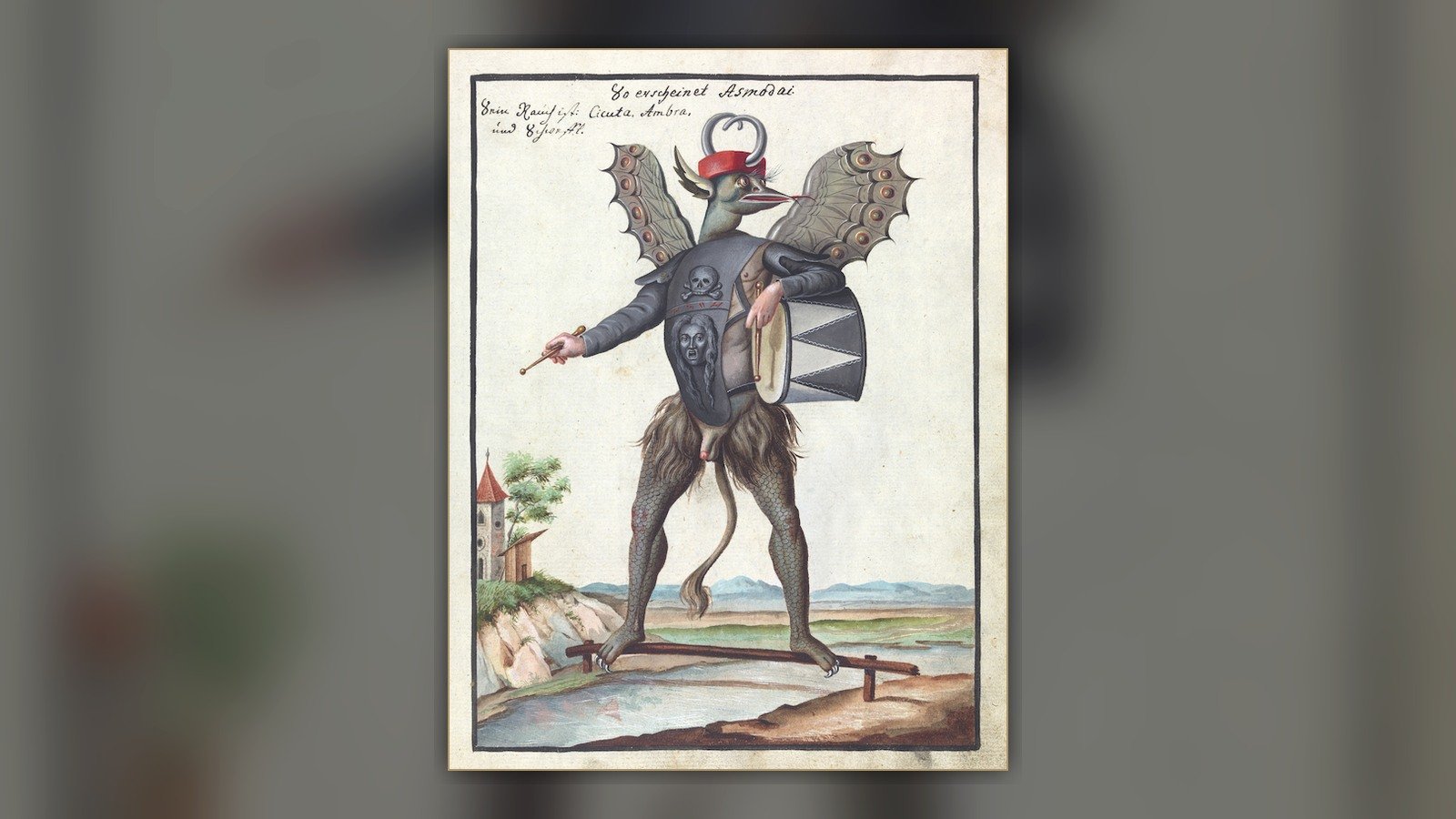
The most immediately striking feature is a sequence of thirty-one demon images. Each figure is given an individual body, colour and posture. Horns, animal limbs, crowns, weapons and hybrid anatomy translate names into visible presences.
The paintings are not neutral illustrations added by a modern publisher. They belong to the manuscript’s conceptual system, helping the reader distinguish powers and imagine the entities addressed by the text.
The archive therefore preserves an unusual union of manual and gallery. The grimoire teaches through image as well as command.
This section matters within the history of Noli Me Tangere grimoire because it joins a textual claim to a recoverable practice of copying, ownership or institutional control. The archive cannot verify every promised supernatural effect, but it can establish who preserved the words, how the material was arranged and which later traditions inherited its structure.
Later occult publishing often produces a clean, continuous text from several damaged or divergent witnesses. That work can make a tradition readable, but it may conceal the decisions of editors. Comparing the edition with a catalogue and image restores omissions, marginalia, layout and the physical sequence in which a historical reader encountered the material.
Asmodai and the Infernal Court
One folio depicts Asmodai, a demon with a long history in Jewish, Christian and magical traditions. In the manuscript he appears within a wider hierarchy whose members are treated as identifiable operators rather than vague symbols.
Names from older demonological traditions are recast through eighteenth-century visual language. The figures resemble an infernal nobility, each carrying marks of office and temperament.
The courtly arrangement makes the unknown administrable. To name and paint a demon is to claim that its place in the invisible order can be known.
This section matters within the history of Noli Me Tangere grimoire because it joins a textual claim to a recoverable practice of copying, ownership or institutional control. The archive cannot verify every promised supernatural effect, but it can establish who preserved the words, how the material was arranged and which later traditions inherited its structure.
Claims of great antiquity require special care. A manuscript may preserve old material while being physically much later, and a legendary attribution may express authority rather than authorship. Separating date of object, date of textual layer and mythical origin produces a stronger history than accepting or dismissing the tradition as a whole.
Treasure Spirits and Buried Wealth
A major current in Germanic and Central European magic concerns treasure guarded by spirits. War, plague, abandoned settlements and buried valuables fed beliefs that wealth remained concealed beneath ruins, forests and gallows fields.
Treasure rites promise discovery but also describe guardians, conditions and dangers. The seeker may need a correct hour, protective circle, silence or a compact with the being attached to the hoard.
Such operations reveal the economic pressure beneath occult literature. The supernatural promise begins in material scarcity and the hope that hidden wealth can break ordinary limits.
This section matters within the history of Noli Me Tangere grimoire because it joins a textual claim to a recoverable practice of copying, ownership or institutional control. The archive cannot verify every promised supernatural effect, but it can establish who preserved the words, how the material was arranged and which later traditions inherited its structure.
Every act of copying is evidence of valuation. Paper, ink and time were spent because someone considered the material useful, dangerous, prestigious or worthy of preservation. Even where performance cannot be demonstrated, transmission itself is a documented historical action with social and intellectual consequences.
The Gallows as a Magical Threshold
The manuscript includes transgressive procedures associated with executed bodies and the gallows. In European folklore, the criminal corpse carried concentrated power because it had crossed violently between law, shame and death.
Hands, fat, nails, rope and earth from execution sites appear in wider magical traditions. Authorities guarded bodies partly because relic-taking and illicit medicine could continue after sentence had been completed.
Gallows magic is frightening because it appropriates the state’s theatre of punishment. The place intended to display authority becomes a source of power outside authority.
This section matters within the history of Noli Me Tangere grimoire because it joins a textual claim to a recoverable practice of copying, ownership or institutional control. The archive cannot verify every promised supernatural effect, but it can establish who preserved the words, how the material was arranged and which later traditions inherited its structure.
Images must also be identified precisely. A related seal, later title page or parallel manuscript can illuminate the subject, but it should not be called the exact folio when it is not. This article distinguishes contextual imagery from direct facsimile so that atmosphere never replaces provenance.
Blood, Animals and Forbidden Materials
Some operations call for animal substances, sacrifice or materials gathered under disturbing conditions. The manuscript treats the body as a store of correspondences: blood, bone, feather, skin and organ carry qualities into a rite.
Not every instruction can be assumed to have been performed. A grimoire can preserve fantasy, threat, inherited recipe and practical experiment on the same page. The text records a horizon of possibility rather than a police report.
Historical restraint does not weaken the darkness. The fact that a scribe considered these materials worth copying reveals the imagined reach of the art.
This section matters within the history of Noli Me Tangere grimoire because it joins a textual claim to a recoverable practice of copying, ownership or institutional control. The archive cannot verify every promised supernatural effect, but it can establish who preserved the words, how the material was arranged and which later traditions inherited its structure.
The surviving evidence must be read at the level of the individual witness. Titles migrate, manuscripts combine unrelated works, and later editors normalize spellings that a copyist left unstable. Shelf mark, folio and date are therefore not decorative citations; they are the controls that keep a famous occult name attached to a real object.
Sigils Written on the Body
The final leaves include signs and sigils, some connected with bodily placement or ritual use. A sigil compresses a name into graphic form, allowing identity and command to be carried without ordinary language.
Body inscription collapses the distance between operator and operation. The skin becomes parchment, and protection or pact is made physically intimate.
This is one reason magical signs alarmed religious and judicial authorities. A hidden mark could travel where a book could be confiscated.
This section matters within the history of Noli Me Tangere grimoire because it joins a textual claim to a recoverable practice of copying, ownership or institutional control. The archive cannot verify every promised supernatural effect, but it can establish who preserved the words, how the material was arranged and which later traditions inherited its structure.
Later occult publishing often produces a clean, continuous text from several damaged or divergent witnesses. That work can make a tradition readable, but it may conceal the decisions of editors. Comparing the edition with a catalogue and image restores omissions, marginalia, layout and the physical sequence in which a historical reader encountered the material.
How the Manuscript Entered the Wellcome Collection
The codex eventually entered the collection assembled by Henry Wellcome, whose interests in medicine, anthropology and the history of the body brought together objects that conventional libraries often ignored.
Institutional preservation changed the manuscript’s status. A dangerous private manual became a catalogued research object, available through high-resolution digitization and formal rights information.
The transition from secret book to public archive is one of forbidden history’s recurring reversals. What earlier owners concealed, a modern institution preserves by making visible.
This section matters within the history of Noli Me Tangere grimoire because it joins a textual claim to a recoverable practice of copying, ownership or institutional control. The archive cannot verify every promised supernatural effect, but it can establish who preserved the words, how the material was arranged and which later traditions inherited its structure.
Claims of great antiquity require special care. A manuscript may preserve old material while being physically much later, and a legendary attribution may express authority rather than authorship. Separating date of object, date of textual layer and mythical origin produces a stronger history than accepting or dismissing the tradition as a whole.
Do Not Touch, but Continue Reading
Noli Me Tangere remains difficult to classify. It is demonological picture book, ritual manual, treasure grimoire and collection of transgressive recipes. Its parts may have been drawn from several earlier sources.
The title acts as warning and invitation. A book that says “do not touch” creates the desire to cross the final distance between viewer and object.
Its power today lies in material specificity: real paper, real pigments, numbered folios and a succession of painted beings whose eyes still meet the reader from an eighteenth-century page.
This section matters within the history of Noli Me Tangere grimoire because it joins a textual claim to a recoverable practice of copying, ownership or institutional control. The archive cannot verify every promised supernatural effect, but it can establish who preserved the words, how the material was arranged and which later traditions inherited its structure.
Every act of copying is evidence of valuation. Paper, ink and time were spent because someone considered the material useful, dangerous, prestigious or worthy of preservation. Even where performance cannot be demonstrated, transmission itself is a documented historical action with social and intellectual consequences.
The Book as Historical Evidence
The enduring power of Noli Me Tangere grimoire comes from the meeting of claim and object. A legendary author, celestial teacher or infernal hierarchy may dominate the title, but the historical work begins with paper, parchment, handwriting, type, pigment, binding and custody. These features identify when a witness could have been made and how it passed from one set of hands to another.
Provenance also changes meaning. A ritual text in a private notebook, a confiscated bundle in a court file and the same leaves in a national library are not socially identical objects. Each setting imposes a new interpretation: tool, evidence, curiosity, pathology, heritage or research source. Forbidden history is the sequence of those transformations.
The featured image used here is an authentic historical reproduction connected directly to the subject or, where explicitly stated, to the precise manuscript tradition discussed. It has been framed for a modern 16:9 website format without replacing the central archival image. Credit and reuse status are recorded in the package ledger.
What the Archive Refused to Lose
Noli Me Tangere and the Black Magic of the Gallows ultimately survives because prohibition never operated alone. Copyists, collectors, physicians, clergy, defendants, censors and librarians all participated in transmission, sometimes while condemning the material they preserved. Their motives were different, but the cumulative result is a record that can still be examined rather than merely repeated as legend.
The most responsible occult history does not drain mystery from the source. It replaces vague mystery with exact strangeness: a named shelf mark, an unexpected language, a corrected spirit name, an erased line, a later hand in the margin, a printed prohibition or a diagram copied by someone whose identity has disappeared. These details are darker than invention because they belong to the surviving object.
Reading the Surviving Witnesses
Researchers approaching Noli Me Tangere grimoire should separate the physical witness from the modern title used to group it. Catalogue descriptions establish dimensions, support, script, foliation and the works bound before and after the relevant text. Those details often reveal whether the item was planned as a coherent book or assembled from papers with independent histories.
Transcription creates another layer. Unfamiliar names can be altered by a single misread letter, especially when Greek, Hebrew, Latin, French, German or invented ritual syllables cross scripts. Variant spelling should therefore be recorded rather than silently corrected, because the history of error is part of the transmission of Noli Me Tangere grimoire.
Digital access has transformed this field by allowing a reader to compare image and edition across institutions. It has not abolished the need for caution. Colour balance, cropped edges, missing blanks and online metadata can affect interpretation, while some composite volumes remain only partially photographed.
The strongest account combines primary witness, institutional catalogue and specialist scholarship. Popular retellings are useful for tracing cultural memory, but they should not be allowed to replace the source that created the story. This hierarchy of evidence gives the narrative depth without turning it into a debunking exercise.
Researchers approaching Noli Me Tangere grimoire should separate the physical witness from the modern title used to group it. Catalogue descriptions establish dimensions, support, script, foliation and the works bound before and after the relevant text. Those details often reveal whether the item was planned as a coherent book or assembled from papers with independent histories.
Transcription creates another layer. Unfamiliar names can be altered by a single misread letter, especially when Greek, Hebrew, Latin, French, German or invented ritual syllables cross scripts. Variant spelling should therefore be recorded rather than silently corrected, because the history of error is part of the transmission of Noli Me Tangere grimoire.
Digital access has transformed this field by allowing a reader to compare image and edition across institutions. It has not abolished the need for caution. Colour balance, cropped edges, missing blanks and online metadata can affect interpretation, while some composite volumes remain only partially photographed.
The strongest account combines primary witness, institutional catalogue and specialist scholarship. Popular retellings are useful for tracing cultural memory, but they should not be allowed to replace the source that created the story. This hierarchy of evidence gives the narrative depth without turning it into a debunking exercise.