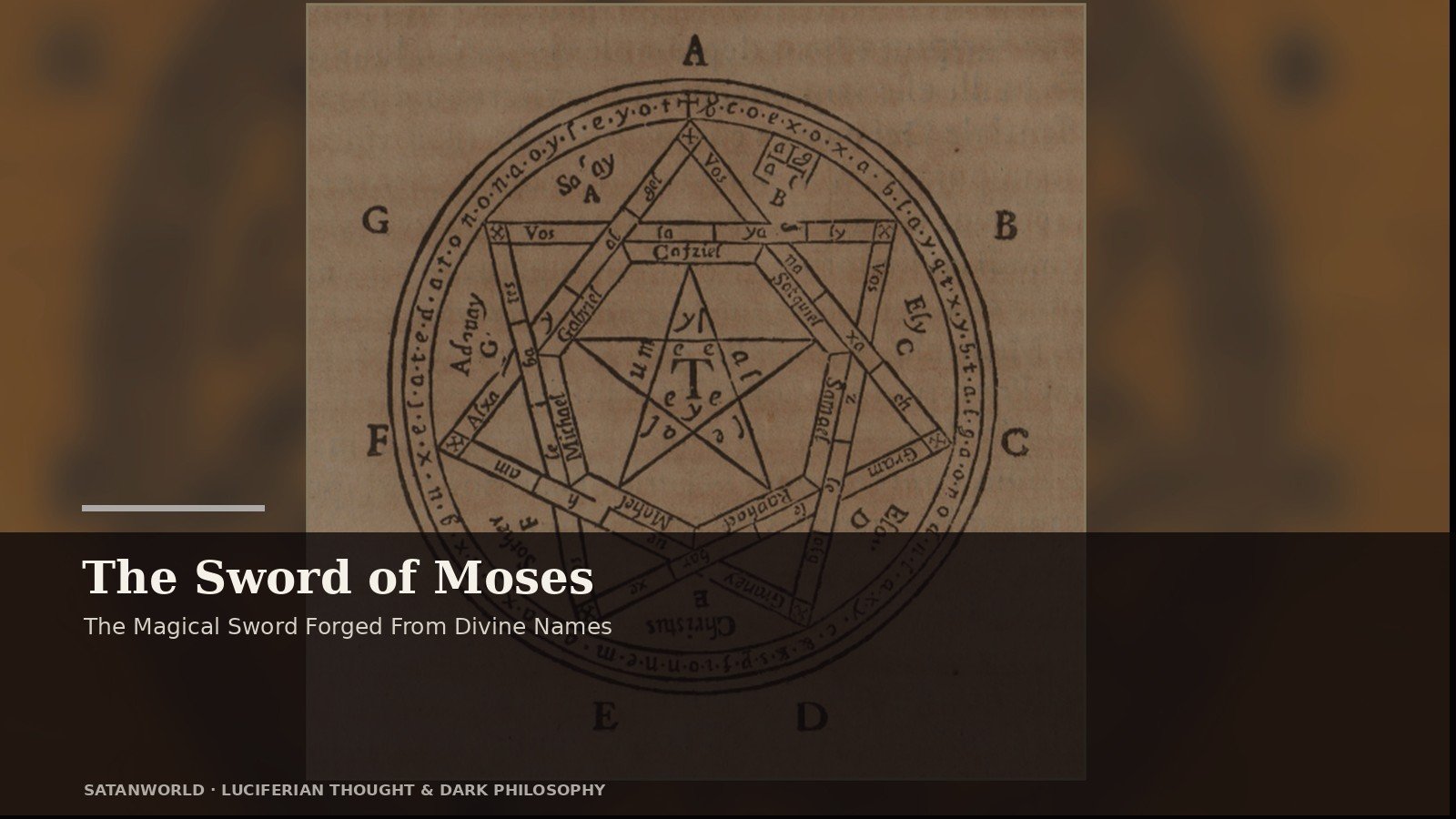
The Sword of Moses presents a chain of divine and angelic names as a weapon of language, preceded by a narrative of revelation and followed by applications attributed to its power.
To open The Sword of Moses is to enter a record whose authority does not come from modern shock value. It comes from age, damaged transmission, communities that guarded or rejected it, and ideas strong enough to survive after the institutions surrounding them disappeared. The book's reputation must therefore be handled with precision: atmosphere matters, but chronology matters more.
What the Book Is
The Sword of Moses belongs to Jewish magical tradition. The Sword of Moses presents a chain of divine and angelic names as a weapon of language, preceded by a narrative of revelation and followed by applications attributed to its power.
It is often advertised as a forbidden book, yet that phrase can conceal several different histories. A work may be noncanonical, copied for initiates, condemned as heresy, legally suspect because of magic, or simply lost when its community vanished. This article distinguishes those conditions rather than pretending that one decree explains every century of transmission.
Alternative names and cataloguing forms include: Harba de-Moshe The identity of the work must follow the manuscripts and scholarly record, not titles invented by modern sellers.
Date, Language and Attributed Authority
The underlying work is situated in Late antique Jewish magical text preserved in medieval manuscripts. Dates refer to composition or major textual layers, not automatically to the age of the physical manuscripts now held in libraries.
Ancient and medieval books commonly speak through authoritative figures—patriarchs, apostles, sages, kings, angels or popes—whose names guarantee revelation. Such attribution can be spiritually meaningful while remaining historically pseudonymous. The decisive question is not whether the named figure held the surviving pen, but what community used that voice and why the voice had power.
Language also changes identity. Translation can preserve a lost original while introducing new titles, divine names and interpretive choices. Every responsible reading of The Sword of Moses keeps composition, translation and surviving copy as separate layers.
The Surviving Manuscript Record
The Hebrew and Aramaic work survives in manuscripts and was first made widely known through modern scholarly publication. Its text contains corruptions produced by generations copying unfamiliar names.
This survival history determines what can honestly be claimed. Missing folios, conflicting recensions and late copies do not make the text meaningless; they reveal the cost of transmission. They also prevent a modern editor from presenting one convenient version as though it descended untouched from antiquity.
The physical record is part of the darkness surrounding the book: torn edges, corrections, unstable names and passages preserved in languages far removed from the lost original. What survives is not a clean revelation dropped into the present. It is a recovered archive bearing the marks of every hand that feared, revered, edited or misunderstood it.
The World Inside the Text
A heavenly sword is transmitted through angelic authority. The practitioner is prepared through purity and prayer before receiving a long sequence of names linked to protection, healing, knowledge and coercive aims.
The book's universe is governed by relationships between visible action and invisible authority. Human events are rarely merely human. Knowledge descends through ranks, error becomes a power, names establish access, and cosmic order is shown as something that can be obeyed, counterfeited or violated.
This is why the work remains effective as dark philosophy. It asks whether the world is governed by justice, ignorance, hierarchy, appetite or secret law—and whether liberation comes through obedience, revelation, refusal or command.
Four Currents of Forbidden Knowledge
Language treated as a blade forms the first current. The text treats this not as decorative myth but as a structure that changes the fate of persons, communities or worlds.
Angelic transmission of an impossible sequence forms the second. Here knowledge is never neutral: revelation may heal, corrupt, expose or condemn according to the authority behind it and the desire of the recipient.
Copyists preserving names they could not understand forms the third. The surviving book repeatedly turns absence into evidence, making loss, exile, silence or damaged memory part of its spiritual architecture.
Purity beside coercive desire forms the final current. The reader is forced to confront a boundary beyond which ordinary religious categories no longer remain stable.
Why the Book Became “Forbidden”
Its use of sacred names for practical power placed it beyond normative liturgy. The book’s secrecy is structural: the sword is not metal but a sequence whose corruption or misuse destroys confidence in transmission.
A precise history avoids the easy claim that the book was banned everywhere. Canon lists differed. Libraries preserved what public authorities condemned. Magical texts were copied by clerics. Heretical works survived in hidden codices without leaving a record of who concealed them. In several cases the strongest evidence is exclusion, polemic or secrecy rather than a documented empire-wide destruction order.
Its forbidden reputation is still historically meaningful. It records the collision between authorized revelation and knowledge that claimed another source. The danger was not only what the book said, but who might gain the right to speak, interpret heaven or command invisible powers without institutional permission.
Transmission, Rediscovery and Distortion
It influenced modern study of Jewish magic and comparisons with Greek magical papyri, Hekhalot literature and later grimoires of divine names.
Rediscovery creates a second life. Once a manuscript enters print, fragments become a supposed complete system, technical terms acquire modern meanings, and a title may be sold as older or darker than the evidence allows. SatanWorld preserves the later occult afterlife without allowing it to overwrite the earliest recoverable identity.
Modern popular culture often isolates one arresting feature—the fallen angel, false creator, secret name, pact or demonic seal—and erases the book's larger argument. The result may be visually powerful but historically thin. A serious archive restores the complete intellectual and religious world around that feature.
The Book as Dark Philosophy
Read philosophically, The Sword of Moses asks who has the authority to define reality. Its answer may be a hidden God, an angelic hierarchy, a corrupted ruler, an initiated sage, a divinely ordered cosmos or a practitioner attempting to compel that cosmos. In every case, knowledge creates responsibility and danger.
The book also confronts the price of revelation. The visionary returns isolated. The magician binds himself by oath. The rebel receives knowledge that becomes violence. The initiate discovers that the familiar world is governed by powers previously mistaken for ultimate truth. These patterns explain why such texts remain close to Luciferian thought even when they predate the modern word Luciferianism.
Their common current is adversarial illumination: light that does not comfort, but exposes hierarchy, contradiction and concealed power. The historical traditions disagree about whether that light is divine, stolen, counterfeit or fatal. The disagreement is the centre of the archive, not a problem to be erased.
Historical Boundaries and Responsible Reading
The source record must remain stronger than the legend. Composition date is not manuscript date. Pseudonymous authorship is not fraud in the modern commercial sense. A noncanonical scripture is not automatically Satanic, and a grimoire that invokes Christian names is not automatically approved by the church whose language it uses.
Descriptions of ritual material remain historical and analytical. This article does not convert fragmented, sacred or coercive operations into instructions. The purpose is to understand what the book contained, why people preserved it, and what dangers its own tradition attached to contact with hidden powers.
The most reliable approach compares editions, identifies the language behind a translation and separates ancient passages from modern occult commentary. That discipline does not weaken the atmosphere. It makes the darkness credible because it belongs to the actual record.
The Page That Refused to Disappear
The Sword of Moses survived because someone copied it when copying carried risk, reverence or both. Its pages crossed languages, libraries and religious boundaries. Even where the complete work vanished, a fragment, quotation or hostile description preserved enough of its shape for later generations to recognize the forbidden outline.
The book now belongs to an archive rather than a secret chamber, but availability has not exhausted it. The central questions remain open: whether forbidden knowledge liberates or enslaves, whether rebellion exposes false authority or creates another tyranny, and whether a name written to command the unseen can ever leave the writer unchanged.
Sources and Further Reading
The following records provide primary texts, manuscript catalogues, historical editions or bibliographic orientation. Modern copyrighted translations are referenced for identification and scholarship, not reproduced.
https://archive.org/search?query=title%3A%22Sword%20of%20Moses%22
https://search.worldcat.org/search?q=%22Sword%20of%20Moses%20magical%20text%22