The Devil of the witch trials rarely appeared with horns and flames. In surviving testimony he came quietly: a black-clad man at the roadside, a dog at the bed, a cold hand in the night or a spectral shape visible only to the afflicted.
The Stranger in Black
Across early modern Europe, accused men and women described encounters with a dark stranger who offered aid, revenge, food or power. He could appear handsome, severe or strangely ordinary. Only later would the witness identify him as the Devil.
In Scottish records, the figure often asked the accused to renounce baptism, accept a new name and mark the body. He promised protection or relief from poverty, then demanded service. The pact was described as both contract and violation.
The ordinary clothing made the apparition more disturbing. Evil did not need to announce itself as monstrous. It could arrive dressed like a gentleman, speak in familiar language and wait for consent.
The Devil at the Bedside
Many encounters occurred during illness, grief, exhaustion or isolation. The visitor stood at the bed, pressed upon the sleeper or spoke from the darkened room.
Agnes Sampson, accused during the North Berwick trials, confessed after severe interrogation to meetings involving the Devil and a conspiracy against King James VI. Official correspondence and later pamphlets turned her testimony into a national account of demonic war against the crown.
Other witnesses described a cold body, a rough hand or a voice offering freedom from suffering. In the records, the moment of apparition often followed a quarrel, bereavement or desperate need. The Devil entered through the wound already present in ordinary life.
Animal Forms and Familiar Spirits
Demonic forces also appeared as cats, dogs, hares, birds, insects and composite animals. English trials gave familiars personal names and distinct appetites. They were said to suck blood from hidden marks and perform harmful tasks for their human keepers.
During the 1645 trial of Elizabeth Clarke in Essex, witnesses described animal spirits including a white cat, a greyhound, a black rabbit and a polecat. The creatures carried names such as Vinegar Tom and Sacke and Sugar.
These forms made the invisible world domestic. The familiar could hide beside the hearth, under a chair or among ordinary animals. A household pet, a nocturnal scratch or an unexplained mark could become evidence of a pact.
Spectres That Attacked the Living
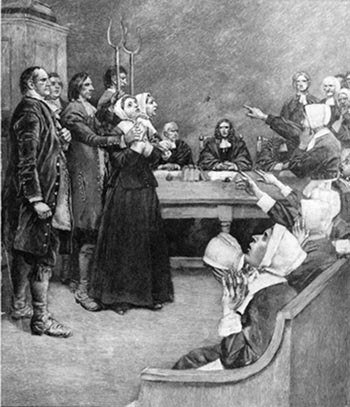
In Salem in 1692, accusers testified that the spectral shapes of neighbours bit, choked and tormented them. The physical person might be elsewhere, yet the court was asked to believe that the Devil could use that person’s image.
This spectral evidence created a terrifying legal problem. If a demon could imitate the innocent, an apparition did not prove consent. Yet the afflicted named the shapes they saw, and those names led to arrest, examination and execution.
The courtroom became a second haunted space. Girls cried out, bodies stiffened and invisible attacks unfolded before magistrates. The apparition entered the law through the witness who claimed to see what no one else could.
Midnight Assemblies
Trial narratives expanded individual encounters into collective gatherings. The accused described night flights, dances, feasts, inverted worship and the Devil preaching against Christian faith.
At these meetings, participants supposedly kissed the Devil, received marks and learned harmful magic. The sabbath brought scattered local fears into one organised kingdom of darkness.
The details varied by region, but the structure was stable: a hidden society existed beneath Christian society, meeting at night and obeying an adversarial lord. The witch trial claimed to reveal its members.
The Mark on the Body
Investigators searched accused bodies for insensible marks, unusual blemishes or places from which familiars were believed to draw blood. Examiners shaved hair, inserted pins and recorded anything that seemed outside ordinary anatomy.
The mark translated an invisible pact into physical evidence. Once found, it could be shown in court. The body became an archive on which the Devil was believed to have signed his name.
For the accused, there was no safe body. A scar could be a mark. The absence of pain could be interpreted as supernatural. The search itself produced the evidence it expected to find.
Voices Preserved by Clerks
The trial records are mediated documents. Clerks translated speech into legal language. Ministers supplied demonological categories. Torture, sleep deprivation and threat shaped confessions.
Yet the pages preserve more than official theory. They contain local animals, remembered voices, family quarrels, dreams and landscapes. The apparition borrowed the materials of the witness’s world.
Databases such as the University of Edinburgh Survey of Scottish Witchcraft allow thousands of these motifs to be traced across cases. The recurring forms show how deeply the demonic imagination entered the legal systems of early modern Europe.
Agnes Sampson and the North Berwick Devil
In 1590, Scotland’s fear of witchcraft gathered around storms that had threatened the voyages of King James VI and his bride, Anne of Denmark. The North Berwick trials accused men and women of assembling with the Devil and raising weather against the royal ships.
Agnes Sampson, a respected healer and midwife from Keith, was arrested and interrogated. The surviving confession dated 29 January 1591 records meetings, charms and a gathering in North Berwick kirk. Accounts say she was deprived of sleep, restrained and subjected to severe bodily examination before confessing.
The Devil appeared in the testimony as a black man who stood in the church and demanded allegiance. Witches kissed him, promised service and participated in rituals while the pulpit and sacred space were reversed. The kirk became, in the legal imagination, a nocturnal court ruled by the adversary.
Sampson was also associated with attempts to identify a private conversation of the king, a detail used to convince James that supernatural knowledge was operating. Her confession was copied into state papers and helped propel the Scottish monarchy toward a more aggressive prosecution of witchcraft.
The apparition mattered because it joined treason to demonology. The black man was not merely tempting an isolated woman; he presided over a conspiracy against the king, the weather and the Christian kingdom.
Familiars in the Essex Records
English trials often gave the Devil an animal body. In the Chelmsford proceedings of 1566, Elizabeth Francis described receiving a white-spotted cat called Sathan from her grandmother. The familiar demanded blood and promised assistance in return.
Francis said the cat taught her how to harm people and obtain wealth or affection. She later passed it to Agnes Waterhouse, who was accused of sending it against neighbours. Waterhouse was executed, while the story of Sathan entered one of England’s earliest printed witch-trial pamphlets.
Other Essex records name familiars such as Vinegar Tom, Pyewacket, Sack and Sugar, Holt and Jarmara. They appeared as cats, dogs, rabbits, imps or creatures that resisted stable description. Witch-finders claimed to discover teats or marks from which these spirits fed.
The familiar made demonic power domestic. It did not always arrive with thunder or a pact written in blood. It lived near the hearth, entered through a window and accepted a drop of blood like milk. The ordinary intimacy of an animal made the accusation especially difficult to escape.
Pendle and the Black Dog
The Pendle trials of 1612 began when Alizon Device encountered peddler John Law on a Lancashire road. After he refused to give or sell her pins, she cursed him, and he collapsed soon afterward. The incident drew magistrate Roger Nowell into the rival households of Demdike and Chattox.
Alizon confessed that a black dog had appeared and offered power. The animal asked for her soul; later she commanded it against Law. The dog in her account was not a pet or symbol but a speaking intermediary between anger and injury.
Investigations expanded through family testimony. James Device described a gathering at Malkin Tower. Young Jennet Device testified against her mother Elizabeth and other relatives. The household became a suspected coven, and local quarrels were reorganized as a demonic association.
The printed account by clerk Thomas Potts turned the trials into a carefully shaped warning. It preserved speeches, confessions and apparitions under the authority of the court. Ten people were executed at Lancaster, their deaths attached to a black dog first said to have appeared on an open road.
Isobel Gowdie and the Shape of the Hare
In 1662, Isobel Gowdie of Auldearn gave four remarkable confessions without a surviving record of formal judicial torture. Her testimony contains one of the richest visionary worlds in the witch archives: covens, fairy beings, elf-shot, magical journeys and transformations into animals.
Gowdie recited charms for becoming a hare, cat or crow. In the hare form, she described running across the landscape while hunters and hounds pursued. The transformation formula joined words, bodily imagination and the Scottish countryside.
She spoke of meeting the Devil, renouncing baptism and receiving a new name. He appeared as a man, sometimes dark and cold to the touch, and presided over gatherings. Her descriptions possess an internal detail that has made the confessions difficult to forget.
Whether Gowdie drew from dreams, folklore, coercive questioning or an intense personal mythology, the clerk preserved her voice at unusual length. In her pages, the demonic apparition does not merely enter a room. It opens a complete parallel world beside the farms and fields of Moray.
The Bamberg Letter
Continental trials could produce equally vivid encounters under far more explicit torture. In 1628, Johannes Junius, burgomaster of Bamberg, wrote secretly to his daughter from prison. He described how torment forced him to confess witchcraft and invent meetings he had never attended.
Under questioning, Junius said the Devil appeared as a woman or goat-like figure and gave him a demonic name. He was made to describe a sabbat, companions and crimes. The interrogators demanded a complete invisible biography, and torture supplied its structure.
His private letter is one of the most terrible documents of the witch persecutions because it shows apparition testimony being manufactured in real time. Junius begged his daughter to understand that everything confessed was false. He was executed nonetheless.
The letter does not empty the apparition of historical power. It reveals how authorities required the Devil to appear. A prisoner had to provide shape, speech, pact and meeting before the court would accept the confession it had already decided to hear.
Salem and the Spectral Shape
In Salem Village in 1692, afflicted girls and young women said invisible beings pinched, choked and bit them. They identified the shapes as the spectres of neighbours. The accused might be standing before the court while an unseen double attacked the witness.
Tituba’s confession introduced a black dog, a red cat, a yellow bird and a tall man who carried a book. She said the man demanded her signature and showed her other marks within it. Her testimony expanded a local affliction into a conspiracy of witches organized by a diabolical master.
Spectral evidence allowed accusation to cross physical impossibility. A person’s body could remain at home or in jail while the spirit travelled to harm. Ministers debated whether the Devil could assume the shape of an innocent person. As long as the answer remained uncertain, visions could lead toward imprisonment and death.
Bridget Bishop, Rebecca Nurse, George Burroughs and others faced testimony concerning apparitions. Burroughs’s great strength and ability to recite the Lord’s Prayer at the gallows complicated the expected signs, but he was hanged. Nineteen people died by hanging, and Giles Corey was pressed to death after refusing a plea.
By autumn, confidence in spectral evidence weakened. Governor William Phips dissolved the Court of Oyer and Terminer. The legal machinery stopped, but the visions had already become written statements preserved in Massachusetts archives.
The Devil’s Mark
Examiners searched bodies for a physical seal of the pact. Moles, scars, numb areas and natural variations could be interpreted as witch marks or teats used to feed familiars. Shaving and pricking transformed the body into a document officials believed they could read.
Professional prickers used needles, sometimes retractable, to locate places that did not bleed or feel pain. In Scotland and England, this practice could create decisive evidence where no witness had seen a spell. The skin was expected to confirm what interrogation had already named.
The mark completed the apparition’s work. The Devil appeared, offered a pact and then signed the recruit’s flesh. Invisible allegiance became visible enough for court presentation.
The Sabbath as an Infernal Court
Across Europe, confessions placed witches at night gatherings reached by flight, animal transformation or spirit transport. The Devil sat on a throne, preached backward doctrine, distributed powders and received homage. Sacred rites were inverted: baptism renounced, crosses desecrated, communal meals turned into feasts without nourishment.
Local details filled the common pattern. A Scottish kirk, a German hill, a French crossroads or a New England field could become the meeting place. The sabbath was portable because it used familiar landscape as the entrance to a hidden kingdom.
Apparitions at these gatherings varied from handsome men to black goats, dogs, stags or monstrous composites. The adversary adapted his body to the witness and the questions of the court. What remained constant was authority: he demanded a name, promise or mark.
What the Clerks Left Behind
Trial documents were created by institutions seeking crime. Clerks summarized speech, translated dialect and arranged answers according to legal expectation. Ministers and magistrates supplied categories that accused people learned under pressure.
Yet the records preserve material no demonological manual could wholly invent: names of animals, remembered fields, family tensions, household objects, weather, dreams and phrases spoken in local cadence. The apparition borrowed its clothing from the world of the witness.
Modern archives and databases permit these motifs to be followed across thousands of cases. The Survey of Scottish Witchcraft, English state papers, Salem records and continental editions reveal both repetition and difference. The Devil is repeatedly a man in black, but no two witnesses meet him in exactly the same road.
These pages are exhaustive not because they prove every vision occurred as described, but because courts treated the visions as acts in the world. Apparitions were entered into indictments, copied by clerks and attached to sentences. The unseen acquired the full weight of law.
Apparitions as Maps of Authority
The demonic figures in trial records repeatedly entered places where authority was uncertain: crossroads, bedrooms, churchyards, edges of fields and the threshold of the home. At these borders, the apparition offered an alternative allegiance. It promised food, revenge, healing or power in exchange for obedience.
Courts translated those meetings into treason against God and sovereign. A private vision became membership in an organized enemy kingdom. The Devil’s body—black man, dog, goat or familiar—showed the accused whom to obey, while the written confession showed magistrates whom to punish.
That structure explains why apparitions appear with such consistency across otherwise different regions. They were not ornamental details. They were the moment at which misfortune became covenant and suspicion became a prosecutable crime.
The Apparitions That Survived the Trials
The courts eventually abandoned spectral evidence and witch prosecutions declined. The figures in the testimony did not vanish. The black man at the crossroads, the animal familiar and the night visitor passed into folklore, literature and modern occult memory.
These apparitions remain powerful because they were written under oath, copied into state papers and attached to real sentences. They stand at the point where vision became evidence and evidence became death.
The records cannot restore the exact nights described by the accused and afflicted. They preserve the shapes those nights were given. Across centuries of parchment, the Devil continues to arrive without horns, dressed for the road and asking the witness to speak his name.