The angel Raziel stands at the threshold of hidden knowledge. In later legend he gives Adam a book after the expulsion from Eden, preserving the secrets of heaven in written form. Medieval manuscripts bearing the name Liber Razielis do not preserve one simple revelation. They gather astrological, angelic and talismanic materials into a changing corpus whose authority depends on the idea that knowledge descended from the celestial world.
Raziel, Keeper of Divine Mysteries
Raziel’s name is commonly understood as the “secret of God.” Jewish angelological traditions associate him with revelation, celestial wisdom and the transmission of mysteries inaccessible to ordinary human reason.
The legend of a book given to Adam provides the corpus with a genealogy before history. The knowledge is imagined as older than kingdoms, languages and institutions, surviving catastrophe through chosen transmitters.
This myth of origin does not date the manuscripts. It explains the kind of authority they claim: not invention, but recovery of a primordial deposit.
This section matters within the history of Liber Razielis because it joins a textual claim to a recoverable practice of copying, ownership or institutional control. The archive cannot verify every promised supernatural effect, but it can establish who preserved the words, how the material was arranged and which later traditions inherited its structure.
The surviving evidence must be read at the level of the individual witness. Titles migrate, manuscripts combine unrelated works, and later editors normalize spellings that a copyist left unstable. Shelf mark, folio and date are therefore not decorative citations; they are the controls that keep a famous occult name attached to a real object.
Not One Book but a Raziel Corpus
Liber Razielis can refer to several related Latin compilations rather than one universally fixed text. Manuscripts differ in division, contents and titles. Some organize the work into books associated with celestial knowledge, times, names and images.
The Hebrew Sefer Raziel HaMalakh is related by name and themes but should not be collapsed into every Latin witness. Hebrew, Latin and later printed traditions have distinct histories, even where they share materials or legends.
The corpus demonstrates how a famous title can become a container into which generations place different forms of angelic and astrological learning.
This section matters within the history of Liber Razielis because it joins a textual claim to a recoverable practice of copying, ownership or institutional control. The archive cannot verify every promised supernatural effect, but it can establish who preserved the words, how the material was arranged and which later traditions inherited its structure.
Later occult publishing often produces a clean, continuous text from several damaged or divergent witnesses. That work can make a tradition readable, but it may conceal the decisions of editors. Comparing the edition with a catalogue and image restores omissions, marginalia, layout and the physical sequence in which a historical reader encountered the material.
Translation in the Medieval West
Latin Raziel materials circulated in the cultural world shaped by translation from Arabic and Hebrew, especially in medieval Iberia. Texts moved among Jewish, Christian and multilingual scholarly communities.
Translation did more than replace words. Divine names, alphabets, planetary terms and ritual instructions had to be copied across scripts and theological boundaries. Errors and reinterpretations entered at every stage.
The resulting manuscripts preserve contact zones. Their strangeness often comes from knowledge that has crossed a language without becoming fully domesticated.
This section matters within the history of Liber Razielis because it joins a textual claim to a recoverable practice of copying, ownership or institutional control. The archive cannot verify every promised supernatural effect, but it can establish who preserved the words, how the material was arranged and which later traditions inherited its structure.
Claims of great antiquity require special care. A manuscript may preserve old material while being physically much later, and a legendary attribution may express authority rather than authorship. Separating date of object, date of textual layer and mythical origin produces a stronger history than accepting or dismissing the tradition as a whole.
BnF Latin 3666 and a Fifteenth-Century Reader
Bibliothèque nationale de France Latin 3666, produced in the third quarter of the fifteenth century, is an important witness to Raziel-related material and angel invocation. Its compilation allows the text to be studied as a physical artifact with a specific sequence and scribal history.
Ownership, annotations and surrounding works can reveal how a reader classified the material. A manuscript may place angelic operations beside astrology, natural magic or devotional texts, creating a local interpretation through binding alone.
The codex replaces the fantasy of an abstract “Book of Raziel” with a page-by-page historical object.
This section matters within the history of Liber Razielis because it joins a textual claim to a recoverable practice of copying, ownership or institutional control. The archive cannot verify every promised supernatural effect, but it can establish who preserved the words, how the material was arranged and which later traditions inherited its structure.
Every act of copying is evidence of valuation. Paper, ink and time were spent because someone considered the material useful, dangerous, prestigious or worthy of preservation. Even where performance cannot be demonstrated, transmission itself is a documented historical action with social and intellectual consequences.
Seven Books and the Ordering of Knowledge
Some Latin forms divide the revelation into seven books. The number evokes planetary order, sacred completeness and the layered structure of the cosmos. Sections may address celestial bodies, times, names, virtues and images.
The organization turns knowledge into ascent. The reader moves from foundations toward increasingly powerful or hidden operations, as though the book itself reproduces the hierarchy of heaven.
Structure is therefore theological as well as practical. The arrangement teaches where each secret belongs in the universe.
This section matters within the history of Liber Razielis because it joins a textual claim to a recoverable practice of copying, ownership or institutional control. The archive cannot verify every promised supernatural effect, but it can establish who preserved the words, how the material was arranged and which later traditions inherited its structure.
Images must also be identified precisely. A related seal, later title page or parallel manuscript can illuminate the subject, but it should not be called the exact folio when it is not. This article distinguishes contextual imagery from direct facsimile so that atmosphere never replaces provenance.
Divine Names, Angels and Ritual Speech
Raziel manuscripts preserve long sequences of divine and angelic names. Their power is located not only in semantic meaning but in correct writing, pronunciation, order and relation to celestial offices.
Names crossing Hebrew, Arabic and Latin scripts are particularly vulnerable to corruption. Yet copyists continued to transmit forms they may not have understood, treating visual fidelity as a safeguard of power.
The page becomes an instrument of sound. Written letters wait to be voiced, while their foreignness intensifies the impression of contact with a nonhuman language.
This section matters within the history of Liber Razielis because it joins a textual claim to a recoverable practice of copying, ownership or institutional control. The archive cannot verify every promised supernatural effect, but it can establish who preserved the words, how the material was arranged and which later traditions inherited its structure.
The surviving evidence must be read at the level of the individual witness. Titles migrate, manuscripts combine unrelated works, and later editors normalize spellings that a copyist left unstable. Shelf mark, folio and date are therefore not decorative citations; they are the controls that keep a famous occult name attached to a real object.
Astrology, Talismans and the Material Heavens
The corpus includes astrological correspondences, images and talismanic procedures. Celestial influence is channelled into prepared materials at chosen times, linking stars, metals, stones, names and figures.
This is not astrology limited to prediction. It is operative astrology: the heavens are read so that their qualities can be received, redirected or fixed in an object.
The talisman stands between prayer and technology. It is a manufactured body designed to hold a relationship with the sky.
This section matters within the history of Liber Razielis because it joins a textual claim to a recoverable practice of copying, ownership or institutional control. The archive cannot verify every promised supernatural effect, but it can establish who preserved the words, how the material was arranged and which later traditions inherited its structure.
Later occult publishing often produces a clean, continuous text from several damaged or divergent witnesses. That work can make a tradition readable, but it may conceal the decisions of editors. Comparing the edition with a catalogue and image restores omissions, marginalia, layout and the physical sequence in which a historical reader encountered the material.
Condemnation and Ambiguous Legitimacy
Medieval theologians and authorities could regard angelic books with suspicion because a spirit claiming a holy name might be deceptive. The line between prayer, conjuration and illicit magic was difficult to police.
Raziel’s sacred attribution offered protection but also magnified the danger. A text claiming Adamic or angelic origin challenged institutional control over revelation.
Forbidden history often begins at this boundary: not with a book openly declaring rebellion, but with a book claiming access to a source of authority older than the institutions judging it.
This section matters within the history of Liber Razielis because it joins a textual claim to a recoverable practice of copying, ownership or institutional control. The archive cannot verify every promised supernatural effect, but it can establish who preserved the words, how the material was arranged and which later traditions inherited its structure.
Claims of great antiquity require special care. A manuscript may preserve old material while being physically much later, and a legendary attribution may express authority rather than authorship. Separating date of object, date of textual layer and mythical origin produces a stronger history than accepting or dismissing the tradition as a whole.
From Manuscript Secret to Printed Amulet Book
Later Hebrew printed editions of Sefer Raziel became famous as protective household books. Ownership itself could be treated as apotropaic, even by readers who never mastered the text’s dense materials.
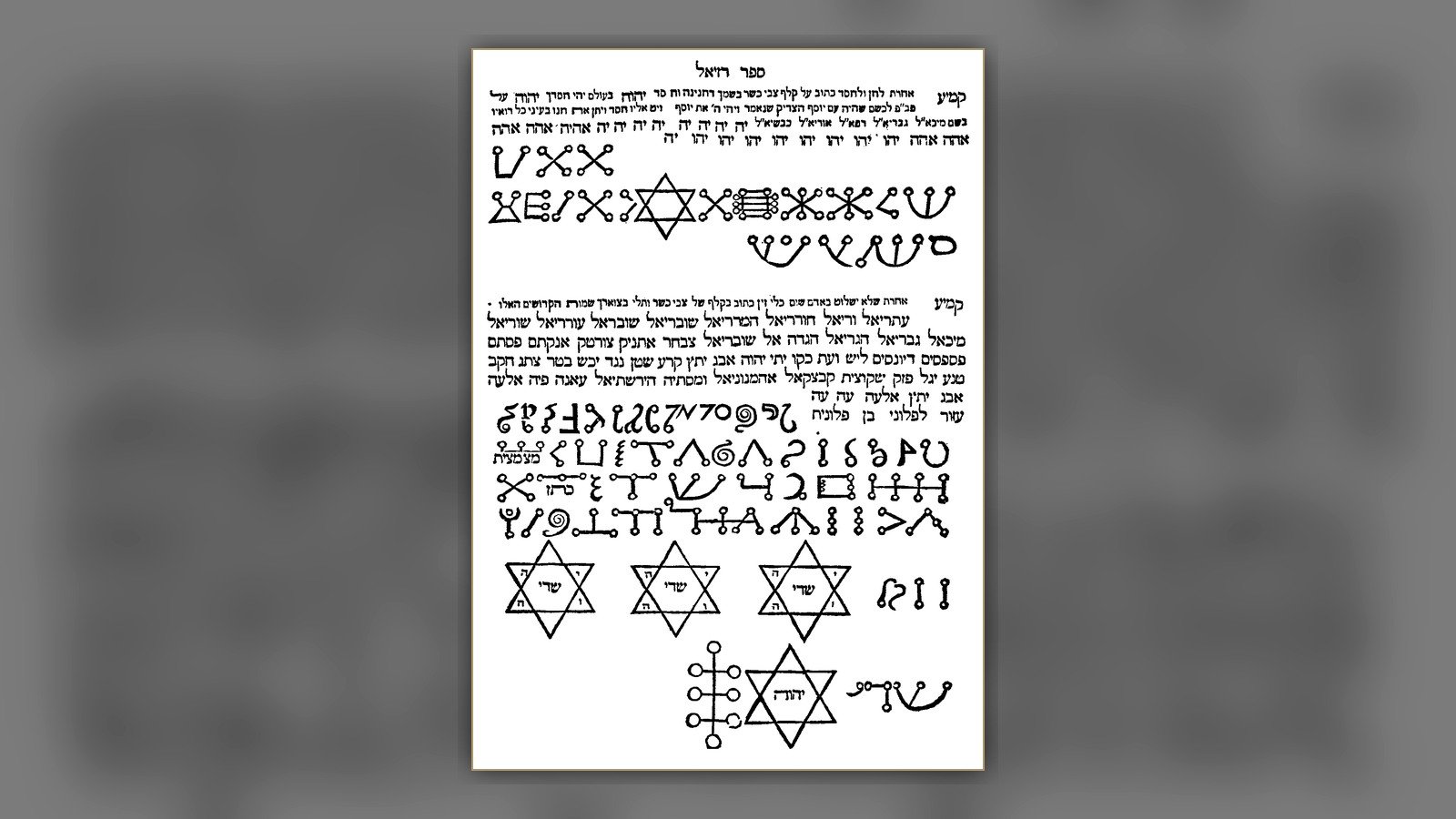
The 1701 Amsterdam edition helped stabilize a visual identity of sigils and diagrams, but it belongs to a later history than medieval Latin manuscripts. Modern occult publishing often combines these streams without distinction.
The responsible archive keeps them connected and separate. Raziel is a constellation of books united by a celestial name, not a single unchanged revelation descending intact through time.
This section matters within the history of Liber Razielis because it joins a textual claim to a recoverable practice of copying, ownership or institutional control. The archive cannot verify every promised supernatural effect, but it can establish who preserved the words, how the material was arranged and which later traditions inherited its structure.
Every act of copying is evidence of valuation. Paper, ink and time were spent because someone considered the material useful, dangerous, prestigious or worthy of preservation. Even where performance cannot be demonstrated, transmission itself is a documented historical action with social and intellectual consequences.
The Book as Historical Evidence
The enduring power of Liber Razielis comes from the meeting of claim and object. A legendary author, celestial teacher or infernal hierarchy may dominate the title, but the historical work begins with paper, parchment, handwriting, type, pigment, binding and custody. These features identify when a witness could have been made and how it passed from one set of hands to another.
Provenance also changes meaning. A ritual text in a private notebook, a confiscated bundle in a court file and the same leaves in a national library are not socially identical objects. Each setting imposes a new interpretation: tool, evidence, curiosity, pathology, heritage or research source. Forbidden history is the sequence of those transformations.
The featured image used here is an authentic historical reproduction connected directly to the subject or, where explicitly stated, to the precise manuscript tradition discussed. It has been framed for a modern 16:9 website format without replacing the central archival image. Credit and reuse status are recorded in the package ledger.
What the Archive Refused to Lose
The Liber Razielis and the Angelic Book of Secrets ultimately survives because prohibition never operated alone. Copyists, collectors, physicians, clergy, defendants, censors and librarians all participated in transmission, sometimes while condemning the material they preserved. Their motives were different, but the cumulative result is a record that can still be examined rather than merely repeated as legend.
The most responsible occult history does not drain mystery from the source. It replaces vague mystery with exact strangeness: a named shelf mark, an unexpected language, a corrected spirit name, an erased line, a later hand in the margin, a printed prohibition or a diagram copied by someone whose identity has disappeared. These details are darker than invention because they belong to the surviving object.
Reading the Surviving Witnesses
Researchers approaching Liber Razielis should separate the physical witness from the modern title used to group it. Catalogue descriptions establish dimensions, support, script, foliation and the works bound before and after the relevant text. Those details often reveal whether the item was planned as a coherent book or assembled from papers with independent histories.
Transcription creates another layer. Unfamiliar names can be altered by a single misread letter, especially when Greek, Hebrew, Latin, French, German or invented ritual syllables cross scripts. Variant spelling should therefore be recorded rather than silently corrected, because the history of error is part of the transmission of Liber Razielis.
Digital access has transformed this field by allowing a reader to compare image and edition across institutions. It has not abolished the need for caution. Colour balance, cropped edges, missing blanks and online metadata can affect interpretation, while some composite volumes remain only partially photographed.
The strongest account combines primary witness, institutional catalogue and specialist scholarship. Popular retellings are useful for tracing cultural memory, but they should not be allowed to replace the source that created the story. This hierarchy of evidence gives the narrative depth without turning it into a debunking exercise.
Researchers approaching Liber Razielis should separate the physical witness from the modern title used to group it. Catalogue descriptions establish dimensions, support, script, foliation and the works bound before and after the relevant text. Those details often reveal whether the item was planned as a coherent book or assembled from papers with independent histories.
Transcription creates another layer. Unfamiliar names can be altered by a single misread letter, especially when Greek, Hebrew, Latin, French, German or invented ritual syllables cross scripts. Variant spelling should therefore be recorded rather than silently corrected, because the history of error is part of the transmission of Liber Razielis.
Digital access has transformed this field by allowing a reader to compare image and edition across institutions. It has not abolished the need for caution. Colour balance, cropped edges, missing blanks and online metadata can affect interpretation, while some composite volumes remain only partially photographed.
The strongest account combines primary witness, institutional catalogue and specialist scholarship. Popular retellings are useful for tracing cultural memory, but they should not be allowed to replace the source that created the story. This hierarchy of evidence gives the narrative depth without turning it into a debunking exercise.
Researchers approaching Liber Razielis should separate the physical witness from the modern title used to group it. Catalogue descriptions establish dimensions, support, script, foliation and the works bound before and after the relevant text. Those details often reveal whether the item was planned as a coherent book or assembled from papers with independent histories.