The Scandinavian black book was often small enough to hide in clothing, a chest or the wall of a house. Its pages could contain a prayer against bleeding, a charm for livestock, a sign to defeat an enemy, a cure, a method of finding thieves or an invocation that called upon the Devil beside Christian names. These books did not belong to one order or doctrine. They were private archives of useful and dangerous words.
Many Names for the Hidden Book
Norwegian sources use svartebøker, Swedish traditions speak of svartkonstböcker, and Iceland preserves galdrabækur. The labels overlap but do not describe an identical corpus across the Nordic world.
“Black” can imply secrecy, illicit power, association with the Devil or simply the feared reputation of a handwritten manual. Some surviving books are more medical and devotional than demonic.
The category was created by owners, neighbours, collectors and folklorists as much as by the texts themselves.
This section matters within the history of Scandinavian black books because it joins a textual claim to a recoverable practice of copying, ownership or institutional control. The archive cannot verify every promised supernatural effect, but it can establish who preserved the words, how the material was arranged and which later traditions inherited its structure.
The surviving evidence must be read at the level of the individual witness. Titles migrate, manuscripts combine unrelated works, and later editors normalize spellings that a copyist left unstable. Shelf mark, folio and date are therefore not decorative citations; they are the controls that keep a famous occult name attached to a real object.
A Tradition from the Late Middle Ages to the Nineteenth Century
Nordic magical manuals survive from the late medieval and early modern periods through the nineteenth century. Norway has roughly one hundred registered black books, with the oldest witnesses reaching toward the late fifteenth century.
Copying continued long after printed almanacs and medical books became available. Handwriting allowed a book to remain local, selective and adapted to the experience of an owner.
The tradition survives because it was useful. A manuscript could absorb new remedies without surrendering old charms.
This section matters within the history of Scandinavian black books because it joins a textual claim to a recoverable practice of copying, ownership or institutional control. The archive cannot verify every promised supernatural effect, but it can establish who preserved the words, how the material was arranged and which later traditions inherited its structure.
Later occult publishing often produces a clean, continuous text from several damaged or divergent witnesses. That work can make a tradition readable, but it may conceal the decisions of editors. Comparing the edition with a catalogue and image restores omissions, marginalia, layout and the physical sequence in which a historical reader encountered the material.
Who Wrote and Owned the Books
Owners included soldiers, clerics, students, farmers, healers and other literate men, although women also participated in the broader practices preserved. In Iceland, prosecutions for learned magic often targeted men rather than matching the female stereotype dominant elsewhere.
Literacy was a form of power. A person who could copy Latin fragments, biblical names or unfamiliar signs possessed resources inaccessible to neighbours who relied on oral transmission.
The black book turned writing itself into an occult technology.
This section matters within the history of Scandinavian black books because it joins a textual claim to a recoverable practice of copying, ownership or institutional control. The archive cannot verify every promised supernatural effect, but it can establish who preserved the words, how the material was arranged and which later traditions inherited its structure.
Claims of great antiquity require special care. A manuscript may preserve old material while being physically much later, and a legendary attribution may express authority rather than authorship. Separating date of object, date of textual layer and mythical origin produces a stronger history than accepting or dismissing the tradition as a whole.
Christian Prayer Beside Forbidden Command
Many texts invoke the Trinity, Christ, saints, angels or biblical phrases. A healing charm may be structurally indistinguishable from a prayer until it introduces coercive wording, secret characters or a forbidden name.
This mixture does not necessarily indicate hypocrisy. Folk religion could treat sacred names as active protections while official authorities objected to unauthorized use and ritual manipulation.
The most unsettling pages are often those where church language and illicit technique cannot be cleanly separated.
This section matters within the history of Scandinavian black books because it joins a textual claim to a recoverable practice of copying, ownership or institutional control. The archive cannot verify every promised supernatural effect, but it can establish who preserved the words, how the material was arranged and which later traditions inherited its structure.
Every act of copying is evidence of valuation. Paper, ink and time were spent because someone considered the material useful, dangerous, prestigious or worthy of preservation. Even where performance cannot be demonstrated, transmission itself is a documented historical action with social and intellectual consequences.
Healing Bodies and Protecting Livestock
Remedies address bleeding, toothache, wounds, fever and other illnesses. Rural books also protect cattle, horses, milk production and crops because household survival depended on animals and seasonal labour.
Herbs and practical treatments appear beside spoken formulas or written signs. Some remedies may preserve empirical knowledge; others rely on analogy, sacred narrative or transferred suffering.
The book functions as a household emergency archive before professional medicine was consistently available.
This section matters within the history of Scandinavian black books because it joins a textual claim to a recoverable practice of copying, ownership or institutional control. The archive cannot verify every promised supernatural effect, but it can establish who preserved the words, how the material was arranged and which later traditions inherited its structure.
Images must also be identified precisely. A related seal, later title page or parallel manuscript can illuminate the subject, but it should not be called the exact folio when it is not. This article distinguishes contextual imagery from direct facsimile so that atmosphere never replaces provenance.
Curses, Theft and Social Conflict
Black books also preserve operations to expose thieves, bind enemies, win legal disputes or cause harm. These sections reveal the same communities from the perspective of suspicion and grievance.
A curse need not have been performed to affect behaviour. The reputation that someone owned a black book could create fear, obedience or accusation.
Knowledge becomes socially powerful before any supernatural result is established.
This section matters within the history of Scandinavian black books because it joins a textual claim to a recoverable practice of copying, ownership or institutional control. The archive cannot verify every promised supernatural effect, but it can establish who preserved the words, how the material was arranged and which later traditions inherited its structure.
The surviving evidence must be read at the level of the individual witness. Titles migrate, manuscripts combine unrelated works, and later editors normalize spellings that a copyist left unstable. Shelf mark, folio and date are therefore not decorative citations; they are the controls that keep a famous occult name attached to a real object.
Icelandic Staves and the Visual Spell
Icelandic magical books are famous for complex staves, often called galdrastafir. Individual signs acquire names and purposes through manuscript context, and later popular reproductions sometimes detach them from that evidence.
Not every symbol widely sold today has a secure Viking origin. Many belong to early modern Christian manuscript culture and incorporate letters, crosses or learned diagrammatic forms.
Historical accuracy makes the signs stranger, not weaker: they emerge from literate Icelandic experimentation rather than a timeless decorative alphabet.
This section matters within the history of Scandinavian black books because it joins a textual claim to a recoverable practice of copying, ownership or institutional control. The archive cannot verify every promised supernatural effect, but it can establish who preserved the words, how the material was arranged and which later traditions inherited its structure.
Later occult publishing often produces a clean, continuous text from several damaged or divergent witnesses. That work can make a tradition readable, but it may conceal the decisions of editors. Comparing the edition with a catalogue and image restores omissions, marginalia, layout and the physical sequence in which a historical reader encountered the material.
Cyprianus and the Legendary Author
Across Scandinavia, magical books were often linked to Cyprianus, a name attached to several legends and printed grimoires. The imagined author could be a saint, sorcerer, bishop or condemned magician depending on the tradition.
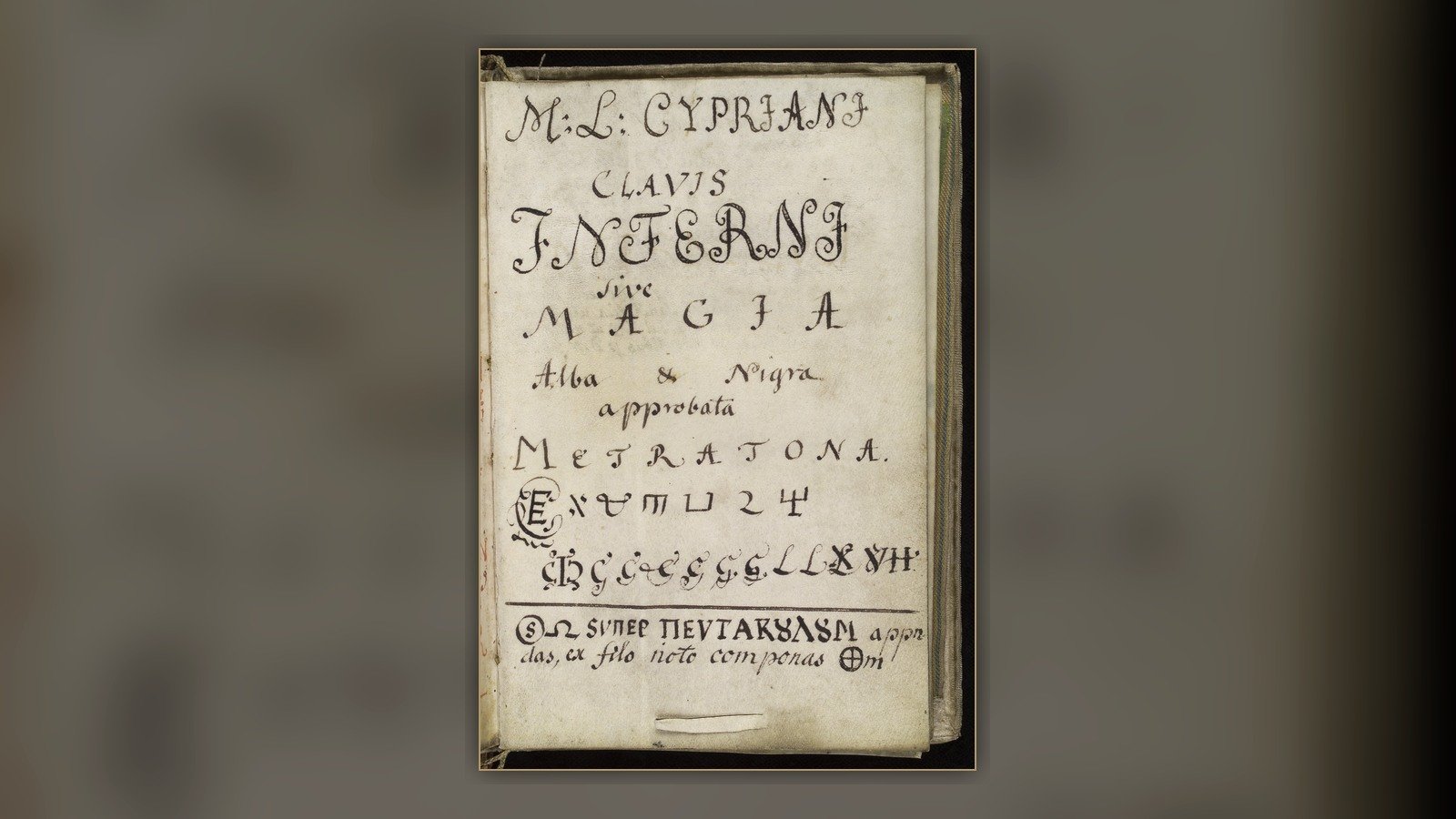
Attribution to Cyprianus gave local notebooks a prestigious and dangerous ancestry. A copied title page could transform a private collection into a fragment of a legendary black book.
The featured image shows an eighteenth-century printed Cyprianus, a relative and influence rather than a photograph of every Scandinavian manuscript.
This section matters within the history of Scandinavian black books because it joins a textual claim to a recoverable practice of copying, ownership or institutional control. The archive cannot verify every promised supernatural effect, but it can establish who preserved the words, how the material was arranged and which later traditions inherited its structure.
Claims of great antiquity require special care. A manuscript may preserve old material while being physically much later, and a legendary attribution may express authority rather than authorship. Separating date of object, date of textual layer and mythical origin produces a stronger history than accepting or dismissing the tradition as a whole.
Collection, Folklore Archives and Survival
Folklorists and museums collected black books from families who had guarded them privately. Institutional cataloguing preserved provenance, dialect and physical details that popular editions often remove.
The act of surrender could end a family tradition while saving the object from decay. Some owners destroyed books out of fear; others passed them with warnings about who was permitted to read.
Scandinavian black books survive as intimate archives. Their darkness is not monumental but portable: folded pages, cramped hands and dangerous knowledge carried through ordinary homes.
This section matters within the history of Scandinavian black books because it joins a textual claim to a recoverable practice of copying, ownership or institutional control. The archive cannot verify every promised supernatural effect, but it can establish who preserved the words, how the material was arranged and which later traditions inherited its structure.
Every act of copying is evidence of valuation. Paper, ink and time were spent because someone considered the material useful, dangerous, prestigious or worthy of preservation. Even where performance cannot be demonstrated, transmission itself is a documented historical action with social and intellectual consequences.
The Book as Historical Evidence
The enduring power of Scandinavian black books comes from the meeting of claim and object. A legendary author, celestial teacher or infernal hierarchy may dominate the title, but the historical work begins with paper, parchment, handwriting, type, pigment, binding and custody. These features identify when a witness could have been made and how it passed from one set of hands to another.
Provenance also changes meaning. A ritual text in a private notebook, a confiscated bundle in a court file and the same leaves in a national library are not socially identical objects. Each setting imposes a new interpretation: tool, evidence, curiosity, pathology, heritage or research source. Forbidden history is the sequence of those transformations.
The featured image used here is an authentic historical reproduction connected directly to the subject or, where explicitly stated, to the precise manuscript tradition discussed. It has been framed for a modern 16:9 website format without replacing the central archival image. Credit and reuse status are recorded in the package ledger.
What the Archive Refused to Lose
Scandinavian Black Books and the Survival of Folk Magic ultimately survives because prohibition never operated alone. Copyists, collectors, physicians, clergy, defendants, censors and librarians all participated in transmission, sometimes while condemning the material they preserved. Their motives were different, but the cumulative result is a record that can still be examined rather than merely repeated as legend.
The most responsible occult history does not drain mystery from the source. It replaces vague mystery with exact strangeness: a named shelf mark, an unexpected language, a corrected spirit name, an erased line, a later hand in the margin, a printed prohibition or a diagram copied by someone whose identity has disappeared. These details are darker than invention because they belong to the surviving object.
Reading the Surviving Witnesses
Researchers approaching Scandinavian black books should separate the physical witness from the modern title used to group it. Catalogue descriptions establish dimensions, support, script, foliation and the works bound before and after the relevant text. Those details often reveal whether the item was planned as a coherent book or assembled from papers with independent histories.
Transcription creates another layer. Unfamiliar names can be altered by a single misread letter, especially when Greek, Hebrew, Latin, French, German or invented ritual syllables cross scripts. Variant spelling should therefore be recorded rather than silently corrected, because the history of error is part of the transmission of Scandinavian black books.
Digital access has transformed this field by allowing a reader to compare image and edition across institutions. It has not abolished the need for caution. Colour balance, cropped edges, missing blanks and online metadata can affect interpretation, while some composite volumes remain only partially photographed.
The strongest account combines primary witness, institutional catalogue and specialist scholarship. Popular retellings are useful for tracing cultural memory, but they should not be allowed to replace the source that created the story. This hierarchy of evidence gives the narrative depth without turning it into a debunking exercise.
Researchers approaching Scandinavian black books should separate the physical witness from the modern title used to group it. Catalogue descriptions establish dimensions, support, script, foliation and the works bound before and after the relevant text. Those details often reveal whether the item was planned as a coherent book or assembled from papers with independent histories.
Transcription creates another layer. Unfamiliar names can be altered by a single misread letter, especially when Greek, Hebrew, Latin, French, German or invented ritual syllables cross scripts. Variant spelling should therefore be recorded rather than silently corrected, because the history of error is part of the transmission of Scandinavian black books.
Digital access has transformed this field by allowing a reader to compare image and edition across institutions. It has not abolished the need for caution. Colour balance, cropped edges, missing blanks and online metadata can affect interpretation, while some composite volumes remain only partially photographed.
The strongest account combines primary witness, institutional catalogue and specialist scholarship. Popular retellings are useful for tracing cultural memory, but they should not be allowed to replace the source that created the story. This hierarchy of evidence gives the narrative depth without turning it into a debunking exercise.
Researchers approaching Scandinavian black books should separate the physical witness from the modern title used to group it. Catalogue descriptions establish dimensions, support, script, foliation and the works bound before and after the relevant text. Those details often reveal whether the item was planned as a coherent book or assembled from papers with independent histories.
Transcription creates another layer. Unfamiliar names can be altered by a single misread letter, especially when Greek, Hebrew, Latin, French, German or invented ritual syllables cross scripts. Variant spelling should therefore be recorded rather than silently corrected, because the history of error is part of the transmission of Scandinavian black books.