The Greek Magical Papyri are not one ancient book and were never buried as a single library under that title. They are a modern scholarly corpus assembled from papyrus rolls, codices and fragments produced across centuries of Greco-Roman Egypt. Within them survive prayers to Egyptian gods, Greek deities, Jewish divine names, angels, spirits and voces magicae that resist translation. They preserve ritual as it was copied for use.
A Modern Name for an Ancient Corpus
The label Papyri Graecae Magicae, or PGM, was created by modern editors for a body of texts dating broadly from the second century BCE to the fifth century CE. The documents came from different hands, places and periods.
Greek is prominent, but the wider corpus includes Demotic Egyptian and Coptic material. Some papyri move between languages within a single operation, reflecting practitioners who inhabited a multilingual religious world.
The modern title is useful only if it does not create the illusion of one standardized pagan bible.
This section matters within the history of Greek Magical Papyri because it joins a textual claim to a recoverable practice of copying, ownership or institutional control. The archive cannot verify every promised supernatural effect, but it can establish who preserved the words, how the material was arranged and which later traditions inherited its structure.
The surviving evidence must be read at the level of the individual witness. Titles migrate, manuscripts combine unrelated works, and later editors normalize spellings that a copyist left unstable. Shelf mark, folio and date are therefore not decorative citations; they are the controls that keep a famous occult name attached to a real object.
The Theban Cache and the Antiquities Market
Many major magical papyri are associated with Thebes and entered European collections through the nineteenth-century antiquities market. Their original archaeological contexts were often poorly recorded or lost.
Collectors divided groups among museums and libraries in London, Leiden, Paris and elsewhere. Fragments that once belonged together can now carry different institutional numbers.
The history of discovery is therefore also a history of displacement. The archive was created through both preservation and rupture.
This section matters within the history of Greek Magical Papyri because it joins a textual claim to a recoverable practice of copying, ownership or institutional control. The archive cannot verify every promised supernatural effect, but it can establish who preserved the words, how the material was arranged and which later traditions inherited its structure.
Later occult publishing often produces a clean, continuous text from several damaged or divergent witnesses. That work can make a tradition readable, but it may conceal the decisions of editors. Comparing the edition with a catalogue and image restores omissions, marginalia, layout and the physical sequence in which a historical reader encountered the material.
The London-Leiden Magical Papyrus
The London-Leiden roll, dated roughly to the early third century CE, is written mainly in Demotic with Greek recitations and forms of Old Coptic. Its two modern halves are held in London and Leiden.
It contains procedures for divination, dreams, love, healing, poisons, protection and visions. The scribe moves between technical recipes and invocations without adopting modern divisions between medicine, religion and magic.
Reuniting the text intellectually requires crossing the institutional split created after its acquisition.
This section matters within the history of Greek Magical Papyri because it joins a textual claim to a recoverable practice of copying, ownership or institutional control. The archive cannot verify every promised supernatural effect, but it can establish who preserved the words, how the material was arranged and which later traditions inherited its structure.
Claims of great antiquity require special care. A manuscript may preserve old material while being physically much later, and a legendary attribution may express authority rather than authorship. Separating date of object, date of textual layer and mythical origin produces a stronger history than accepting or dismissing the tradition as a whole.
Names That Cross Pantheons
The papyri invoke figures such as Helios, Hermes, Hecate, Isis, Osiris and Anubis beside names drawn from Jewish and emerging Christian traditions. Divine identities can merge through long chains of epithets.
This is not random confusion. Ritual specialists selected names for authority, sound, antiquity and perceived power, building composite addresses suited to a particular operation.
Roman Egypt appears here as a laboratory of religious combination where boundaries remained active but permeable.
This section matters within the history of Greek Magical Papyri because it joins a textual claim to a recoverable practice of copying, ownership or institutional control. The archive cannot verify every promised supernatural effect, but it can establish who preserved the words, how the material was arranged and which later traditions inherited its structure.
Every act of copying is evidence of valuation. Paper, ink and time were spent because someone considered the material useful, dangerous, prestigious or worthy of preservation. Even where performance cannot be demonstrated, transmission itself is a documented historical action with social and intellectual consequences.
Voces Magicae and Untranslatable Speech
Many spells include strings of syllables called voces magicae. Some may preserve distorted foreign words, divine names or deliberate sound patterns; others remain opaque.
Correct sequence matters more than ordinary translation. The voice performs a pattern believed to be recognized by divine or spiritual powers, while unusual writing protects the formula from casual use.
The papyrus thus records language at the edge of meaning, where sound itself becomes ritual material.
This section matters within the history of Greek Magical Papyri because it joins a textual claim to a recoverable practice of copying, ownership or institutional control. The archive cannot verify every promised supernatural effect, but it can establish who preserved the words, how the material was arranged and which later traditions inherited its structure.
Images must also be identified precisely. A related seal, later title page or parallel manuscript can illuminate the subject, but it should not be called the exact folio when it is not. This article distinguishes contextual imagery from direct facsimile so that atmosphere never replaces provenance.
Love, Binding and Human Desire
Attraction spells and binding operations are among the most discussed texts. They may call for images, inscribed lead, papyrus, hair, lamps or deposits in graves and other charged locations.
Their language can be coercive and violent, demanding sleeplessness, burning desire or separation from rivals. These documents expose private desperation more directly than official religious inscriptions.
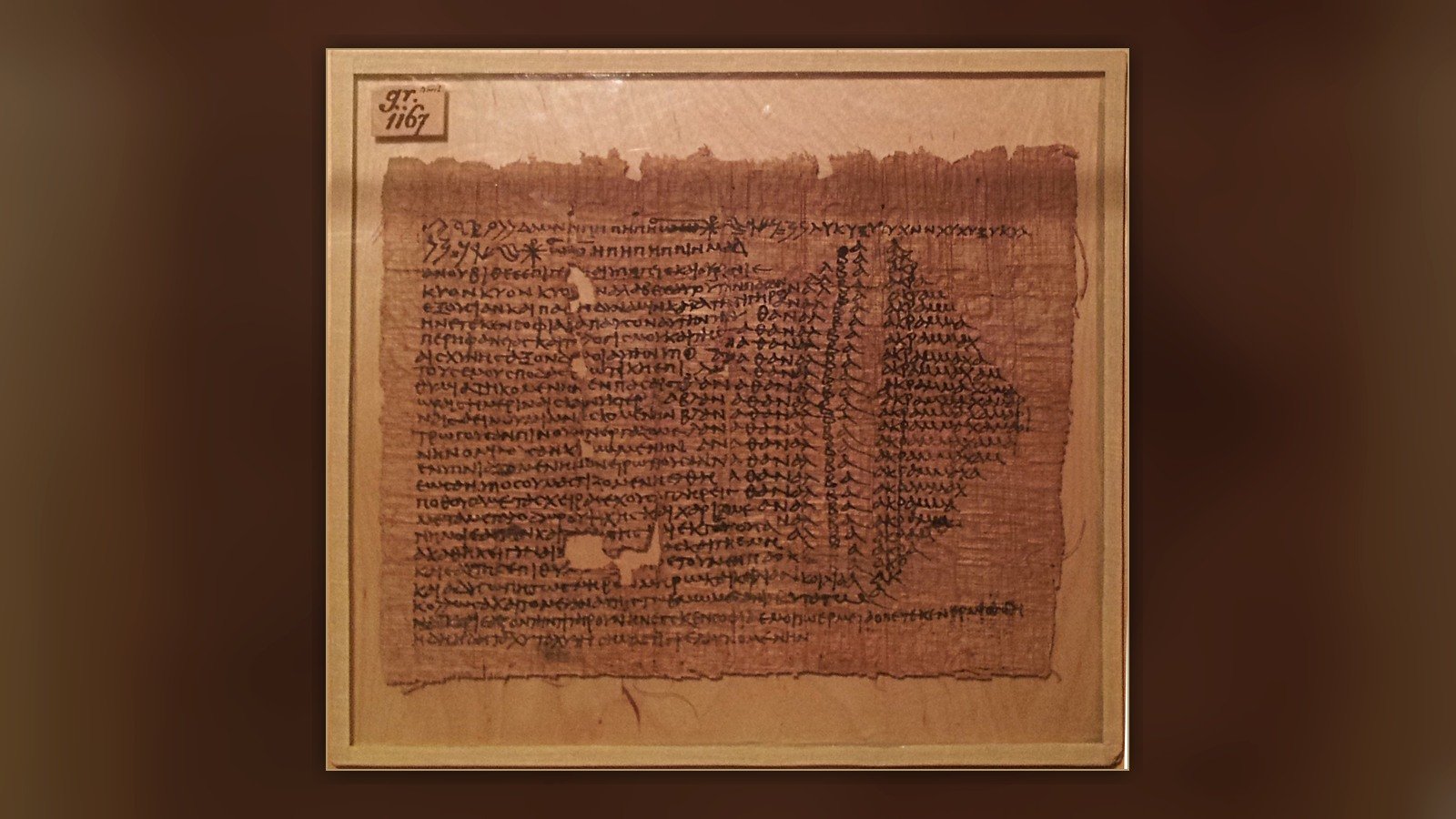
The featured papyrus is a real fourth-century love-binding text. Its survival gives material form to an intimate attempt to govern another person’s will.
This section matters within the history of Greek Magical Papyri because it joins a textual claim to a recoverable practice of copying, ownership or institutional control. The archive cannot verify every promised supernatural effect, but it can establish who preserved the words, how the material was arranged and which later traditions inherited its structure.
The surviving evidence must be read at the level of the individual witness. Titles migrate, manuscripts combine unrelated works, and later editors normalize spellings that a copyist left unstable. Shelf mark, folio and date are therefore not decorative citations; they are the controls that keep a famous occult name attached to a real object.
Healing, Protection and Exorcism
Other operations address fever, pain, dangerous animals, childbirth, hostile spirits and unseen attack. Amulets carry abbreviated prayers or names close to the body.
The same practitioner could use ingredients recognizable as medicine alongside spoken invocations. Efficacy was understood through correspondences, inherited recipes, divine authority and observed result.
The corpus resists the claim that ancient magic was only spectacular evocation. Much of it belongs to daily survival.
This section matters within the history of Greek Magical Papyri because it joins a textual claim to a recoverable practice of copying, ownership or institutional control. The archive cannot verify every promised supernatural effect, but it can establish who preserved the words, how the material was arranged and which later traditions inherited its structure.
Later occult publishing often produces a clean, continuous text from several damaged or divergent witnesses. That work can make a tradition readable, but it may conceal the decisions of editors. Comparing the edition with a catalogue and image restores omissions, marginalia, layout and the physical sequence in which a historical reader encountered the material.
Divine Vision and the Ritual of Ascent
Some texts promise direct encounter with a god, revelatory dream or ascent through celestial regions. Preparation may include fasting, purification, lamps, incense, special clothing and long invocations.
The operator does not merely ask a question. The entire body and room are transformed into a controlled setting for revelation.
These rites stand behind later traditions of theurgy and visionary magic, although direct lines of transmission must be argued rather than assumed.
This section matters within the history of Greek Magical Papyri because it joins a textual claim to a recoverable practice of copying, ownership or institutional control. The archive cannot verify every promised supernatural effect, but it can establish who preserved the words, how the material was arranged and which later traditions inherited its structure.
Claims of great antiquity require special care. A manuscript may preserve old material while being physically much later, and a legendary attribution may express authority rather than authorship. Separating date of object, date of textual layer and mythical origin produces a stronger history than accepting or dismissing the tradition as a whole.
From Buried Fragment to Critical Edition
Editors such as Karl Preisendanz created the numbered PGM corpus, and later translators made the texts available to broader audiences. Numbering allows fragments in different collections to be discussed together.
Editing inevitably regularizes damaged writing, expansions and uncertain readings. Photographs and museum records remain necessary for checking what the papyrus actually preserves.
The Greek Magical Papyri are powerful because they are incomplete. Torn edges and uncertain letters remind the reader that most ancient ritual books did not survive at all.
This section matters within the history of Greek Magical Papyri because it joins a textual claim to a recoverable practice of copying, ownership or institutional control. The archive cannot verify every promised supernatural effect, but it can establish who preserved the words, how the material was arranged and which later traditions inherited its structure.
Every act of copying is evidence of valuation. Paper, ink and time were spent because someone considered the material useful, dangerous, prestigious or worthy of preservation. Even where performance cannot be demonstrated, transmission itself is a documented historical action with social and intellectual consequences.
The Book as Historical Evidence
The enduring power of Greek Magical Papyri comes from the meeting of claim and object. A legendary author, celestial teacher or infernal hierarchy may dominate the title, but the historical work begins with paper, parchment, handwriting, type, pigment, binding and custody. These features identify when a witness could have been made and how it passed from one set of hands to another.
Provenance also changes meaning. A ritual text in a private notebook, a confiscated bundle in a court file and the same leaves in a national library are not socially identical objects. Each setting imposes a new interpretation: tool, evidence, curiosity, pathology, heritage or research source. Forbidden history is the sequence of those transformations.
The featured image used here is an authentic historical reproduction connected directly to the subject or, where explicitly stated, to the precise manuscript tradition discussed. It has been framed for a modern 16:9 website format without replacing the central archival image. Credit and reuse status are recorded in the package ledger.
What the Archive Refused to Lose
The Greek Magical Papyri and the Buried Rituals of Egypt ultimately survives because prohibition never operated alone. Copyists, collectors, physicians, clergy, defendants, censors and librarians all participated in transmission, sometimes while condemning the material they preserved. Their motives were different, but the cumulative result is a record that can still be examined rather than merely repeated as legend.
The most responsible occult history does not drain mystery from the source. It replaces vague mystery with exact strangeness: a named shelf mark, an unexpected language, a corrected spirit name, an erased line, a later hand in the margin, a printed prohibition or a diagram copied by someone whose identity has disappeared. These details are darker than invention because they belong to the surviving object.
Reading the Surviving Witnesses
Researchers approaching Greek Magical Papyri should separate the physical witness from the modern title used to group it. Catalogue descriptions establish dimensions, support, script, foliation and the works bound before and after the relevant text. Those details often reveal whether the item was planned as a coherent book or assembled from papers with independent histories.
Transcription creates another layer. Unfamiliar names can be altered by a single misread letter, especially when Greek, Hebrew, Latin, French, German or invented ritual syllables cross scripts. Variant spelling should therefore be recorded rather than silently corrected, because the history of error is part of the transmission of Greek Magical Papyri.
Digital access has transformed this field by allowing a reader to compare image and edition across institutions. It has not abolished the need for caution. Colour balance, cropped edges, missing blanks and online metadata can affect interpretation, while some composite volumes remain only partially photographed.
The strongest account combines primary witness, institutional catalogue and specialist scholarship. Popular retellings are useful for tracing cultural memory, but they should not be allowed to replace the source that created the story. This hierarchy of evidence gives the narrative depth without turning it into a debunking exercise.
Researchers approaching Greek Magical Papyri should separate the physical witness from the modern title used to group it. Catalogue descriptions establish dimensions, support, script, foliation and the works bound before and after the relevant text. Those details often reveal whether the item was planned as a coherent book or assembled from papers with independent histories.
Transcription creates another layer. Unfamiliar names can be altered by a single misread letter, especially when Greek, Hebrew, Latin, French, German or invented ritual syllables cross scripts. Variant spelling should therefore be recorded rather than silently corrected, because the history of error is part of the transmission of Greek Magical Papyri.
Digital access has transformed this field by allowing a reader to compare image and edition across institutions. It has not abolished the need for caution. Colour balance, cropped edges, missing blanks and online metadata can affect interpretation, while some composite volumes remain only partially photographed.
The strongest account combines primary witness, institutional catalogue and specialist scholarship. Popular retellings are useful for tracing cultural memory, but they should not be allowed to replace the source that created the story. This hierarchy of evidence gives the narrative depth without turning it into a debunking exercise.
Researchers approaching Greek Magical Papyri should separate the physical witness from the modern title used to group it. Catalogue descriptions establish dimensions, support, script, foliation and the works bound before and after the relevant text. Those details often reveal whether the item was planned as a coherent book or assembled from papers with independent histories.
Transcription creates another layer. Unfamiliar names can be altered by a single misread letter, especially when Greek, Hebrew, Latin, French, German or invented ritual syllables cross scripts. Variant spelling should therefore be recorded rather than silently corrected, because the history of error is part of the transmission of Greek Magical Papyri.
Digital access has transformed this field by allowing a reader to compare image and edition across institutions. It has not abolished the need for caution. Colour balance, cropped edges, missing blanks and online metadata can affect interpretation, while some composite volumes remain only partially photographed.