Before the reader reaches the great seal, the prayers or the names of angels, the book demands silence. It imagines a council of magicians facing persecution, reducing their art to one volume and swearing that only a few worthy successors will ever receive it. The secrecy is not a decorative preface. It is the architecture of the Sworn Book of Honorius.
The Liber Iuratus Honorii
The Latin title Liber Iuratus Honorii means the Sworn Book of Honorius. It is among the oldest extensive surviving works of medieval ritual magic and should not be confused with the later Grimoire of Pope Honorius. The authorial Honorius is called a master of Thebes and son of Euclid in the text’s legendary genealogy. Surviving manuscripts date mainly from the late Middle Ages and early modern period. The result is a body of evidence that must be read through manuscripts, catalogues and the material history of the object rather than through later legend alone.
The surviving record places this material within a precise historical world. The work claims deeper antiquity.. Every copied name, altered diagram, ownership mark or change of sequence records a decision made by a reader who believed the text deserved preservation. Those decisions are often as revealing as the stated operation itself.
Its false or symbolic attribution is part of the book’s authority. Honorius is less a recoverable person than the guardian of a transmitted art. In the culture that produced it, sacred language, natural philosophy, astrology, law and ritual were not always separated by the boundaries used today. The manuscript therefore speaks from a world in which knowledge could be devotional, technical and forbidden at the same time.
Read closely, this section also explains why the subject continued to generate fear. Its authority does not depend upon a modern claim that every operation worked exactly as promised. It rests on the historical fact that scribes, collectors, judges or practitioners treated the words as consequential—important enough to copy, hide, condemn, transport or preserve across generations.
The Council of Eighty-Nine Masters
The prologue tells of eighty-nine masters from Naples, Athens and Toledo who gathered when princes and church authorities sought to destroy magical books. The masters supposedly selected Honorius to compress their knowledge. Inferior books were burned as a diversion. The result is a body of evidence that must be read through manuscripts, catalogues and the material history of the object rather than through later legend alone.
The manuscript becomes clearer when its physical details are read beside its claims. The true art was preserved under oath.. Every copied name, altered diagram, ownership mark or change of sequence records a decision made by a reader who believed the text deserved preservation. Those decisions are often as revealing as the stated operation itself.
This is a foundation myth written from inside persecution. Whether or not such a council existed, the narrative explains why the text is rare, composite and forbidden. In the culture that produced it, sacred language, natural philosophy, astrology, law and ritual were not always separated by the boundaries used today. The manuscript therefore speaks from a world in which knowledge could be devotional, technical and forbidden at the same time.
Read closely, this section also explains why the subject continued to generate fear. Its authority does not depend upon a modern claim that every operation worked exactly as promised. It rests on the historical fact that scribes, collectors, judges or practitioners treated the words as consequential—important enough to copy, hide, condemn, transport or preserve across generations.
The Oath and the Three Copies
The book limits transmission with extraordinary severity. A master may make only a small number of copies and must test the character of a recipient before entrusting the work. The oath excludes casual circulation. Disciples are commanded to protect one another’s secrets. The result is a body of evidence that must be read through manuscripts, catalogues and the material history of the object rather than through later legend alone.
What appears at first to be a single mystery is actually a chain of copying, use and reinterpretation. If no worthy successor exists, the book should be buried with its master or hidden permanently.. Every copied name, altered diagram, ownership mark or change of sequence records a decision made by a reader who believed the text deserved preservation. Those decisions are often as revealing as the stated operation itself.
The oath transforms copying into initiation. To reproduce the text is not simple scribal labour but a moral and spiritual risk. In the culture that produced it, sacred language, natural philosophy, astrology, law and ritual were not always separated by the boundaries used today. The manuscript therefore speaks from a world in which knowledge could be devotional, technical and forbidden at the same time.
Read closely, this section also explains why the subject continued to generate fear. Its authority does not depend upon a modern claim that every operation worked exactly as promised. It rests on the historical fact that scribes, collectors, judges or practitioners treated the words as consequential—important enough to copy, hide, condemn, transport or preserve across generations.
The Vision at the Centre
The most exalted operation seeks the beatific vision: knowledge or sight of the divine majesty while still alive. This goal distinguishes the Sworn Book from manuals concerned mainly with treasure or coercion. The rite requires extended prayer, purification and carefully ordered petitions. Angelic assistance mediates the approach. The result is a body of evidence that must be read through manuscripts, catalogues and the material history of the object rather than through later legend alone.
The archive preserves both the ambition of the text and the limitations of what can now be known. Failure can result from impurity, error or lack of permission.. Every copied name, altered diagram, ownership mark or change of sequence records a decision made by a reader who believed the text deserved preservation. Those decisions are often as revealing as the stated operation itself.
The operation is audacious precisely because it is devotional. It pushes Christian contemplative desire beyond accepted limits and turns private revelation into a repeatable ritual technology. In the culture that produced it, sacred language, natural philosophy, astrology, law and ritual were not always separated by the boundaries used today. The manuscript therefore speaks from a world in which knowledge could be devotional, technical and forbidden at the same time.
Read closely, this section also explains why the subject continued to generate fear. Its authority does not depend upon a modern claim that every operation worked exactly as promised. It rests on the historical fact that scribes, collectors, judges or practitioners treated the words as consequential—important enough to copy, hide, condemn, transport or preserve across generations.
Fasting, Prayer and the Discipline of Time
The practitioner must prepare through bodily restraint, confession, prayer and a regulated sequence of days. The work is demanding because its claimed vision cannot be approached casually. Specific prayers recur in ordered sets. Ritual timing structures the ascent. The result is a body of evidence that must be read through manuscripts, catalogues and the material history of the object rather than through later legend alone.
The surviving record places this material within a precise historical world. Purity rules govern food, conduct and intention.. Every copied name, altered diagram, ownership mark or change of sequence records a decision made by a reader who believed the text deserved preservation. Those decisions are often as revealing as the stated operation itself.
The body becomes part of the manuscript. Hunger, wakefulness, speech and silence are written into the operation as surely as the words on parchment. In the culture that produced it, sacred language, natural philosophy, astrology, law and ritual were not always separated by the boundaries used today. The manuscript therefore speaks from a world in which knowledge could be devotional, technical and forbidden at the same time.
Read closely, this section also explains why the subject continued to generate fear. Its authority does not depend upon a modern claim that every operation worked exactly as promised. It rests on the historical fact that scribes, collectors, judges or practitioners treated the words as consequential—important enough to copy, hide, condemn, transport or preserve across generations.
The Seal of God
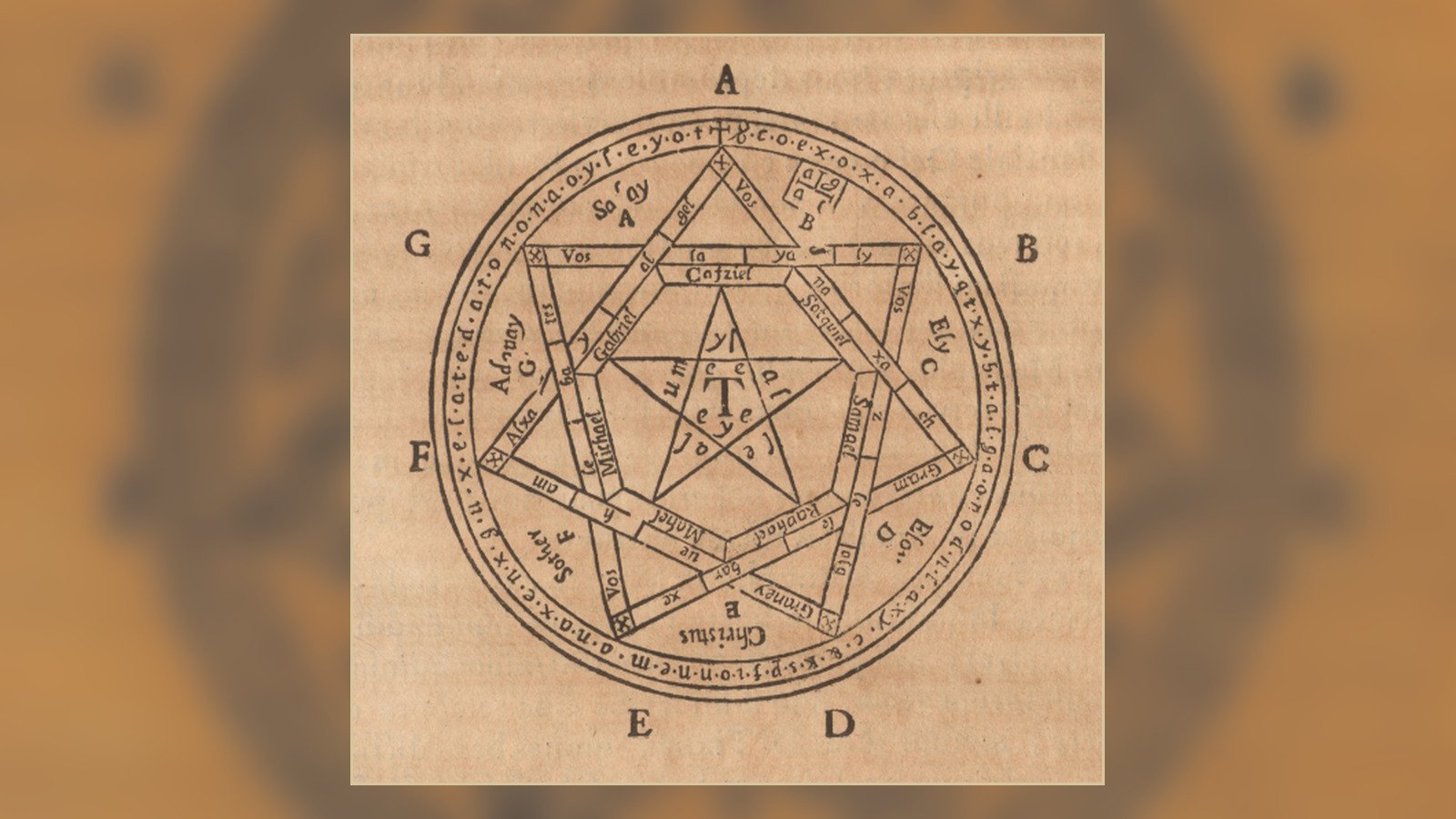
One of the text’s central instruments is an elaborate Seal of God composed from divine names and geometric divisions. Versions of the seal appear across manuscripts and related amuletic traditions. The seal is connected with seventy-two names. Instructions specify construction and consecration. The result is a body of evidence that must be read through manuscripts, catalogues and the material history of the object rather than through later legend alone.
The manuscript becomes clearer when its physical details are read beside its claims. Blood, parchment, metals or prepared surfaces appear in manuscript variants and related witnesses.. Every copied name, altered diagram, ownership mark or change of sequence records a decision made by a reader who believed the text deserved preservation. Those decisions are often as revealing as the stated operation itself.
The seal compresses the book’s theology into an image. Divine language is arranged as geometry so that the operator may stand before invisible powers under a sign of absolute authority. In the culture that produced it, sacred language, natural philosophy, astrology, law and ritual were not always separated by the boundaries used today. The manuscript therefore speaks from a world in which knowledge could be devotional, technical and forbidden at the same time.
Read closely, this section also explains why the subject continued to generate fear. Its authority does not depend upon a modern claim that every operation worked exactly as promised. It rests on the historical fact that scribes, collectors, judges or practitioners treated the words as consequential—important enough to copy, hide, condemn, transport or preserve across generations.
Angels, Winds and the Lower Spirits
Beyond the beatific vision, the book maps hierarchies of angels and spirits associated with planets, directions, winds, air and earth. Named ministers govern distinct regions. Some operations seek knowledge, command or protection. The result is a body of evidence that must be read through manuscripts, catalogues and the material history of the object rather than through later legend alone.
What appears at first to be a single mystery is actually a chain of copying, use and reinterpretation. Higher beings and lower spirits are addressed through different ritual expectations.. Every copied name, altered diagram, ownership mark or change of sequence records a decision made by a reader who believed the text deserved preservation. Those decisions are often as revealing as the stated operation itself.
The invisible world is not chaotic. It is a layered kingdom, and the book claims to know the names by which each gate can be opened. In the culture that produced it, sacred language, natural philosophy, astrology, law and ritual were not always separated by the boundaries used today. The manuscript therefore speaks from a world in which knowledge could be devotional, technical and forbidden at the same time.
Read closely, this section also explains why the subject continued to generate fear. Its authority does not depend upon a modern claim that every operation worked exactly as promised. It rests on the historical fact that scribes, collectors, judges or practitioners treated the words as consequential—important enough to copy, hide, condemn, transport or preserve across generations.
Royal MS 17 A XLII and the Surviving Witnesses
The British Library’s Royal MS 17 A XLII is a major fifteenth-century witness, written on parchment and containing Latin and English material. Other manuscripts preserve overlapping portions and variant seals. Royal MS 17 A XLII includes suffumigations, angelic classes, the Seal of God and drawings of angels. Sloane manuscripts preserve related text. The result is a body of evidence that must be read through manuscripts, catalogues and the material history of the object rather than through later legend alone.
The archive preserves both the ambition of the text and the limitations of what can now be known. Later copies show adaptation and omission.. Every copied name, altered diagram, ownership mark or change of sequence records a decision made by a reader who believed the text deserved preservation. Those decisions are often as revealing as the stated operation itself.
Comparison reveals a living tradition rather than a pristine original. Scribes changed spellings, diagrams and sequence while preserving the oath’s claim to exact secrecy. In the culture that produced it, sacred language, natural philosophy, astrology, law and ritual were not always separated by the boundaries used today. The manuscript therefore speaks from a world in which knowledge could be devotional, technical and forbidden at the same time.
Read closely, this section also explains why the subject continued to generate fear. Its authority does not depend upon a modern claim that every operation worked exactly as promised. It rests on the historical fact that scribes, collectors, judges or practitioners treated the words as consequential—important enough to copy, hide, condemn, transport or preserve across generations.
The Paradox of a Secret That Survived
The Sworn Book endured because its oath was repeatedly broken in the only way that could preserve it: someone copied the forbidden text and passed it onward. Early modern magicians, including circles connected with John Dee, knew related seals and material. Modern editions compare manuscripts. The result is a body of evidence that must be read through manuscripts, catalogues and the material history of the object rather than through later legend alone.
The surviving record places this material within a precise historical world. Institutional catalogues now disclose what the prologue ordered hidden.. Every copied name, altered diagram, ownership mark or change of sequence records a decision made by a reader who believed the text deserved preservation. Those decisions are often as revealing as the stated operation itself.
Its survival is the final ritual. Every reader enters after the masters, the copyists and the collectors who chose transmission over burial. In the culture that produced it, sacred language, natural philosophy, astrology, law and ritual were not always separated by the boundaries used today. The manuscript therefore speaks from a world in which knowledge could be devotional, technical and forbidden at the same time.
Read closely, this section also explains why the subject continued to generate fear. Its authority does not depend upon a modern claim that every operation worked exactly as promised. It rests on the historical fact that scribes, collectors, judges or practitioners treated the words as consequential—important enough to copy, hide, condemn, transport or preserve across generations.
The Manuscript as Witness
The enduring importance of Sworn Book of Honorius lies in the convergence of text and object. A title alone cannot show how the work changed: one must examine handwriting, parchment or paper, pigments, bindings, ownership notes, omissions and the order in which separate texts were placed together. These details reveal whether a copy was made for use, collection, instruction, defence or concealment. They also show why modern printed editions, however valuable, can create the illusion of a stable book where the historical record preserves a family of changing witnesses.
Institutional catalogues have become essential to this reconstruction. Shelf marks that appear dry or technical are the coordinates of survival. They identify the exact volume, distinguish one recension from another and prevent famous titles from absorbing unrelated material. For SatanWorld, those catalogue identities are treated as part of the story: the route from private hand to royal cabinet, confiscated collection, antiquarian sale or national library explains how forbidden knowledge crossed the centuries.
The visual record is equally important. A circle, initial, seal, table or miniature cannot be replaced by a verbal summary without loss. Images determine the pace of reading and often carry information that the words do not explain. For that reason, this article presents historical images with their holding institution and reuse status, while original editorial diagrams are clearly identified as modern explanatory work rather than manuscript facsimiles.
What the Darkness Preserved
The Sworn Book of Honorius and the Oath of Secrecy belongs to forbidden history because the work survived a repeated conflict over who could possess knowledge and by what authority. The danger attributed to it changed with time: demonic assistance, unauthorised revelation, unlawful prosecution, secret communication, intellectual pride or the fear that a diagram might make inaccessible power portable. Yet each generation that feared the material also helped define and preserve it.
The final mystery is therefore not only whether a spirit appeared, a talisman received celestial force or a prayer transformed memory. It is why human beings continued to copy these instructions when copying was slow, possession could be dangerous and many of the names were barely understood. The answer lies somewhere between faith, ambition and the refusal to accept that the visible world contains all available knowledge.