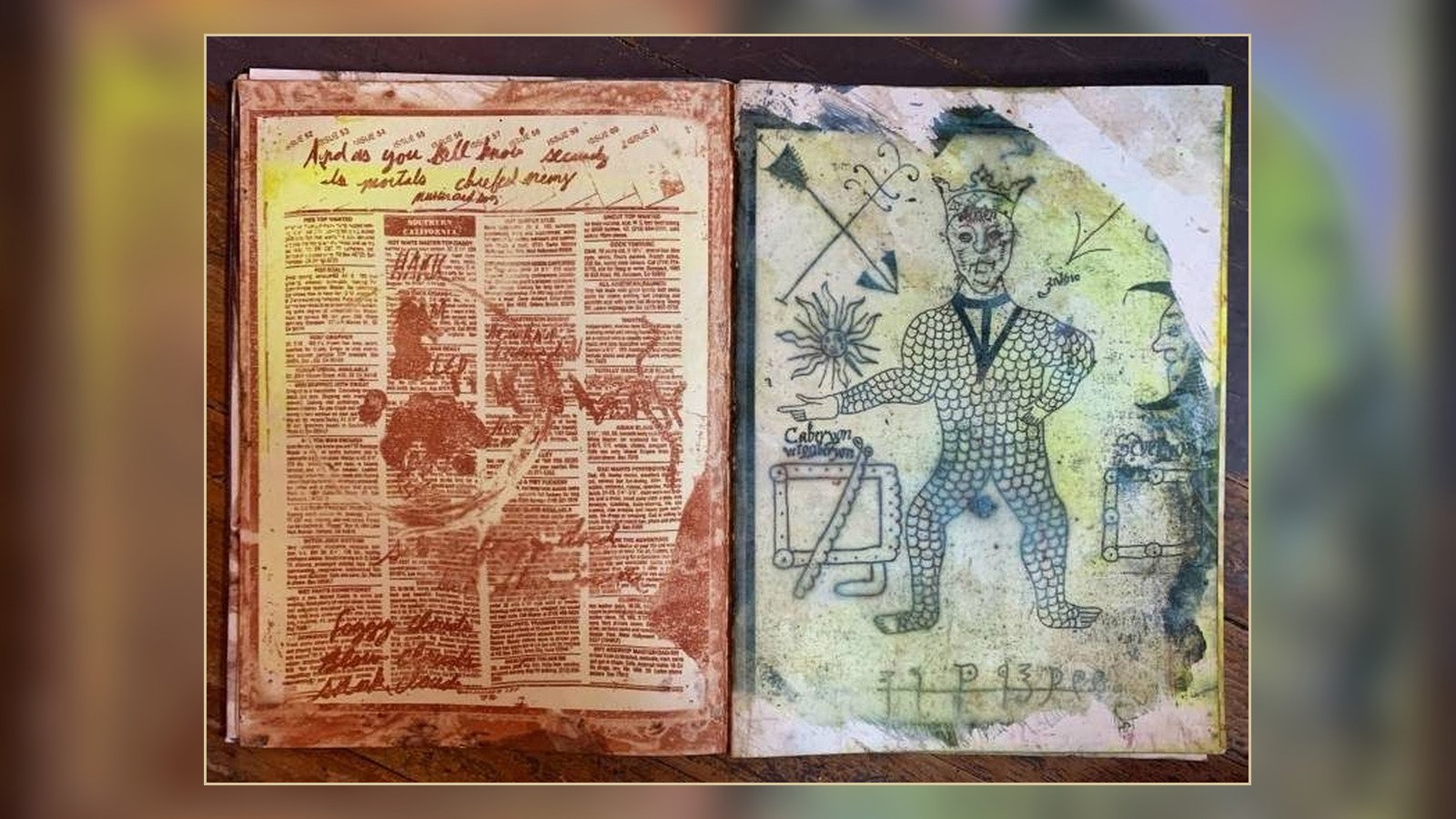
In a manuscript copied during the reign of Elizabeth I, a crowned spirit waits to be called. His name is written as Oberyon. He teaches physic, reveals the properties of stones and herbs, locates treasure and commands the hidden regions of water and earth. Around him gather hundreds of other rites, names and figures—the surviving remains of an English magician’s working world.
Folger MS V.b.26
The Book of Oberon is the modern name given to Folger Shakespeare Library MS V.b.26, a large two-volume magical compilation created from about 1577 to sometime after 1583. The manuscript contains hundreds of pages in Latin and English. Black and red inks distinguish text and ritual emphasis. The result is a body of evidence that must be read through manuscripts, catalogues and the material history of the object rather than through later legend alone.
The surviving record places this material within a precise historical world. Charts, circles and spirit figures interrupt the dense script.. Every copied name, altered diagram, ownership mark or change of sequence records a decision made by a reader who believed the text deserved preservation. Those decisions are often as revealing as the stated operation itself.
Its scale makes it more than a grimoire copied from one source. It is a sourcebook assembled from multiple streams of Elizabethan ritual knowledge. In the culture that produced it, sacred language, natural philosophy, astrology, law and ritual were not always separated by the boundaries used today. The manuscript therefore speaks from a world in which knowledge could be devotional, technical and forbidden at the same time.
Read closely, this section also explains why the subject continued to generate fear. Its authority does not depend upon a modern claim that every operation worked exactly as promised. It rests on the historical fact that scribes, collectors, judges or practitioners treated the words as consequential—important enough to copy, hide, condemn, transport or preserve across generations.
A Manuscript Broken and Reunited
The two surviving volumes were separated by the nineteenth century, and the opening leaves remain missing. Their reunion in the Folger collection is part of the manuscript’s modern history. One portion passed through occultist Frederick Hockley and collector R. C. Smith, known as Raphael. The Folger acquired parts in 1958 and 2007. The result is a body of evidence that must be read through manuscripts, catalogues and the material history of the object rather than through later legend alone.
The manuscript becomes clearer when its physical details are read beside its claims. At least fourteen opening pages are still unlocated.. Every copied name, altered diagram, ownership mark or change of sequence records a decision made by a reader who believed the text deserved preservation. Those decisions are often as revealing as the stated operation itself.
The physical fracture mirrors the tradition itself. The book survives as recovered fragments of a larger practice, with absences that no edition can completely restore. In the culture that produced it, sacred language, natural philosophy, astrology, law and ritual were not always separated by the boundaries used today. The manuscript therefore speaks from a world in which knowledge could be devotional, technical and forbidden at the same time.
Read closely, this section also explains why the subject continued to generate fear. Its authority does not depend upon a modern claim that every operation worked exactly as promised. It rests on the historical fact that scribes, collectors, judges or practitioners treated the words as consequential—important enough to copy, hide, condemn, transport or preserve across generations.
The Hands Behind the Book
Internal dates and ownership traces point toward several users rather than one famous magician. Names such as John Weston and the anagrammatic John Porter appear within the volume. Different hands copied and corrected material. The sequence accumulated over time. The result is a body of evidence that must be read through manuscripts, catalogues and the material history of the object rather than through later legend alone.
What appears at first to be a single mystery is actually a chain of copying, use and reinterpretation. Practical notes suggest use rather than decorative collecting.. Every copied name, altered diagram, ownership mark or change of sequence records a decision made by a reader who believed the text deserved preservation. Those decisions are often as revealing as the stated operation itself.
The anonymous or half-concealed compilers are essential to the manuscript’s atmosphere. They represent the educated provincial practitioners who rarely enter official histories except when accused. In the culture that produced it, sacred language, natural philosophy, astrology, law and ritual were not always separated by the boundaries used today. The manuscript therefore speaks from a world in which knowledge could be devotional, technical and forbidden at the same time.
Read closely, this section also explains why the subject continued to generate fear. Its authority does not depend upon a modern claim that every operation worked exactly as promised. It rests on the historical fact that scribes, collectors, judges or practitioners treated the words as consequential—important enough to copy, hide, condemn, transport or preserve across generations.
Oberyon, King of the Fairies
The spirit who gave the book its modern title appears as a crowned king associated with the Sun and Moon. The manuscript attributes to him knowledge of medicine, nature, metals, treasure and invisibility. His name connects learned ritual magic with the wider literary and folkloric figure of Oberon. The text calls him king of the fairies. The result is a body of evidence that must be read through manuscripts, catalogues and the material history of the object rather than through later legend alone.
The archive preserves both the ambition of the text and the limitations of what can now be known. A specific method of conjuration accompanies the description.. Every copied name, altered diagram, ownership mark or change of sequence records a decision made by a reader who believed the text deserved preservation. Those decisions are often as revealing as the stated operation itself.
Oberyon stands at a threshold. He is neither simply the theatrical fairy king nor a conventional demon, but a powerful spirit translated into the commanding grammar of ceremonial magic. In the culture that produced it, sacred language, natural philosophy, astrology, law and ritual were not always separated by the boundaries used today. The manuscript therefore speaks from a world in which knowledge could be devotional, technical and forbidden at the same time.
Read closely, this section also explains why the subject continued to generate fear. Its authority does not depend upon a modern claim that every operation worked exactly as promised. It rests on the historical fact that scribes, collectors, judges or practitioners treated the words as consequential—important enough to copy, hide, condemn, transport or preserve across generations.
A Court of Spirits
The manuscript catalogues angels, demons, planetary rulers, directional powers and named spirits with particular offices. Their appearances and capabilities form an invisible court. Some spirits teach sciences. Others reveal theft, treasure or future events. The result is a body of evidence that must be read through manuscripts, catalogues and the material history of the object rather than through later legend alone.
The surviving record places this material within a precise historical world. Names familiar from Solomonic and continental traditions appear beside English material.. Every copied name, altered diagram, ownership mark or change of sequence records a decision made by a reader who believed the text deserved preservation. Those decisions are often as revealing as the stated operation itself.
The catalogue turns the unseen world into administration. Each being has jurisdiction, rank, form and task, and the operator’s problem is to address the correct office. In the culture that produced it, sacred language, natural philosophy, astrology, law and ritual were not always separated by the boundaries used today. The manuscript therefore speaks from a world in which knowledge could be devotional, technical and forbidden at the same time.
Read closely, this section also explains why the subject continued to generate fear. Its authority does not depend upon a modern claim that every operation worked exactly as promised. It rests on the historical fact that scribes, collectors, judges or practitioners treated the words as consequential—important enough to copy, hide, condemn, transport or preserve across generations.
Circles, Conjurations and Sacred Authority
The rites use circles, divine names, psalms, prayers and escalating commands. Christianity is not a surface disguise but the principal language through which authority is claimed. The operator invokes God, angels and biblical power. Spirits are constrained rather than worshipped. The result is a body of evidence that must be read through manuscripts, catalogues and the material history of the object rather than through later legend alone.
The manuscript becomes clearer when its physical details are read beside its claims. Ritual protection and dismissal are treated as essential.. Every copied name, altered diagram, ownership mark or change of sequence records a decision made by a reader who believed the text deserved preservation. Those decisions are often as revealing as the stated operation itself.
The manuscript reveals a Christianity stretched beyond authorised boundaries. The magician asks sacred language to do work the parish church would condemn. In the culture that produced it, sacred language, natural philosophy, astrology, law and ritual were not always separated by the boundaries used today. The manuscript therefore speaks from a world in which knowledge could be devotional, technical and forbidden at the same time.
Read closely, this section also explains why the subject continued to generate fear. Its authority does not depend upon a modern claim that every operation worked exactly as promised. It rests on the historical fact that scribes, collectors, judges or practitioners treated the words as consequential—important enough to copy, hide, condemn, transport or preserve across generations.
Magic for Ordinary Crisis
Alongside grand spirit conjurations are operations for healing, stolen property, love, knowledge and practical need. The manuscript’s world is not confined to cosmic revelation. Thief-catching rites respond to local crime. Medical operations address sickness. The result is a body of evidence that must be read through manuscripts, catalogues and the material history of the object rather than through later legend alone.
What appears at first to be a single mystery is actually a chain of copying, use and reinterpretation. Treasure and invisibility answer fantasies of escape and wealth.. Every copied name, altered diagram, ownership mark or change of sequence records a decision made by a reader who believed the text deserved preservation. Those decisions are often as revealing as the stated operation itself.
This mixture makes the book human. Its elaborate circles exist beside the urgent problems of bodies, households and money. In the culture that produced it, sacred language, natural philosophy, astrology, law and ritual were not always separated by the boundaries used today. The manuscript therefore speaks from a world in which knowledge could be devotional, technical and forbidden at the same time.
Read closely, this section also explains why the subject continued to generate fear. Its authority does not depend upon a modern claim that every operation worked exactly as promised. It rests on the historical fact that scribes, collectors, judges or practitioners treated the words as consequential—important enough to copy, hide, condemn, transport or preserve across generations.
Elizabethan England Beyond the Stage
The manuscript was compiled during the same decades that produced Marlowe, Shakespeare, expanding print culture and intense religious surveillance. Learned magic moved through this unsettled environment. Astrology remained respectable in many settings. Conjuration could bring prosecution. The result is a body of evidence that must be read through manuscripts, catalogues and the material history of the object rather than through later legend alone.
The archive preserves both the ambition of the text and the limitations of what can now be known. Catholic and Protestant ritual languages overlapped within private books.. Every copied name, altered diagram, ownership mark or change of sequence records a decision made by a reader who believed the text deserved preservation. Those decisions are often as revealing as the stated operation itself.
The Book of Oberon shows an Elizabethan world larger than its public theatre. Behind the stage stood rooms where names were copied in red and a spirit king was invited to appear. In the culture that produced it, sacred language, natural philosophy, astrology, law and ritual were not always separated by the boundaries used today. The manuscript therefore speaks from a world in which knowledge could be devotional, technical and forbidden at the same time.
Read closely, this section also explains why the subject continued to generate fear. Its authority does not depend upon a modern claim that every operation worked exactly as promised. It rests on the historical fact that scribes, collectors, judges or practitioners treated the words as consequential—important enough to copy, hide, condemn, transport or preserve across generations.
From Secret Book to Sourcebook
Modern transcription and translation have made the manuscript accessible, but its material complexity remains important. The Folger catalogue preserves details of hands, provenance and physical arrangement. The edition by Daniel Harms, James R. Clark and Joseph H. Peterson established the title Book of Oberon. Digital images permit close study. The result is a body of evidence that must be read through manuscripts, catalogues and the material history of the object rather than through later legend alone.
The surviving record places this material within a precise historical world. Contemporary artists continue to respond to its missing leaves and spirit figures.. Every copied name, altered diagram, ownership mark or change of sequence records a decision made by a reader who believed the text deserved preservation. Those decisions are often as revealing as the stated operation itself.
The manuscript endures because it refuses one identity. It is Christian and forbidden, practical and visionary, English and cosmopolitan—a whole occult archive gathered around a king who may never have appeared. In the culture that produced it, sacred language, natural philosophy, astrology, law and ritual were not always separated by the boundaries used today. The manuscript therefore speaks from a world in which knowledge could be devotional, technical and forbidden at the same time.
Read closely, this section also explains why the subject continued to generate fear. Its authority does not depend upon a modern claim that every operation worked exactly as promised. It rests on the historical fact that scribes, collectors, judges or practitioners treated the words as consequential—important enough to copy, hide, condemn, transport or preserve across generations.
The Manuscript as Witness
The enduring importance of Book of Oberon lies in the convergence of text and object. A title alone cannot show how the work changed: one must examine handwriting, parchment or paper, pigments, bindings, ownership notes, omissions and the order in which separate texts were placed together. These details reveal whether a copy was made for use, collection, instruction, defence or concealment. They also show why modern printed editions, however valuable, can create the illusion of a stable book where the historical record preserves a family of changing witnesses.
Institutional catalogues have become essential to this reconstruction. Shelf marks that appear dry or technical are the coordinates of survival. They identify the exact volume, distinguish one recension from another and prevent famous titles from absorbing unrelated material. For SatanWorld, those catalogue identities are treated as part of the story: the route from private hand to royal cabinet, confiscated collection, antiquarian sale or national library explains how forbidden knowledge crossed the centuries.
The visual record is equally important. A circle, initial, seal, table or miniature cannot be replaced by a verbal summary without loss. Images determine the pace of reading and often carry information that the words do not explain. For that reason, this article presents historical images with their holding institution and reuse status, while original editorial diagrams are clearly identified as modern explanatory work rather than manuscript facsimiles.
What the Darkness Preserved
The Book of Oberon and the Spirits of Elizabethan England belongs to forbidden history because the work survived a repeated conflict over who could possess knowledge and by what authority. The danger attributed to it changed with time: demonic assistance, unauthorised revelation, unlawful prosecution, secret communication, intellectual pride or the fear that a diagram might make inaccessible power portable. Yet each generation that feared the material also helped define and preserve it.
The final mystery is therefore not only whether a spirit appeared, a talisman received celestial force or a prayer transformed memory. It is why human beings continued to copy these instructions when copying was slow, possession could be dangerous and many of the names were barely understood. The answer lies somewhere between faith, ambition and the refusal to accept that the visible world contains all available knowledge.