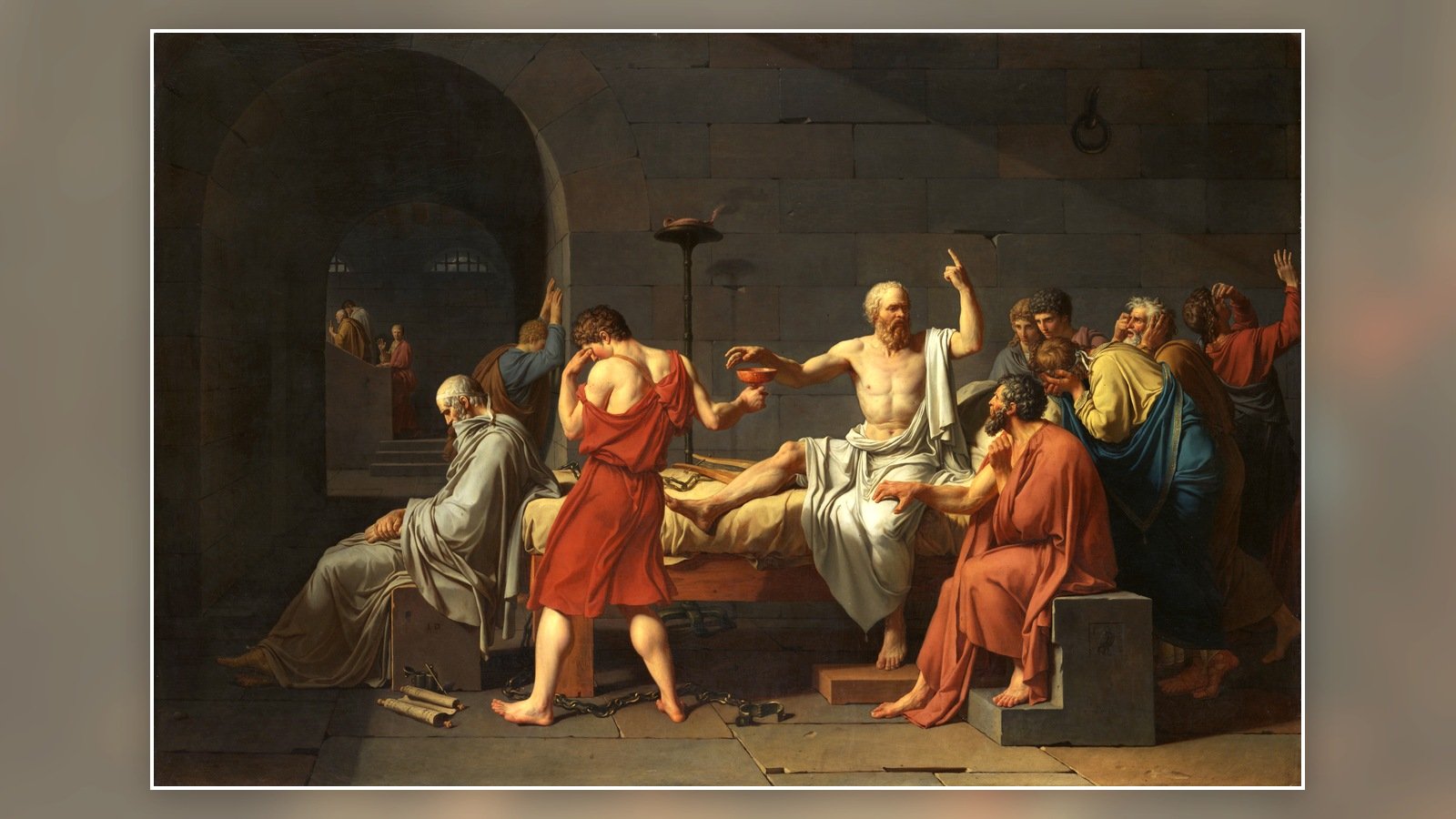
Socrates stands in Jacques-Louis David’s prison with one hand reaching toward the cup and the other raised in argument. The city has judged him, but the examination continues. An adversary in this sense is not merely a hostile person. It is a function: the voice that asks the question a consensus would prefer to leave unasked, tests the claim that authority declares settled, and forces belief to survive opposition. Across philosophy, law, theology and science, institutions have created adversarial roles because certainty without resistance decays into error. The method is dangerous, however, when contradiction becomes performance and the critic no longer accepts any burden of truth.
The Historical and Philosophical Problem
The Adversary as a Method of Critical Thought belongs to Socratic philosophy, scholastic disputation, canon law, scientific criticism and modern institutional risk analysis. Its central problem is the deliberate use of opposition to test claims, expose hidden assumptions and prevent authority from confusing consensus with truth. The article follows historical comparison of philosophical, legal, religious and scientific adversarial practices and keeps one contradiction in view: adversarial challenge can protect knowledge, but permanent contrarianism can destroy trust and reward manipulation. The purpose is not to turn a literary or philosophical figure into an object of compulsory belief. It is to show how rebellion, knowledge and authority were argued through real texts and institutions.
The stakes concern whether institutions can build criticism into their structure before dissent is forced outside as rebellion. That question is larger than the original author or event because later readers inherited the symbol under different conditions. The history must therefore distinguish initial meaning, hostile accusation, sympathetic reception and modern appropriation while allowing them to illuminate one another.
Socrates and the Elenchus
The Socratic elenchus begins from an interlocutor’s claim and draws out commitments that may conflict with it. Its immediate result is often aporia, an impasse rather than a replacement doctrine. The method attacks pretended knowledge, including the complacency of the questioner. Socrates’s adversarial role in Athens was political because claims to wisdom supported status and power. His death made the examiner a symbol of the cost imposed when a community treats uncomfortable questioning as corruption.
At the philosophical centre lies the use of adversarial rhetoric to delay accountability, manufacture doubt or turn public reasoning into spectacle. Rebellion is not purified merely because its opponent is oppressive. Every adversarial tradition must ask what forms of conduct it authorizes once the old command has been rejected and whether another person remains more than material for the rebel’s freedom.
The Adversary Within Philosophy
Philosophical argument developed through objection and reply. A position becomes clearer when reconstructed by an opponent capable of identifying its weakest premise. This discipline differs from insult or reflexive negation. The adversary must understand the claim well enough to challenge its strongest form. When criticism attacks only a caricature, it protects the original position by allowing defenders to answer an easier enemy.
The section contributes to the adversary as an office of intellectual conscience rather than a personification of evil. Cultural legacy is not evidence that later users recovered an unchanged secret tradition. It is evidence that an image or argument remained capable of organizing new conflicts. Transmission transforms, and the transformations themselves belong to history.
Scholastic Questions and Structured Objections
Medieval scholastic writing often presented objections before a determination, then answered them individually. The form acknowledged that truth should encounter resistance inside the text itself. Although the final authority might remain theological, the procedure institutionalized conflict as a path to clarity. The reader witnessed a proposition exposed to contrary reasons rather than announced without process. Adversarial form could therefore exist even within a strongly hierarchical intellectual world.
The conflict over whether institutions can build criticism into their structure before dissent is forced outside as rebellion also explains why the subject repeatedly crosses the boundary between literature and religion. A literary figure can become a spiritual emblem; a theological accusation can become a political identity. Accuracy requires following the passage rather than deciding in advance where the “real” meaning must reside.
The Devil’s Advocate in Canonization
The popular phrase “devil’s advocate” is connected to the Promoter of the Faith in Catholic canonization procedures, an official charged with raising difficulties and testing evidence for sainthood. The historical office changed over time and is often simplified in modern retelling, but the principle is important: a sacred institution recognized that enthusiasm, local devotion and institutional interest could produce error. Holiness was tested by an authorized skeptic from within the process.
A darker implication is that authority often creates the adversary it fears. By forbidding a question, persecuting a book or demanding ritual assent, an institution gives dissent a shared symbol. Yet prohibition alone does not prove the dissenter correct. It proves only that power has entered the argument.
Law and the Conflict of Cases
Adversarial legal systems assume that opposing advocates can expose weaknesses that a single investigator may miss. The method does not guarantee truth; resources, skill and unequal power shape outcomes. Yet it separates accusation from judgment and gives contested evidence a formal hearing. The legal adversary is constrained by rules, disclosure duties and a tribunal. Without those limits, opposition becomes combat rather than inquiry.
The individual reader is implicated as well. It is easy to admire defiance at a historical distance while avoiding the discipline of self-critique. The adversarial method becomes serious only when it tests cherished rebellion with the same severity used against inherited authority.
Science, Falsification and Peer Criticism
Scientific knowledge advances through attempts to reproduce, challenge and falsify claims. Peer review, replication and open data create adversarial pressure even when researchers share broad goals. The critic does not prove wisdom by rejecting consensus; criticism must engage methods and evidence. Manufactured doubt—especially when funded to protect commercial or political interests—imitates the form of skepticism while abandoning its discipline. The adversary serves knowledge only when willing to be corrected.
This is why the subject belongs to dark philosophy rather than inspirational mythology. It asks what freedom costs, what knowledge fails to repair, and how a person acts after certainty has been broken. The darkness is not decoration; it is the absence of an innocent position.
Political Opposition and the Right to Dissent
A functioning opposition allows government claims to be challenged without requiring civil war. Whistleblowers, investigative journalists and minority parties perform adversarial roles that institutions frequently praise in theory and punish in practice. Dissent becomes especially valuable when emergency, patriotism or sacred identity is used to suppress scrutiny. Yet opposition that treats every compromise as betrayal may make collective action impossible. The method requires a shared commitment to procedures stronger than victory.
The historical value of political opposition and the right to dissent is that it exposes the deliberate use of opposition to test claims, expose hidden assumptions and prevent authority from confusing consensus with truth. Later summaries often preserve the dramatic conclusion and lose the route by which it was reached. Restoring publication, audience and argument makes the subject more disturbing rather than less: the symbol was produced through real conflicts over whether institutions can build criticism into their structure before dissent is forced outside as rebellion.
Red Teams and Institutional Failure
Modern security, military and organizational planning uses red teams to think like an adversary and identify vulnerabilities. The role is most useful before failure, when leaders still have the power to change course. It fails when the red team is ceremonial, when criticism cannot reach decision-makers, or when dissenters are punished for producing unwelcome results. An institution reveals its real relationship to truth by what happens to the person who finds the flaw.
This stage also sharpens the central tension: adversarial challenge can protect knowledge, but permanent contrarianism can destroy trust and reward manipulation. The opposition cannot be resolved by declaring one side enlightened and the other benighted. The archive shows intelligence, fear, self-interest and sincere conviction operating across the conflict. A serious adversarial reading keeps those mixed motives visible.
From Adversary to Contrarian Brand
Digital media rewards visible opposition because conflict attracts attention. The adversary can become a brand whose status depends upon rejecting whatever others accept. This reverses the method: instead of testing a claim, the contrarian begins with the need to differ and searches for material afterward. Serious adversarial thought accepts asymmetry. Some claims have survived stronger evidence than others, and fairness does not require pretending that every denial is equally credible.
The material should be read through historical comparison of philosophical, legal, religious and scientific adversarial practices. Primary language establishes what the author actually constructed; reception shows how the work escaped its first context; later movements reveal which elements became usable symbols. None of these layers may silently replace the others.
Deeper Questions
The adversary’s moral authority depends upon risk. Socrates risked judgment; whistleblowers risk careers; internal critics risk belonging. Performative opposition that carries no cost and accepts no responsibility can imitate courage without practicing it.
A strong institution does not wait for an enemy to reveal its weakness. It creates channels through which criticism can travel without being neutralized by hierarchy. The adversary becomes a form of maintenance rather than an existential threat.
Luciferian thought can interpret the adversary as the intelligence that refuses protected claims. The symbolism is useful when it preserves method—evidence, consistency and self-critique. It becomes dogma when opposition itself is sacred.
The critic must also submit to criticism. An adversary who cannot be questioned occupies the same structure of infallibility he claims to resist. Reciprocal examination distinguishes philosophy from denunciation.
The final goal is not permanent conflict but claims capable of surviving honest resistance. A truth that requires silence is politically powerful and intellectually fragile.
A further question concerns the material form of the archive. Books, paintings, trials and institutional procedures do not merely carry ideas; they decide who may encounter them and under what conditions. The survival of philosophy of the adversary as a searchable subject depends upon acts of preservation that earlier authorities may have intended as refutation or control.
The language of illumination should not be confused with the possession of final truth. Every figure in this history sees something the official order excludes, but partial sight can still become arrogance. The ethical measure is whether new knowledge enlarges responsibility or merely enlarges the self’s claim to rule.
Reception also changes when a work moves from scandal to canon. Once taught, collected and digitized, a forbidden text can lose the danger of its first appearance. Recovering the original conflict restores the cost paid by writers, publishers and readers without requiring modern audiences to imitate their conclusions.
The political lesson is equally unstable. Institutions need continuity, but continuity can protect error; rebels need disruption, but disruption can destroy the conditions of freedom. The archive offers no formula that removes this tension. It offers cases through which judgment can be trained.
A further question concerns the material form of the archive. Books, paintings, trials and institutional procedures do not merely carry ideas; they decide who may encounter them and under what conditions. The survival of philosophy of the adversary as a searchable subject depends upon acts of preservation that earlier authorities may have intended as refutation or control.
The language of illumination should not be confused with the possession of final truth. Every figure in this history sees something the official order excludes, but partial sight can still become arrogance. The ethical measure is whether new knowledge enlarges responsibility or merely enlarges the self’s claim to rule.
Reception also changes when a work moves from scandal to canon. Once taught, collected and digitized, a forbidden text can lose the danger of its first appearance. Recovering the original conflict restores the cost paid by writers, publishers and readers without requiring modern audiences to imitate their conclusions.
The political lesson is equally unstable. Institutions need continuity, but continuity can protect error; rebels need disruption, but disruption can destroy the conditions of freedom. The archive offers no formula that removes this tension. It offers cases through which judgment can be trained.
A further question concerns the material form of the archive. Books, paintings, trials and institutional procedures do not merely carry ideas; they decide who may encounter them and under what conditions. The survival of philosophy of the adversary as a searchable subject depends upon acts of preservation that earlier authorities may have intended as refutation or control.
The language of illumination should not be confused with the possession of final truth. Every figure in this history sees something the official order excludes, but partial sight can still become arrogance. The ethical measure is whether new knowledge enlarges responsibility or merely enlarges the self’s claim to rule.
Reception also changes when a work moves from scandal to canon. Once taught, collected and digitized, a forbidden text can lose the danger of its first appearance. Recovering the original conflict restores the cost paid by writers, publishers and readers without requiring modern audiences to imitate their conclusions.
The political lesson is equally unstable. Institutions need continuity, but continuity can protect error; rebels need disruption, but disruption can destroy the conditions of freedom. The archive offers no formula that removes this tension. It offers cases through which judgment can be trained.
A further question concerns the material form of the archive. Books, paintings, trials and institutional procedures do not merely carry ideas; they decide who may encounter them and under what conditions. The survival of philosophy of the adversary as a searchable subject depends upon acts of preservation that earlier authorities may have intended as refutation or control.
The language of illumination should not be confused with the possession of final truth. Every figure in this history sees something the official order excludes, but partial sight can still become arrogance. The ethical measure is whether new knowledge enlarges responsibility or merely enlarges the self’s claim to rule.
Reception also changes when a work moves from scandal to canon. Once taught, collected and digitized, a forbidden text can lose the danger of its first appearance. Recovering the original conflict restores the cost paid by writers, publishers and readers without requiring modern audiences to imitate their conclusions.
The political lesson is equally unstable. Institutions need continuity, but continuity can protect error; rebels need disruption, but disruption can destroy the conditions of freedom. The archive offers no formula that removes this tension. It offers cases through which judgment can be trained.
What Remains
The subject leaves no painless conclusion. It preserves the adversary as an office of intellectual conscience rather than a personification of evil while exposing the use of adversarial rhetoric to delay accountability, manufacture doubt or turn public reasoning into spectacle. The inherited authority may be unjust, the rebel’s question may be necessary, and the rebel may still fail. Dark philosophy begins where those statements are allowed to remain true together.
SatanWorld approaches this history as an archive of contested knowledge. The task is to hear the forbidden voice without granting it automatic innocence, and to examine authority without treating opposition as a substitute for evidence. What remains is the responsibility of judgment: freedom after command, knowledge after prohibition, and the difficult refusal to become the power one resisted.