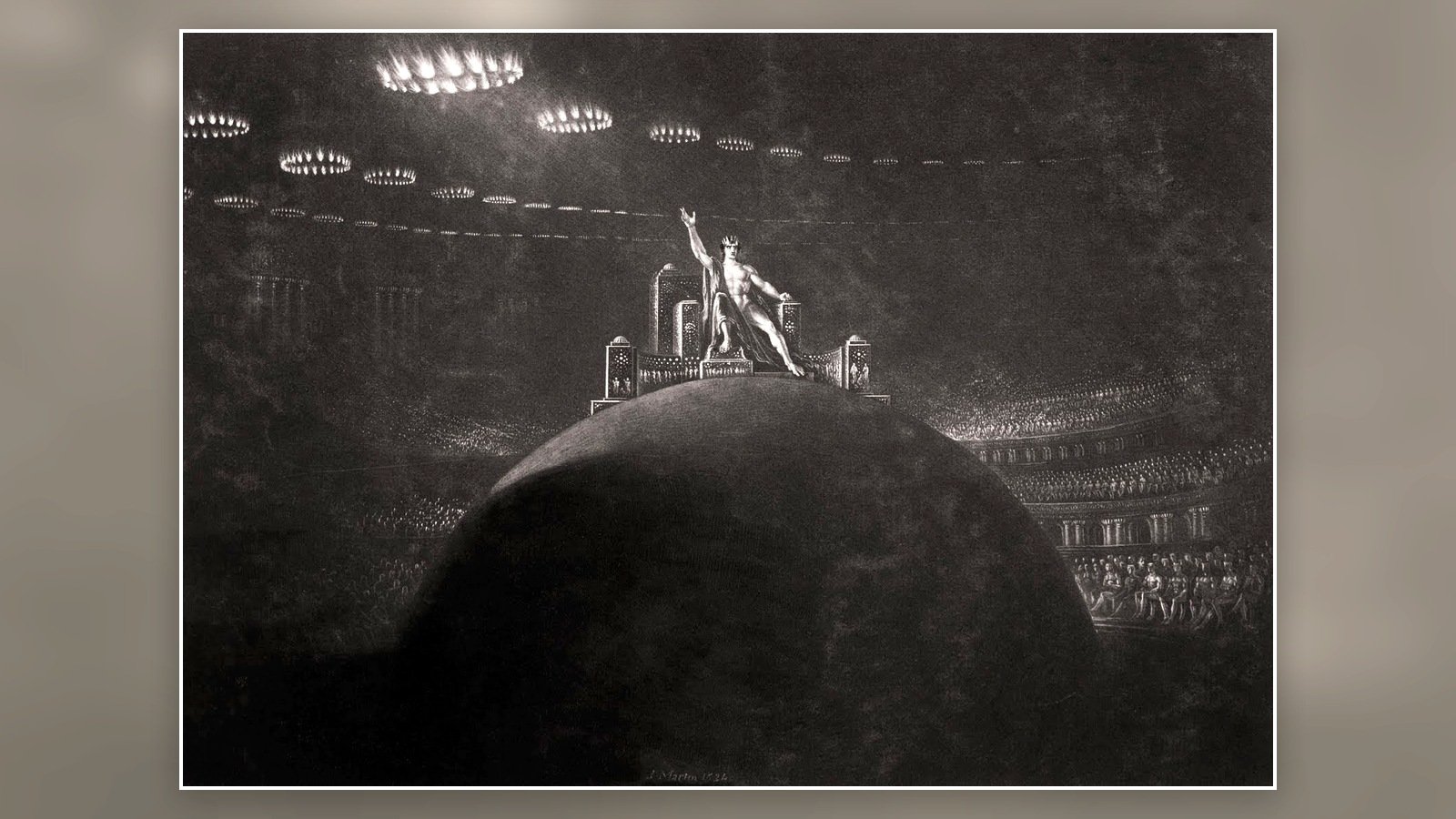
John Martin’s Satan sits above the infernal council like an emperor addressing a parliament of the damned. The image is theological, literary and political at once. By 1824, the Devil could still signify absolute evil, yet Milton and the Romantics had made his posture available for another reading: the defeated rebel who speaks against Heaven’s throne. Satan’s history as a symbol is not a straight path from religion to modern freedom. It is a struggle among accusation, fear, art, politics and self-identification. The figure has been used to condemn outsiders, to dramatize forbidden desire, to sell panic and, eventually, to name communities that deliberately appropriated the enemy’s image.
The Historical and Philosophical Problem
Satan as Symbol from Theology to Counterculture belongs to biblical and Christian demonology, polemical accusations, Romantic literature, occult revival and modern counterculture. Its central problem is the transformation of Satan from an imposed label of evil into a consciously reinterpreted symbol of rebellion, individuality and religious innovation. The article follows history of religion, literary reception, political symbolism and study of modern new religious movements and keeps one contradiction in view: the symbol can expose oppressive moral authority, yet it also carries histories of fear, conspiracy and real extremist appropriation. The purpose is not to turn a literary or philosophical figure into an object of compulsory belief. It is to show how rebellion, knowledge and authority were argued through real texts and institutions.
The stakes concern who controls the meaning of the enemy and whether a condemned image can be reclaimed without inheriting every meaning attached to it. That question is larger than the original author or event because later readers inherited the symbol under different conditions. The history must therefore distinguish initial meaning, hostile accusation, sympathetic reception and modern appropriation while allowing them to illuminate one another.
From Accuser to Cosmic Enemy
The Hebrew satan could function as an accuser or adversarial agent, while later Jewish and Christian traditions developed more independent figures of evil. Christian scripture, patristic interpretation and apocalyptic imagination gradually combined serpent, tempter, dragon and fallen angel into a powerful enemy of God. The synthesis was never perfectly uniform, but it created a symbolic centre through which disobedience, heresy and temptation could be narrated.
A darker implication is that authority often creates the adversary it fears. By forbidding a question, persecuting a book or demanding ritual assent, an institution gives dissent a shared symbol. Yet prohibition alone does not prove the dissenter correct. It proves only that power has entered the argument.
The Invention of the Satanist
For much of European history, Satanism existed primarily as an accusation. Heretics, witches, political enemies and rival religious groups were described as servants of the Devil. The charge explained dissent by denying its sincerity: opponents did not merely reason differently; they secretly desired evil. Confessions extracted under coercion and polemical literature then appeared to confirm the stereotype. Modern scholarship distinguishes these imposed identities from later people who consciously adopted Satanic language.
The individual reader is implicated as well. It is easy to admire defiance at a historical distance while avoiding the discipline of self-critique. The adversarial method becomes serious only when it tests cherished rebellion with the same severity used against inherited authority.
Milton and the Persuasive Adversary
Paradise Lost gave Satan extraordinary rhetorical force while preserving a theological account of his degradation. Readers could experience the attraction of his defiance even as the poem exposed pride and domination. This doubleness made later rehabilitation possible. Satan became psychologically legible as an injured, eloquent rebel rather than only an external monster. Literature created a space where sympathy could be explored without requiring doctrinal worship.
This is why the subject belongs to dark philosophy rather than inspirational mythology. It asks what freedom costs, what knowledge fails to repair, and how a person acts after certainty has been broken. The darkness is not decoration; it is the absence of an innocent position.
Romantic Rehabilitation
Blake, Byron, Shelley and other Romantic writers used Satanic or Promethean figures to question religious authority, political tyranny and moral repression. Their positions differed and should not be merged into a single creed. Scholars emphasize that literary sympathy is not the same as self-declared religious Satanism. Yet the Romantic transformation was decisive: it attached the adversary to liberty, science, sexuality and resistance, making positive identification culturally imaginable.
The historical value of romantic rehabilitation is that it exposes the transformation of Satan from an imposed label of evil into a consciously reinterpreted symbol of rebellion, individuality and religious innovation. Later summaries often preserve the dramatic conclusion and lose the route by which it was reached. Restoring publication, audience and argument makes the subject more disturbing rather than less: the symbol was produced through real conflicts over who controls the meaning of the enemy and whether a condemned image can be reclaimed without inheriting every meaning attached to it.
Satan in Nineteenth-Century Counterculture
Radicals, socialists, anarchists, anti-clericals and occultists found strategic value in the Devil’s image. Proudhon and Bakunin could use Satanic language against divine and political authority; Michelet reimagined the witch; Éliphas Lévi transformed occult symbolism. The figure moved through poetry, caricature and esoteric speculation. Satan’s usefulness came partly from scandal: adopting the enemy of the Church turned condemnation into a weapon against the condemning institution.
This stage also sharpens the central tension: the symbol can expose oppressive moral authority, yet it also carries histories of fear, conspiracy and real extremist appropriation. The opposition cannot be resolved by declaring one side enlightened and the other benighted. The archive shows intelligence, fear, self-interest and sincere conviction operating across the conflict. A serious adversarial reading keeps those mixed motives visible.
Decadence, Art and Forbidden Desire
Baudelaire and later Decadents joined Satan to exile, sensuality, illness and artistic autonomy. The symbol offered a language for desires excluded from respectable morality. It also encouraged theatricality and self-mythologizing. Counterculture often depends upon an audience capable of being shocked; the forbidden sign loses force if no authority recognizes it. Satanic art therefore remains entangled with the moral order it opposes.
The material should be read through history of religion, literary reception, political symbolism and study of modern new religious movements. Primary language establishes what the author actually constructed; reception shows how the work escaped its first context; later movements reveal which elements became usable symbols. None of these layers may silently replace the others.
Modern Self-Identified Satanisms
In the modern period, individuals and organizations began to adopt Satanic identity deliberately. These movements vary: some are atheistic and symbolic, some esoteric or theistic, some political, and some deliberately transgressive. Historians warn against treating them as the hidden continuation of medieval cults imagined by persecutors. Modern Satanism is better understood as religious innovation produced through secularization, Romantic reception and the conscious appropriation of an inherited antagonist.
The most common distortion is collapsing accusation, literary sympathy, symbolic identity and theistic worship into one undifferentiated Satanism. That simplification removes the ethical pressure from the subject by making judgment automatic. The original work is stronger because it allows attraction and danger to occupy the same scene, forcing the reader to decide without the protection of a slogan.
The Satanic Panic
During the late twentieth century, claims of vast secret Satanic networks spread through media, therapy, policing and religious activism, especially in the United States and other English-speaking societies. Investigations failed to establish the enormous ritual conspiracy alleged, but accusations damaged lives and institutions. The panic repeated an old pattern: ambiguous social fears were organized around an enemy whose hidden nature made absence of evidence appear as proof of concealment.
At the philosophical centre lies the danger of sensationalism that erases differences and the opposite danger of romanticization that ignores destructive movements. Rebellion is not purified merely because its opponent is oppressive. Every adversarial tradition must ask what forms of conduct it authorizes once the old command has been rejected and whether another person remains more than material for the rebel’s freedom.
Symbol, Religion and Political Protest
Contemporary uses of Satan include private spirituality, organized religion, artistic identity and legal-political protest. A symbol can function differently for members, opponents and media audiences at the same time. Some groups invoke Satan to defend secularism or bodily autonomy; others treat the figure as a real spiritual being. Accurate analysis requires naming the specific movement and claim rather than allowing the most sensational meaning to dominate.
The section contributes to the adversary as one of modern culture’s most contested symbols of refusal. Cultural legacy is not evidence that later users recovered an unchanged secret tradition. It is evidence that an image or argument remained capable of organizing new conflicts. Transmission transforms, and the transformations themselves belong to history.
Deeper Questions
Reclamation does not erase history. A symbol used for centuries to demonize minorities carries the memory of accusation even when adopted positively. That burden can make the act of reclamation powerful, but it also demands care toward people harmed by the older stereotype.
Theological believers and symbolic Satanists often speak past one another because they disagree about what a symbol is. For one, Satan names a real enemy; for another, a literary or political construct. Public controversy frequently treats these ontologies as though they were merely competing opinions about the same object.
The figure’s market value complicates counterculture. Music, fashion and entertainment can circulate Satanic imagery without philosophical commitment. Commercial repetition may normalize the symbol while emptying it, or introduce new audiences to deeper histories. Neither result is automatic.
A serious archive must keep extremist appropriation distinct from mainstream symbolic or religious uses without pretending it does not exist. Precision is the alternative to both panic and apologetics.
Satan endures because the symbol condenses a permanent political question: what happens when the authority that defines evil is itself accused? Every rehabilitation of the adversary reopens that judgment, but none settles it forever.
A further question concerns the material form of the archive. Books, paintings, trials and institutional procedures do not merely carry ideas; they decide who may encounter them and under what conditions. The survival of Satan as a symbol as a searchable subject depends upon acts of preservation that earlier authorities may have intended as refutation or control.
The language of illumination should not be confused with the possession of final truth. Every figure in this history sees something the official order excludes, but partial sight can still become arrogance. The ethical measure is whether new knowledge enlarges responsibility or merely enlarges the self’s claim to rule.
Reception also changes when a work moves from scandal to canon. Once taught, collected and digitized, a forbidden text can lose the danger of its first appearance. Recovering the original conflict restores the cost paid by writers, publishers and readers without requiring modern audiences to imitate their conclusions.
The political lesson is equally unstable. Institutions need continuity, but continuity can protect error; rebels need disruption, but disruption can destroy the conditions of freedom. The archive offers no formula that removes this tension. It offers cases through which judgment can be trained.
A further question concerns the material form of the archive. Books, paintings, trials and institutional procedures do not merely carry ideas; they decide who may encounter them and under what conditions. The survival of Satan as a symbol as a searchable subject depends upon acts of preservation that earlier authorities may have intended as refutation or control.
The language of illumination should not be confused with the possession of final truth. Every figure in this history sees something the official order excludes, but partial sight can still become arrogance. The ethical measure is whether new knowledge enlarges responsibility or merely enlarges the self’s claim to rule.
Reception also changes when a work moves from scandal to canon. Once taught, collected and digitized, a forbidden text can lose the danger of its first appearance. Recovering the original conflict restores the cost paid by writers, publishers and readers without requiring modern audiences to imitate their conclusions.
The political lesson is equally unstable. Institutions need continuity, but continuity can protect error; rebels need disruption, but disruption can destroy the conditions of freedom. The archive offers no formula that removes this tension. It offers cases through which judgment can be trained.
A further question concerns the material form of the archive. Books, paintings, trials and institutional procedures do not merely carry ideas; they decide who may encounter them and under what conditions. The survival of Satan as a symbol as a searchable subject depends upon acts of preservation that earlier authorities may have intended as refutation or control.
The language of illumination should not be confused with the possession of final truth. Every figure in this history sees something the official order excludes, but partial sight can still become arrogance. The ethical measure is whether new knowledge enlarges responsibility or merely enlarges the self’s claim to rule.
Reception also changes when a work moves from scandal to canon. Once taught, collected and digitized, a forbidden text can lose the danger of its first appearance. Recovering the original conflict restores the cost paid by writers, publishers and readers without requiring modern audiences to imitate their conclusions.
The political lesson is equally unstable. Institutions need continuity, but continuity can protect error; rebels need disruption, but disruption can destroy the conditions of freedom. The archive offers no formula that removes this tension. It offers cases through which judgment can be trained.
A further question concerns the material form of the archive. Books, paintings, trials and institutional procedures do not merely carry ideas; they decide who may encounter them and under what conditions. The survival of Satan as a symbol as a searchable subject depends upon acts of preservation that earlier authorities may have intended as refutation or control.
The language of illumination should not be confused with the possession of final truth. Every figure in this history sees something the official order excludes, but partial sight can still become arrogance. The ethical measure is whether new knowledge enlarges responsibility or merely enlarges the self’s claim to rule.
Reception also changes when a work moves from scandal to canon. Once taught, collected and digitized, a forbidden text can lose the danger of its first appearance. Recovering the original conflict restores the cost paid by writers, publishers and readers without requiring modern audiences to imitate their conclusions.
The political lesson is equally unstable. Institutions need continuity, but continuity can protect error; rebels need disruption, but disruption can destroy the conditions of freedom. The archive offers no formula that removes this tension. It offers cases through which judgment can be trained.
What Remains
The subject leaves no painless conclusion. It preserves the adversary as one of modern culture’s most contested symbols of refusal while exposing the danger of sensationalism that erases differences and the opposite danger of romanticization that ignores destructive movements. The inherited authority may be unjust, the rebel’s question may be necessary, and the rebel may still fail. Dark philosophy begins where those statements are allowed to remain true together.
SatanWorld approaches this history as an archive of contested knowledge. The task is to hear the forbidden voice without granting it automatic innocence, and to examine authority without treating opposition as a substitute for evidence. What remains is the responsibility of judgment: freedom after command, knowledge after prohibition, and the difficult refusal to become the power one resisted.