In Genesis, Cain speaks little before the blow that makes him the first murderer. Lord Byron gave him a voice. In the 1821 dramatic mystery Cain, the eldest son of Adam and Eve wakes beneath a sentence he did not choose: mortality inherited from his parents, labour imposed after a transgression committed before his birth, and worship expected from a God whose justice he cannot understand. When the family offers morning prayer, Cain remains apart. His refusal is not the posture of a simple villain. It is the beginning of an interrogation that Lucifer will deepen until knowledge, resentment and love collide at Abel’s altar.
The Historical and Philosophical Problem
Byron’s Cain and the Refusal to Worship belongs to the biblical imagination, Calvinist inheritance, Enlightenment skepticism and Romantic rebellion. Its central problem is Byron’s transformation of a brief biblical figure into a philosophical rebel whose demand for explanation does not protect him from moral catastrophe. The article follows close reading of the 1821 text, Byron’s religious formation, contemporary reception and Romantic debates about knowledge and keeps one contradiction in view: Cain’s questions about death and justice are powerful, but the play refuses to make intellectual grievance an excuse for killing. The purpose is not to turn a literary or philosophical figure into an object of compulsory belief. It is to show how rebellion, knowledge and authority were argued through real texts and institutions.
The stakes concern whether worship can be morally required without understanding, and whether inherited suffering justifies revolt against the order of existence. That question is larger than the original author or event because later readers inherited the symbol under different conditions. The history must therefore distinguish initial meaning, hostile accusation, sympathetic reception and modern appropriation while allowing them to illuminate one another.
A Mystery Published in 1821
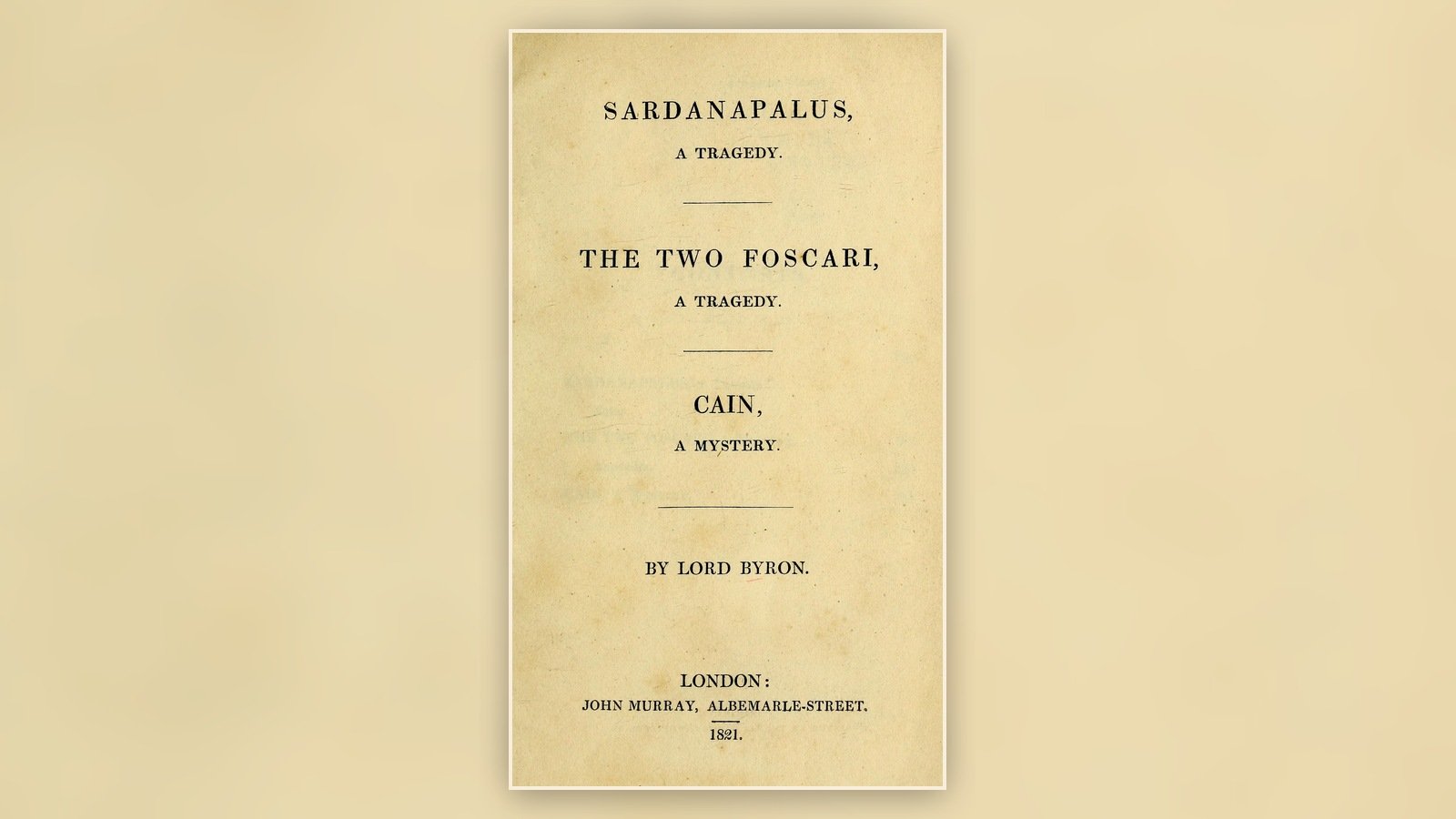
Byron composed Cain during the summer and early autumn of 1821 and published it in December with Sardanapalus and The Two Foscari. He called it “A Mystery,” invoking medieval biblical drama while replacing devotional certainty with philosophical argument. The volume appeared through John Murray at a moment when Byron was living in Italy, politically involved with liberal causes and watched by conservative critics at home. The subtitle was deliberately double-edged: it named a genre, but it also admitted that the questions surrounding evil, mortality and divine justice would not be resolved by a neat doctrinal answer.
The historical value of a mystery published in 1821 is that it exposes Byron’s transformation of a brief biblical figure into a philosophical rebel whose demand for explanation does not protect him from moral catastrophe. Later summaries often preserve the dramatic conclusion and lose the route by which it was reached. Restoring publication, audience and argument makes the subject more disturbing rather than less: the symbol was produced through real conflicts over whether worship can be morally required without understanding, and whether inherited suffering justifies revolt against the order of existence.
The Silence Inside Genesis
Genesis gives the outline: offerings are made, Abel’s is regarded, Cain’s is not, anger rises, a brother dies, and the murderer is marked and exiled. Byron enters the immense spaces between those verses. He imagines Adam and Eve’s children growing up east of Eden, aware that death has entered the world but not yet knowing what death looks like. Cain’s anguish begins before the rejected sacrifice. He resents a condition in which he must praise the author of a life already condemned to end, and he refuses to accept guilt by inheritance as self-evidently just.
This stage also sharpens the central tension: Cain’s questions about death and justice are powerful, but the play refuses to make intellectual grievance an excuse for killing. The opposition cannot be resolved by declaring one side enlightened and the other benighted. The archive shows intelligence, fear, self-interest and sincere conviction operating across the conflict. A serious adversarial reading keeps those mixed motives visible.
Lucifer as the Tutor of Questioning
Byron’s Lucifer does not merely whisper a command to sin. He recognizes Cain’s dissatisfaction and offers him intellectual companionship. The attraction is knowledge: the possibility that the official story told by Adam may not exhaust reality. Lucifer describes himself as a being who will not bend and invites Cain to judge rather than submit. Yet the tutor remains ambiguous. He expands Cain’s vision, but he also nourishes pride and isolation. Byron makes the adversary persuasive precisely because his questions are not trivial, while refusing to certify every answer he gives.
The material should be read through close reading of the 1821 text, Byron’s religious formation, contemporary reception and Romantic debates about knowledge. Primary language establishes what the author actually constructed; reception shows how the work escaped its first context; later movements reveal which elements became usable symbols. None of these layers may silently replace the others.
The Journey Beyond the Human World
Lucifer carries Cain through vast regions of space and into the realm of death. Byron draws on contemporary speculation about geology, extinct worlds and pre-Adamic creation, making the biblical family suddenly small within an immense cosmos. Cain sees forms of life destroyed before humanity and confronts the possibility that death is not an accident limited to his parents’ fall. The vision humiliates him: knowledge does not grant mastery, and cosmic scale does not provide moral consolation. He returns to earth more informed, but not more capable of bearing his condition.
The most common distortion is treating Byron’s Cain either as a heroic manifesto or as nothing more than an attack on Christianity. That simplification removes the ethical pressure from the subject by making judgment automatic. The original work is stronger because it allows attraction and danger to occupy the same scene, forcing the reader to decide without the protection of a slogan.
Adah, Love and the Human Answer
Adah, Cain’s sister and wife within Byron’s compressed first family, answers his metaphysical revolt with attachment. She does not solve the problem of evil. Instead she insists that love, kinship and the immediate life before them possess value even under mortality. Her loyalty exposes a division in Cain’s thought: he demands a universe that can be justified in total, while Adah asks whether a finite good may be loved without such justification. Byron gives the domestic voice dignity, preventing Luciferian knowledge from becoming the only form of seriousness in the play.
At the philosophical centre lies the danger that justified doubt can be converted into entitlement, and that a rebel may reproduce the violence he condemns. Rebellion is not purified merely because its opponent is oppressive. Every adversarial tradition must ask what forms of conduct it authorizes once the old command has been rejected and whether another person remains more than material for the rebel’s freedom.
The Offerings of Cain and Abel
The brothers’ offerings crystallize the drama’s conflict. Abel accepts sacrifice and gives animal life; Cain offers the fruits of the earth and recoils from the preference for blood. His objection has moral force, especially in a world where death remains horrifyingly new. But Cain also wants recognition on his own terms. When the offering is rejected, theological protest merges with wounded pride. Byron structures the scene so that an argument about divine violence becomes the prelude to human violence, making the rebel confront the possibility that he carries the destructive principle within himself.
The section contributes to the modern image of Cain as a metaphysical dissenter rather than only a marked criminal. Cultural legacy is not evidence that later users recovered an unchanged secret tradition. It is evidence that an image or argument remained capable of organizing new conflicts. Transmission transforms, and the transformations themselves belong to history.
The First Murder
The killing is not presented as a lucid act of emancipation. It erupts from anger during the brothers’ struggle, and Cain initially cannot comprehend the irreversible stillness of Abel’s body. The man who demanded knowledge of death becomes the one who introduces its visible reality into the family. This tragic reversal is essential. Byron does not say that questioning causes murder; he shows that intelligence without self-command can coexist with brutality. Cain’s insight into injustice remains real, but it cannot cancel the body lying before him.
The conflict over whether worship can be morally required without understanding, and whether inherited suffering justifies revolt against the order of existence also explains why the subject repeatedly crosses the boundary between literature and religion. A literary figure can become a spiritual emblem; a theological accusation can become a political identity. Accuracy requires following the passage rather than deciding in advance where the “real” meaning must reside.
The Mark and the Exile
After the murder, the biblical mark becomes both protection and sentence. Cain is not surrendered to immediate vengeance, yet he must leave the community whose bonds he has broken. Adah chooses exile with him, and the drama ends not with triumphant revolt but with departure into a future darkened by memory. Cain has refused worship, received forbidden vision and acted against his brother; none of these events can be reduced to one another. The final movement preserves the mystery of a consciousness that sees genuine contradictions and still commits an unjustifiable act.
A darker implication is that authority often creates the adversary it fears. By forbidding a question, persecuting a book or demanding ritual assent, an institution gives dissent a shared symbol. Yet prohibition alone does not prove the dissenter correct. It proves only that power has entered the argument.
Blasphemy, Reception and Romantic Satanism
Contemporary reviewers attacked Cain as blasphemous and morally dangerous. Shelley, by contrast, praised its revelatory force. The controversy helped place the drama within what later scholars call Romantic Satanism: the literary rehabilitation of adversarial figures as instruments for examining tyranny, knowledge and moral authority. Byron did not establish a Luciferian church, nor did he simply endorse Lucifer’s cosmology. He created a dramatic field in which inherited theology could be questioned without transforming the questioner into an innocent saint.
The individual reader is implicated as well. It is easy to admire defiance at a historical distance while avoiding the discipline of self-critique. The adversarial method becomes serious only when it tests cherished rebellion with the same severity used against inherited authority.
Deeper Questions
Byron’s own religious memory matters. His childhood exposure to Calvinist ideas of innate corruption and predestination left him fascinated by a moral system in which the human being enters history already burdened. Cain intensifies that unease by asking what consent could mean for a creature born after Eden. The drama’s force comes partly from the fact that Byron never wholly escapes the emotional gravity of the doctrines he contests.
The play also distinguishes knowledge from wisdom. Cain learns that the cosmos is older, larger and more violent than the family story suggests, but this enlargement does not teach him how to live with Abel. The failure is not an argument for ignorance. It is a warning that information can deepen despair when it is sought only as a weapon against dependence.
Lucifer’s refusal to bow gives the drama its adversarial magnetism. Yet refusal can become a fixed identity, as dependent on the authority it opposes as obedience is on the authority it serves. Cain begins to define himself through negation. The more he rejects the family’s language, the less able he becomes to hear Adah’s different account of freedom.
The dramatic mystery remains important because it allows incompatible truths to stand together. Mortality is terrifying; inherited punishment is morally difficult; Abel is innocent; Cain’s anger is intelligible; the murder is wrong. A weaker work would sacrifice one of these claims to save a system. Byron’s darkness lies in refusing that rescue.
For a Luciferian archive, Cain is valuable not as a model to imitate but as a study in the cost of adversarial consciousness. He demands reasons where tradition demands praise, but he also reveals how quickly the hunger for reasons can be corrupted by humiliation. The true philosophical question is not whether one should ask, but what discipline must accompany the asking.
A further question concerns the material form of the archive. Books, paintings, trials and institutional procedures do not merely carry ideas; they decide who may encounter them and under what conditions. The survival of Byron Cain as a searchable subject depends upon acts of preservation that earlier authorities may have intended as refutation or control.
The language of illumination should not be confused with the possession of final truth. Every figure in this history sees something the official order excludes, but partial sight can still become arrogance. The ethical measure is whether new knowledge enlarges responsibility or merely enlarges the self’s claim to rule.
Reception also changes when a work moves from scandal to canon. Once taught, collected and digitized, a forbidden text can lose the danger of its first appearance. Recovering the original conflict restores the cost paid by writers, publishers and readers without requiring modern audiences to imitate their conclusions.
The political lesson is equally unstable. Institutions need continuity, but continuity can protect error; rebels need disruption, but disruption can destroy the conditions of freedom. The archive offers no formula that removes this tension. It offers cases through which judgment can be trained.
A further question concerns the material form of the archive. Books, paintings, trials and institutional procedures do not merely carry ideas; they decide who may encounter them and under what conditions. The survival of Byron Cain as a searchable subject depends upon acts of preservation that earlier authorities may have intended as refutation or control.
The language of illumination should not be confused with the possession of final truth. Every figure in this history sees something the official order excludes, but partial sight can still become arrogance. The ethical measure is whether new knowledge enlarges responsibility or merely enlarges the self’s claim to rule.
Reception also changes when a work moves from scandal to canon. Once taught, collected and digitized, a forbidden text can lose the danger of its first appearance. Recovering the original conflict restores the cost paid by writers, publishers and readers without requiring modern audiences to imitate their conclusions.
The political lesson is equally unstable. Institutions need continuity, but continuity can protect error; rebels need disruption, but disruption can destroy the conditions of freedom. The archive offers no formula that removes this tension. It offers cases through which judgment can be trained.
What Remains
The subject leaves no painless conclusion. It preserves the modern image of Cain as a metaphysical dissenter rather than only a marked criminal while exposing the danger that justified doubt can be converted into entitlement, and that a rebel may reproduce the violence he condemns. The inherited authority may be unjust, the rebel’s question may be necessary, and the rebel may still fail. Dark philosophy begins where those statements are allowed to remain true together.
SatanWorld approaches this history as an archive of contested knowledge. The task is to hear the forbidden voice without granting it automatic innocence, and to examine authority without treating opposition as a substitute for evidence. What remains is the responsibility of judgment: freedom after command, knowledge after prohibition, and the difficult refusal to become the power one resisted.